A buyer-focused guide to the written answers that matter at Apogee South Beach: what emergency power actually serves, whether a cooled refuge is available, and how municipal re-entry differs from permission to occupy the building.
At Apogee South Beach, a serious buyer's storm-readiness conversation should move beyond the reassuring phrase “emergency power.” The questions that matter concern allocation: which systems receive electricity, whether residents can access a cooled space, and what must happen before an owner can return after an evacuation. These practical dimensions of ownership deserve the same scrutiny as the residence itself.
Apogee's emergency-power allocation, generator runtime, cooling-refuge availability, and building-level re-entry procedures require written association or management documentation. They should not be treated as established capabilities. General high-rise guidance does not establish this building's equipment or operating condition, and a sales presentation is not an association operating record.
The objective is not to seek assurance that every service will continue. It is to understand the limits well enough to build a household plan that does not depend on assumptions.
Begin with a written description of the systems served by emergency power, if any. Ask management to distinguish among building safety functions, common-area services, elevator operation, and electricity inside individual residences. The answer should identify what is supported, what is excluded, and which services take priority when available capacity is constrained.
“The building has a generator” does not answer those questions. Request a plain-language explanation of the intended operating sequence, supported by relevant equipment or operating documentation. Ask whether any residence circuits are supplied and, if so, exactly which ones. Do not infer that refrigeration, outlets, or private air conditioning will operate.
Runtime deserves a separate discussion. Ask what duration management anticipates under the stated load, which assumptions underpin that estimate, and how refueling would be handled after a storm. These are requests for building-specific information, not claims about Apogee's capacity. A useful answer distinguishes an estimate from a commitment and explains the conditions that could change it.
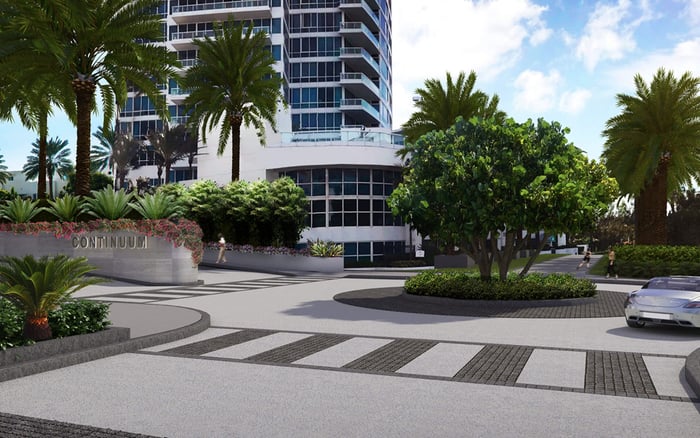
For buyers also considering Continuum on South Beach, the same questions provide a disciplined basis for comparison. Compare written operating provisions rather than assuming that different buildings offer equivalent continuity.
A cooled refuge should never be inferred from the presence of a lounge, lobby, or generator. Ask whether Apogee designates an indoor area for cooling during an outage, whether its cooling equipment receives emergency power, and under what conditions the area may open or close.
If management confirms a designated space, request its location, occupancy limit, access arrangements, staffing expectations, and intended operating hours. Ask whether residents with limited mobility can reach it if elevators are unavailable. Clarify whether it is intended for temporary relief or a longer stay. Until these details are documented, cooled-refuge availability remains unresolved.
Coastal high-rise cooling equipment may be shut down during a hurricane. Residents should not assume air conditioning will remain available throughout the storm. High-rise windows and balcony doors should remain completely closed even when indoor temperatures rise. A household cooling plan must respect those safety constraints.
Owners with power-dependent medical needs should not assume a high-rise will remain suitable during an extended outage. A potentially cooled common area is not a substitute for an individualized plan for medical power, care, and alternative accommodation.
Emergency-power discussions should address elevators explicitly. During an outage, high-rise residents may face non-operational elevators, making upper-floor access especially consequential for anyone with mobility limitations.
Ask whether any elevator service is contemplated under emergency power, how its use would be managed, and what conditions could suspend it. Request a clear distinction between anticipated service during an outage and service after post-storm assessment. Neither should be assumed from a general statement about backup electricity.
The same distinction matters when evaluating Five Park Miami Beach: the buyer's question is not simply whether a residence is accessible under ordinary conditions, but what documented arrangements apply when normal services are interrupted. That comparison implies no particular emergency capability at either property.
Two decisions must remain separate: authorization to enter Miami Beach and permission to occupy a particular residence. Local officials and law enforcement control municipal re-entry after an evacuation. Condominium management cannot independently authorize access to the city.
Emergency Management, police, fire officials, and Public Works help determine when evacuated areas are safe, and re-entry may be phased. Official announcements come through city communication channels and local media. Returning residents must follow law-enforcement instructions at entry points and should be prepared to show identification, proof of residence, employment credentials, or another demonstrated need to enter a restricted area.
Miami Beach no longer issues re-entry tags for condominium managers or other association-designated parties. Buyers should not rely on an assumed association pass as their return strategy. Associations are encouraged to designate and register Emergency Response Teams for post-storm damage assessment, building safety, and security responsibilities. Ask whether Apogee has such a team and what its documented role is.
Municipal access does not establish building habitability. If Miami Beach's Building Official determines a home is uninhabitable, occupants must leave until required repairs are completed. Ask management how assessments, restrictions, and occupancy updates would be communicated to owners.
For a second-home buyer, the most valuable protocol may be the one governing absence. Ask who can assess the residence, how management will contact an owner away from Florida, and what authorization a designated representative needs. Clarify how building updates will distinguish inspection access from permission to stay.
After a hurricane, residents should remain inside until local officials confirm it is safe to go outside. Electrical repairs required for utility reconnection must involve a state- or locally certified contractor, with an electrical permit filed before or immediately after the work. Miami Beach may issue emergency building permits to expedite storm-related repairs, but that possibility is not an occupancy guarantee.
Do not substitute a portable generator for unresolved building arrangements. Improper use can cause fatal carbon-monoxide poisoning; generators must not operate indoors or near open windows.
Before committing, request a current written package covering emergency-power allocation, runtime assumptions, any designated cooling area, elevator limitations, and post-storm communications. Ask management to identify unresolved questions rather than letting broad assurances stand in for specifics.
A sound purchase decision accepts that interruption is possible while establishing what the household can reasonably plan around. Clear operating boundaries are more useful than promises of uninterrupted comfort.
For a discreet perspective on South Florida luxury ownership, explore MILLION.
If branded residences are on your mind — as a home or as an allocation — we would be glad to share what we are seeing, privately.
Begin a quiet conversationNo. Buyers should obtain written association or management documentation identifying supported systems, exclusions, and load priorities.
No. Ask whether individual residence circuits are supplied and which functions, if any, are supported.
Request the anticipated duration under the stated load, the assumptions behind it, and the refueling plan. Treat an estimate as conditional rather than a guarantee.
Cooling-refuge availability is not established here. Request written confirmation of any designated space, its power supply, capacity, access, and operating conditions.
No. Cooling equipment may be shut down, and windows and balcony doors should remain completely closed even if indoor temperatures rise.
Elevators may be non-operational during an outage. Upper-floor access is especially consequential for residents with mobility limitations.
No. Municipal re-entry is controlled by local officials and law enforcement, and access may be phased.
Be prepared to provide identification, proof of residence, employment credentials, or another demonstrated need to enter restricted areas. Follow law-enforcement instructions at entry points.
No. City access and building habitability are separate; occupants must leave a home deemed uninhabitable by Miami Beach's Building Official until required repairs are completed.
They should not assume a high-rise will remain suitable during an extended outage. An individualized plan for medical power, care, and alternative accommodation is essential.