A discerning Key Biscayne condo purchase begins with the ownership file: comparable layouts, verified privacy, transferable amenities, and documented carrying costs. Together, these tests help separate a compelling residence from an unsupported resale premium.

A Key Biscayne condominium can be beautiful, generously proportioned, and still difficult to value. The challenge is not recognizing an exceptional residence; it is distinguishing what is genuinely hard to replace from what is simply well presented. For a buyer considering eventual resale, three questions deserve equal weight: how scarce is the floor plate, how private is the daily experience, and how clearly are ownership costs understood?
The ownership file should answer those questions with plans, comparable transactions, governing documents, and financial records. None of these tests guarantees a premium. Together, they provide a more defensible basis for deciding what to pay-and what a future buyer will need to understand.
A broad set of Key Biscayne condo transactions over a trailing 24-month period includes 351 qualifying arm’s-length sales, a median sale price of $1.275 million, and median pricing of $887 per square foot. The exact start and end dates are unspecified, so these figures should not be treated as a precisely dated current-market snapshot.
The luxury segment presents a different picture. Indicative 2026 pricing places oceanfront residences at around $2,000-$2,800 per square foot, depending on floor and view, with trophy resales above $3,000 per square foot. These figures reflect different samples from the broad transaction median. They cannot be combined into a single island-wide valuation benchmark or used to calculate a reliable luxury premium.
For an individual purchase, narrow the comparison to residences with similar interior area, condition, floor, outlook, and layout. A renovated apartment with a strong ocean view is not interchangeable with an older inland residence simply because both share an island address. Keep asking prices separate from closed transactions, and document why each comparable belongs in the file.
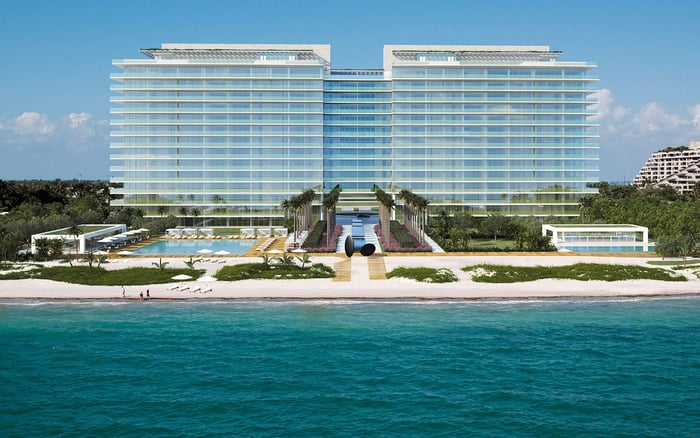
At Oceana Key Biscayne, the advertised composition is 142 residences across two towers on a 10.3-acre site, with floor-plan sizes ranging from approximately 1,750 to 7,500 square feet. Those figures describe the development’s scale and range, not the rarity of any particular apartment.
The useful question is narrower: how many residences offer a comparable combination of dimensions, orientation, bedroom arrangement, and outdoor space? A large plan may have several substitutes. A smaller one may be harder to replicate for a buyer who values a particular separation between entertaining rooms and sleeping quarters.
Request the applicable floor plans and compare circulation, shared walls, service access, and furniture placement. At Ocean Club, floor-through contemporary plans are advertised, but the individual resale file should establish the actual configuration. A floor-through designation is a starting point for evaluating how a residence lives, not proof of a resale advantage.
If the search also includes Park Grove Coconut Grove, apply the same layout questions there. Cross-shopping should clarify which spatial qualities the buyer values without treating different neighborhoods as interchangeable pricing comparables.
Privacy is not a single amenity. It is a sequence: the arrival, the elevator journey, the corridor, the entrance, the living spaces, and the terrace. A low residence count does not establish private elevator access, limited shared walls, or freedom from neighboring sightlines.
Walk that sequence during an inspection. Confirm residences per floor and elevator arrangements in the relevant plans and documents. From the principal rooms and outdoor seating areas, assess what is visible from neighboring residences and common spaces. Distinguish visual privacy from acoustic comfort, which requires its own inspection rather than an assumption based on density.
For a buyer also considering Oceana Bal Harbour, the same privacy checklist can structure the comparison. The point is not to presume equivalent arrangements between developments, but to describe the experience consistently before attaching value to it.
Record those findings alongside the plan. “Private” remains a marketing adjective until the file explains which aspects of daily life it describes.
Advertised view categories at Ocean Club include the Atlantic Ocean, city, lakes, and nearby state park. The development name alone does not establish an oceanfront outlook. Verify the actual view from the residence, including the rooms and terrace areas from which it is enjoyed.
The distinction between an amenity and a transferable right is equally important. Advertised amenities at Ocean Club include private storage units for each residence, a fitness center, spa, salon, two restaurants, and 125 private cabanas. Those descriptions do not establish that a particular cabana conveys with a resale or that every service is included in dues.
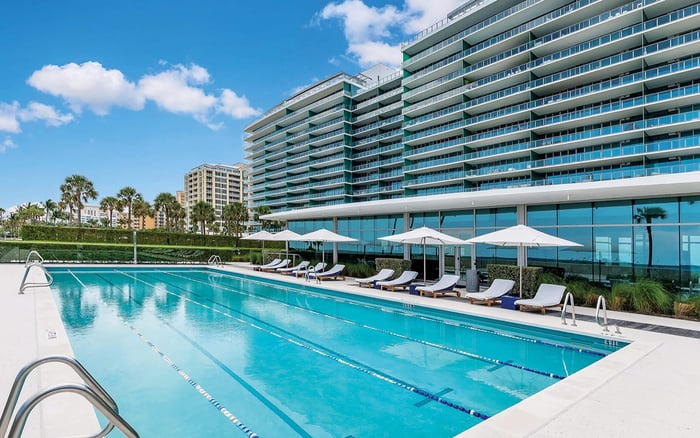
Advertised amenities at Oceana include gated entry, 500 feet of private beach, relaxation and lap pools, beach service, and a poolside restaurant. For either development, request written confirmation of included services, additional charges, and any storage, parking, cabana, or club rights associated with the apartment. What matters is the package the purchaser actually acquires.
Indicative estimates place luxury Key Biscayne condo association fees at roughly $1,500 to more than $6,000 per month, depending on residence size, building age, and amenities. That range is not a verified budget for any individual building and should not substitute for a current dues statement.
Low dues alone do not demonstrate operating-cost discipline. Request the association budget, financial statements, reserve disclosures, insurance details, assessment history, and documentation of pending capital work. Review them together before deciding whether current charges reflect the building’s obligations. Higher dues are not, by themselves, evidence of stronger management either.
For a consistent comparison, calculate annual dues, property taxes, owner-paid insurance, utilities, mandatory service charges, and recurring assessments. Divide that total by verified interior square footage. Keep one-time assessments separate so an immediate capital obligation is not obscured within an annual average.
Avoid double-counting expenses already included in dues. Then distinguish confirmed costs from estimates and unresolved obligations. Predictability matters, but it must be established through records rather than inferred from the size of the monthly payment.
The strongest ownership file connects the asking price to evidence: relevant closed sales, demonstrable layout differences, inspected privacy, transferable rights, and a clear operating-cost schedule. Where a claimed advantage remains unverified, leave it out of the premium calculation.
No quantified resale premium here is attributable specifically to scarcity, privacy, or cost discipline. Their value is best treated as a proposition to test, not a return to promise. Buy the residence whose daily qualities you appreciate and whose economics you can explain without relying on adjectives.
For a discreet perspective on your next South Florida residence, explore MILLION.
If branded residences are on your mind — as a home or as an allocation — we would be glad to share what we are seeing, privately.
Begin a quiet conversationInclude relevant closed sales, floor plans, governing documents, financial records, and confirmation of transferable amenities. The file should explain both the residence’s distinguishing qualities and its ownership obligations.
It represents a broad sample of 351 qualifying arm’s-length condo sales over a trailing 24-month period whose exact dates are unspecified. It is not a benchmark for every luxury or oceanfront residence.
Indicative 2026 pricing places oceanfront residences around $2,000–$2,800 per square foot, depending on floor and view. These figures describe a different sample from the broad condo transaction median.
No. Scarcity requires checking how many comparable layouts offer similar dimensions, orientation, bedroom arrangements, and outdoor space.
Published floor-plan sizes range from approximately 1,750 to 7,500 square feet. Verify the individual residence’s dimensions and area before using them in a valuation.
Inspect the arrival sequence, elevator access, corridors, shared walls, and terrace sightlines. Low density alone does not establish visual or acoustic privacy.
An ocean view should not be assumed. Advertised view categories include the Atlantic Ocean, city, lakes, and nearby state park, so the specific outlook requires verification.
Confirm those rights in the individual resale documents. Advertised storage and cabana amenities do not establish that a particular cabana or every associated service is included.
Add annual dues, taxes, owner-paid insurance, utilities, mandatory service charges, and recurring assessments, then divide by verified interior square footage. Show one-time assessments separately and avoid double-counting costs included in dues.
No quantified premium attributable specifically to those factors is established here. Treat each as a purchase consideration requiring evidence, not a promised return.