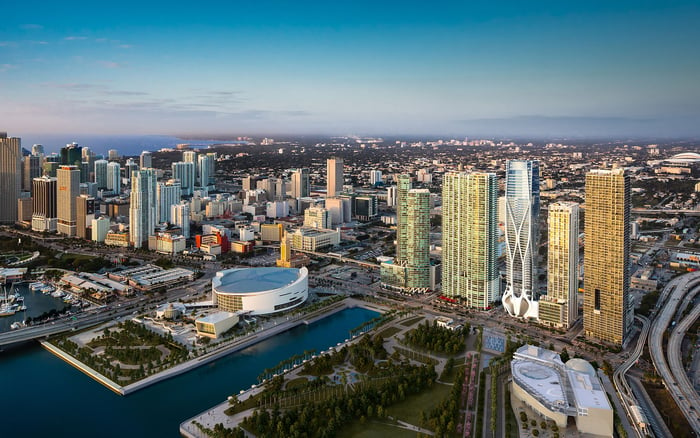
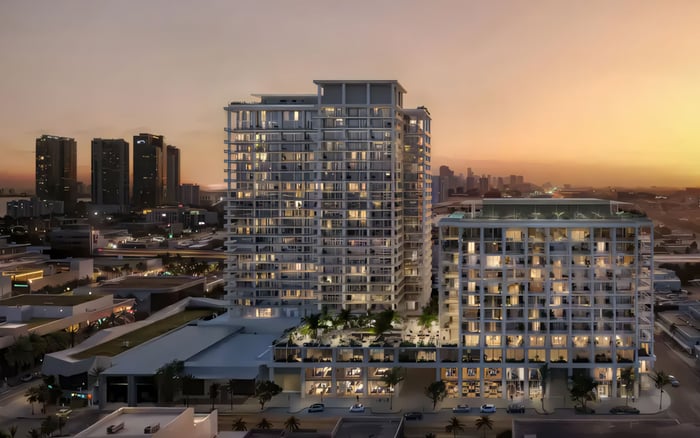
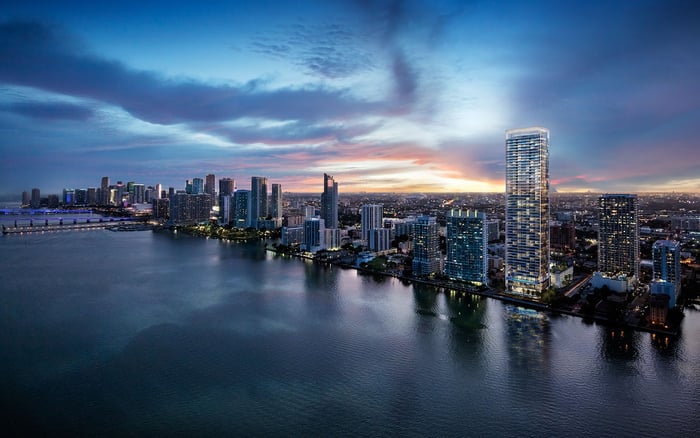
A buyer-focused editorial on evaluating Midtown Miami ownership through access, privacy, daily rhythm, design discipline, and long-term residential fit.

For the international buyer, the real question in Midtown Miami is not simply whether the neighborhood feels convenient. It is whether the ownership experience can hold two opposing desires at once: global access and a private residential rhythm. The most sophisticated purchasers are not shopping only for a view, a lobby, or a recognizably Miami address. They are testing how a residence behaves on an ordinary Tuesday, how it receives guests, how it buffers movement, and how it supports a life that may be divided among several cities.
Midtown Miami invites a different kind of assessment than the more obvious waterfront or branded residential markets. It is not defined by a single resort promise. Its appeal is more urban, more layered, and more dependent on the buyer’s own habits. For some, that is precisely the attraction. A home here can feel connected without requiring constant performance. For others, the absence of a singular lifestyle script calls for greater diligence. The building, floor plan, arrival sequence, terrace orientation, service model, parking logic, and surrounding cadence matter intensely.
The ownership test begins with a simple question: can the residence deliver proximity without friction? If the answer is yes, Midtown Miami becomes less about trend and more about controlled access.
Global buyers often compare Midtown Miami with Brickell, Downtown, Wynwood, and Edgewater because each offers a distinct version of city living. Brickell suggests finance and vertical polish. Downtown can feel civic and event-driven. Wynwood brings creative energy. Edgewater leans toward bay-oriented condominium living. Midtown Miami enters the conversation as a more personal choice, especially for those who want to be near the action without feeling absorbed by it.
That distinction matters. A buyer who travels frequently may value a residence that does not demand elaborate rituals with every return. The best home is often the one that reopens easily after a week away, receives a driver without confusion, allows a quiet morning, and supports an evening out without turning every errand into an event. Luxury, in this sense, is not excess. It is operational ease.
The same logic applies to guests. A globally connected owner may host family, business contacts, or friends moving through South Florida. The residence should remain composed under pressure. A secondary bedroom should not feel like an afterthought. Common spaces should allow conversation without sacrificing privacy. Service areas, storage, and circulation should work quietly in the background.
Privacy in Midtown Miami is not only about seclusion. It is about sequencing. How does one move from street to lobby, from elevator to residence, from living room to terrace, from public energy to personal calm? A strong building makes those transitions feel intuitive. A weak one makes them feel exposed.
Buyers should look beyond finishes and ask how the home will function at different hours. Morning light, evening noise, elevator dependence, guest arrival, package flow, pet routines, fitness access, and parking convenience all shape the ownership experience. Even the most elegant residence can become tiring if the daily rhythm is poorly resolved.
This is where restraint becomes a luxury signal. A building does not need to announce itself loudly to perform well. In fact, the most durable ownership experiences often come from properties that privilege proportion, quiet circulation, and well-judged amenities over visual drama alone. The buyer who understands this will judge a residence by its composure, not its theatrics.
Investment is a legitimate ambition, but it should not overpower the residential brief. In Midtown Miami, the strongest buyer is usually the one who can separate speculation from usefulness. A residence that fits real life has a better chance of remaining relevant because it serves an actual owner profile, not only a marketing moment.
That means avoiding the temptation to buy only the loudest story. A disciplined purchaser studies who the future resident might be. Is the plan efficient for a professional couple, a part-time owner, or a relocating family? Does the building feel credible for long stays as well as short returns? Are the amenities scaled to daily use rather than brochure appeal? Is the residence easy to maintain, furnish, and secure?
New-construction buyers should be especially clear about priorities. Fresh design can be compelling, but the test remains practical. Ceiling heights, glazing, kitchen function, closet depth, service reliability, and acoustic comfort matter after the initial excitement fades. The more urban the setting, the more these details determine whether the home feels luxurious over time.
A Midtown Miami tour should be slower than most buyers expect. Begin at the curb. Notice the arrival sequence and whether it feels natural, discreet, and protected. Continue into the lobby and observe whether the space feels calm or merely decorative. Ask how residents actually move through the building, where deliveries are managed, and how guests are received.
Inside the residence, resist the instinct to stand only at the window. Walk the plan as if living there. Where would luggage go after a late flight? Where would a laptop live during a working morning? Could two people take separate calls without conflict? Is the primary suite sufficiently removed from entertaining space? Does the terrace feel usable, or is it mainly visual?
Return at a different hour when possible. A residence that feels polished at midday may behave differently at night. The ownership decision should account for multiple moods, not a single staged impression.
Midtown Miami is best suited to buyers who enjoy urban adjacency but do not necessarily want the formality of a purely corporate district or the full leisure identity of a beach address. It can serve the owner who moves between continents, the couple downsizing into a more connected routine, or the part-time resident who wants a base that feels personal rather than ceremonial.
It is less ideal for buyers who require absolute retreat, expansive grounds, or a lifestyle centered entirely on waterfront ritual. Those buyers may be better served elsewhere. The Midtown Miami purchaser is usually more flexible, more design-aware, and more interested in how a home performs within a wider city pattern.
The most important trait is self-knowledge. If your life is built around access, privacy, dining, culture, work, and the ability to move easily between different Miami experiences, Midtown Miami may deserve serious attention. If your priority is maximal isolation, the test will likely point in another direction.
What is the main ownership test in Midtown Miami? The test is whether a residence can provide urban access while preserving privacy, calm, and daily ease.
Is Midtown Miami only for full-time residents? No. It may also suit part-time owners who want a practical Miami base without a resort-style routine.
How should buyers compare Midtown Miami with Brickell? Brickell may feel more business-oriented, while Midtown Miami should be assessed for a more personal urban rhythm.
Does Midtown Miami work for buyers considering Downtown alternatives? It can, especially for buyers who want city access but prefer a less civic or event-driven residential mood.
Why compare Midtown Miami with Wynwood? Wynwood helps buyers understand how much creative energy they want near daily life and how much separation they require.
Why compare Midtown Miami with Edgewater? Edgewater can sharpen the question of whether the buyer prioritizes bay-oriented living or a more interior urban pattern.
What should matter most during a property tour? Arrival, circulation, sound, storage, terrace usability, service flow, and the plan’s ability to support real routines.
Is new construction automatically the better choice? Not automatically. The better choice is the residence with stronger livability, privacy, proportions, and long-term usefulness.
How should investment buyers think about Midtown Miami? They should prioritize durable residential demand, functional layouts, and disciplined pricing over short-term excitement.
What is the best way to shortlist comparable options for touring? Start with location fit, delivery status, and daily lifestyle priorities, then compare stacks and elevations to validate views and privacy.
For a tailored shortlist and next-step guidance, connect with MILLION.
If branded residences are on your mind — as a home or as an allocation — we would be glad to share what we are seeing, privately.
Begin a quiet conversation