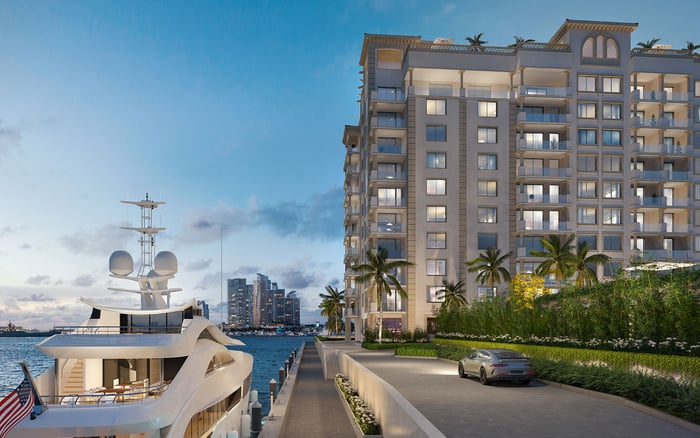
A buyer-focused comparison of household-staff circulation at The Links Estates at Fisher Island and The Residences at Six Fisher Island, framed around estate autonomy versus managed-residence coordination.

For ultra-private buyers, household staffing is not a secondary detail. It is the daily infrastructure behind a home expected to absorb family life, guests, deliveries, vendors, housekeeping, security coordination, wellness appointments, catering, and occasional events without making that activity visible to the owner’s social world. That is why the comparison between The Links Estates at Fisher Island and The Residences at Six Fisher Island is most useful when viewed through household-staff flow rather than broad amenity language.
The key question is not whether staff can reach Fisher Island. The more revealing question is what happens after island-level entry. Does a private household team move directly into an estate environment, largely coordinated by the owner’s household manager? Or does staff movement pass through a managed residential building, where shared service infrastructure, building procedures, package handling, elevators, and property-management coordination shape the daily rhythm?
For a Fisher Island buyer, that distinction can influence privacy, payroll structure, vendor selection, event preparation, storage, response time, and the ease with which a household can expand from occasional service to a full private team. It is also the kind of distinction that should be verified in detail before contract, because exact staff entrances, security procedures, elevator assignments, loading rules, association documents, and property-management protocols are not publicly standardized across ownership models.
The Links Estates at Fisher Island is best understood as the estate-style side of this comparison. In that model, the likely operational emphasis is owner control: a household manager can coordinate scheduling, select vendors, set internal service routes, sequence arrivals, and adapt staffing around family preferences. The physical and managerial experience is closer to running a private residence than occupying a managed vertical building.
That autonomy matters for large households. A chef, housekeepers, nanny, driver, estate manager, private security consultant, florist, caterer, and maintenance vendors may all require distinct arrival windows and different degrees of access. In an estate setting, due diligence should focus on arrival sequence, parking or loading logic, service entries, back-of-house movement, storage for staff and vendors, and how effectively private family zones remain separate from working zones.
The Links Estates model may be especially appealing to buyers who want a household-manager-led ecosystem of their own. The tradeoff is that autonomy can also mean more responsibility. The owner’s team will typically need to create the operating playbook, train vendors, supervise access, and maintain consistency when the principal is away. For some buyers, that is precisely the point: they want discretion shaped by their own standards, not a building-wide service template.
The Residences at Six Fisher Island sits on the managed-building side of the ownership spectrum. Its operational logic is likely to be more institutionalized, with staff movement coordinated through building infrastructure and residence-level property management. That does not make it less private. It means privacy is achieved through procedures, separation, and shared systems rather than through the owner’s direct control over every internal path.
In this model, buyers should study lobby and service-entry procedures, elevator policies, loading areas, package flow, housekeeping circulation, vendor authorization, and after-hours coordination. The daily experience may be smoother for owners who prefer a clear building interface: staff and vendors interact with management, packages move through established channels, and the household does not need to invent every protocol from scratch.
This is the same broad question sophisticated buyers ask across Fisher Island’s managed residences. At Palazzo del Sol, often discussed as Palazzo del Sol Fisher Island, and Palazzo della Luna, often framed as Palazzo della Luna Fisher Island, the appeal of a residence is partly the possibility of support systems that reduce friction. The Residences at Six Fisher Island belongs in that discussion because its ownership model invites a careful look at how resident-facing elegance and service-facing movement are separated.
The most useful comparison is practical. At The Links Estates, ask how a housekeeper arrives, where a caterer stages, how a florist unloads, how a driver waits, where supplies are stored, and whether a family can host dinner without staff crossing primary living areas. Ask whether a household manager can build a recurring schedule around the owner’s exact routine. Ask how emergency or after-hours access would be handled if a vendor is needed quickly.
At The Residences at Six Fisher Island, ask a different set of questions. How does the building authorize recurring staff? What is the package and delivery sequence? Which areas are used for loading? How are housekeeping teams expected to move? What is the coordination process when a resident has multiple vendors arriving for the same event? How does management separate private arrival experiences from operational traffic?
Neither model is inherently better. The Links Estates may offer more customizability for a large private household team, while The Residences at Six Fisher Island may offer more standardized coordination. One favors bespoke control; the other favors procedural clarity. The right answer depends on whether the buyer wants to operate a private estate or inhabit a residence with a more defined management interface.
In new-construction and ultra-luxury resale conversations, staff flow should be treated like view, floor plan, and finish quality. It is not enough to admire scale. A buyer should understand how the property actually works at 7 a.m. when housekeeping arrives, at noon when provisions are delivered, at 5 p.m. when a driver is waiting, and at midnight when an urgent maintenance issue appears.
For The Links Estates at Fisher Island, the diligence file should include questions about owner-controlled routing, vendor staging, internal service separation, household staffing capacity, parking or loading expectations, storage, and event preparation. For The Residences at Six Fisher Island, it should include building rules, management contacts, service elevator or access procedures if applicable, package policies, housekeeping coordination, and after-hours escalation.
The most discreet homes are often the ones whose labor is least visible. On Fisher Island, that invisibility is designed in two different ways: through the autonomy of the private estate and through the coordination of the managed residence. A buyer who understands that distinction will read both ownership models with far greater precision.
Is this a price comparison? No. The focus is household-staff movement, owner control, and building coordination rather than pricing or amenity rankings.
Which property is the estate-style model? The Links Estates at Fisher Island is the estate-style side of the comparison, with likely emphasis on owner-directed household operations.
Which property is the managed-residence model? The Residences at Six Fisher Island is the managed-building side, where service circulation is likely shaped by shared infrastructure and management.
Does the article confirm exact staff entrances? No. Buyers should verify exact entrances, loading rules, elevator procedures, and access policies through the relevant documents and management teams.
Why does staff flow matter so much? It affects privacy, daily convenience, vendor efficiency, housekeeping visibility, event setup, and emergency coordination.
Who may prefer The Links Estates? Buyers with a large private household team may prefer the customizability and household-manager control of an estate model.
Who may prefer The Residences at Six Fisher Island? Buyers who value standardized support and a clearer management interface may prefer a managed-residence model.
Should vendors be reviewed before purchase? Yes. Recurring vendors, delivery timing, event staff, and after-hours needs should all be considered during due diligence.
Is managed circulation less private than estate circulation? Not necessarily. It can be highly private when resident-facing and service-facing flows are clearly separated.
What is the main buyer takeaway? The Links Estates emphasizes bespoke control, while The Residences at Six Fisher Island emphasizes coordinated structure.
If you'd like a private walkthrough and a curated shortlist, connect with MILLION.
If branded residences are on your mind — as a home or as an allocation — we would be glad to share what we are seeing, privately.
Begin a quiet conversation