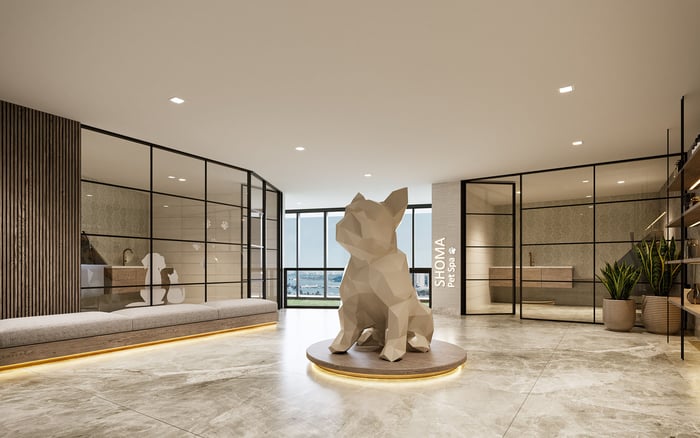
A discreet buyer’s guide for families evaluating pet-relief rules at The Cove Residences Edgewater, with practical questions on access, sanitation, enforcement, terraces, balconies, and daily routines.

At The Cove Residences Edgewater, the essential pet question is rarely whether a dog is welcome in principle. For family buyers, the sharper question is how pet care will function at 6:45 a.m., after school pickup, during a rainstorm, or when a grandparent is visiting with the children. In a luxury condominium, pet-relief rules shape the daily choreography of elevators, lobbies, amenity decks, staff interactions, and neighborly comfort.
That matters especially for households with children. A family may be drawn to a residence for its views, plan, finishes, Balcony, Terrace, and amenity program, only to discover later that pet logistics require more coordination than expected. Rules can determine which elevator may be used, where a dog may be walked, what cleaning protocol follows an accident, whether relief areas are open at all hours, and how enforcement is handled.
The right approach is calm and practical. Before becoming attached to a view line or floor height, buyers should ask for the governing documents, pet policies, house rules, and any supplemental guidance from management. Pet rules should not be treated as a footnote. They are a component of livability in Edgewater.
Begin with the basics. How many pets are permitted per residence? Are there weight, breed, or species limitations? Are emotional support animals, service animals, visiting pets, and foster pets addressed separately? If a family has two dogs and expects relatives to stay seasonally, these details matter.
Next, ask whether pets must be registered with the association or management office. Registration can involve vaccination records, photographs, emergency contacts, and acknowledgments of the rules. For families with nannies, dog walkers, tutors, or household staff, confirm whether third parties may handle pets through common areas and whether they need to be listed in advance.
Also ask who interprets the rules. A written pet policy is useful, but families should understand whether day-to-day questions are handled by the property manager, front desk, board, or another building representative. Clarity now can prevent tense exchanges later.
Pet-relief convenience is not just about a designated location. It is about access. Ask where the approved relief area is located, whether it is indoors, outdoors, covered, or exposed, and whether it can be reached without crossing high-traffic amenity zones. If the route passes near the lobby, Pool, valet area, or children’s spaces, families should understand the expected etiquette.
Hours are equally important. Some buildings allow access at all times, while others may have procedures that change overnight or during maintenance. A household with young children may need predictable early-morning and late-evening walks. A family with an older dog may need more frequent relief access. If a child’s bedtime routine depends on one parent handling both the dog and the stroller, the route must feel simple and safe.
Weather deserves a direct question. South Florida living brings sudden rain, heat, and humidity. Ask whether the pet-relief area has shade, drainage, lighting, and a cleaning station. If the designated area is temporarily unavailable, ask what alternative procedure is approved.
Luxury towers often distinguish between resident, service, and staff routes. Families should ask whether pets may use all resident elevators or only certain cars. If certain elevators are required, determine whether that could create delays during school hours, dinner reservations, or busy weekend periods.
The same applies to lobby protocol. Must pets be carried through certain areas? Are leashes required at all times in common spaces? Are retractable leashes discouraged? Are pets allowed to pause in seating areas, mail rooms, package rooms, or arrival courts? These questions may sound granular, but they become daily habits.
For families, the ideal rule set is not necessarily the most permissive. It is the one that is clear, consistently enforced, and easy to teach to children and caregivers. When everyone knows the route, expectations are less likely to be tested.
A private outdoor area can feel like a natural extension of family life, but buyers should not assume that a Balcony or Terrace may be used as a pet-relief area. Ask directly whether any in-residence outdoor space may be used for pet pads, turf systems, rinsing, or temporary relief. If the answer is no, understand the enforcement approach and any cleaning obligations.
Even when a pet pad is permitted, families should consider odor control, drainage, visibility from neighboring residences, and the practical realities of maintenance. In a refined building, the private choices of one household can affect the comfort of another. Rules on outdoor pet use often reflect more than preference. They protect sightlines, air quality, and the shared residential atmosphere.
This is also a child-safety issue. If a family intends to keep pet accessories outdoors, ask about storage restrictions, railings, wind exposure, and what may be visible from common areas. A polished residence should not require improvisation.
The strongest pet policies are specific about sanitation. Ask who cleans the relief area, how often it is maintained, and what residents must do after use. Confirm whether waste bags, disposal stations, rinsing systems, or odor-control measures are provided. If an accident occurs in an elevator or corridor, ask what the immediate reporting procedure is.
Families should also review penalties. Are there warnings, fines, loss of privileges, or escalation steps for repeated violations? Are complaints documented? Is there a process for responding if a neighbor alleges an issue? In a new-construction setting, rules may be refined as residents move in and everyday patterns emerge, so buyers should pay attention to how changes are adopted and communicated.
Pets are part of the home, but condominium living depends on shared standards. A well-run policy should protect responsible owners while giving management a clear way to address problems.
Do not review the pet policy in isolation. Read it beside the declaration, bylaws, rules and regulations, leasing provisions, guest policies, and architectural guidelines. A pet question can intersect with move-in rules, staffing permissions, noise standards, and amenity access.
Then walk through a normal weekday. One parent leaves early. One child has school. A dog walker arrives at midday. Guests come for dinner. The family uses the Pool on Saturday. Pets need relief before bedtime. If each step is permitted and logical, the building may support the household’s rhythm. If several steps require exceptions, approvals, or workarounds, ask more questions before proceeding.
The most elegant buildings are often the most precise about daily conduct. For family buyers at The Cove Residences Edgewater, that precision can be an advantage, provided expectations are understood before closing.
Pet-relief rules may seem secondary to architecture, views, and finish quality, but they sit close to the heart of how a family actually lives. Ask early, read carefully, and test the rules against a real schedule. A residence that works beautifully for children and pets will feel organized not because every desire is unrestricted, but because the boundaries are intelligent, transparent, and livable.
Should family buyers ask for pet rules before making an offer? Yes. Pet rules can affect daily routines, staffing, and comfort, so they should be reviewed early in the buying process.
Can a balcony automatically be used as a pet-relief area? No. Buyers should ask whether any Balcony use for pet relief is permitted and what cleaning or storage rules apply.
Are pet-relief rules different from general pet permissions? Yes. A building may allow pets while still limiting where they can relieve themselves and how they move through common areas.
Should families ask about elevator rules for pets? Yes. Elevator routing can affect school mornings, dog-walker access, stroller use, and household staff coordination.
What should buyers ask about guest pets? Ask whether visiting pets are permitted, whether they must be registered, and whether the same relief rules apply.
Do pet rules usually cover sanitation? They should. Buyers should review cleaning duties, accident reporting, waste disposal, and any fines for violations.
Why does the route to the relief area matter? The route can determine how convenient pet care feels during rain, peak elevator times, or busy family schedules.
Should families ask whether children may walk the dog alone? Yes. Rules may address supervision, leash control, and responsible handling in common areas.
Can pet policies change after purchase? They can. Buyers should understand how rule changes are approved, noticed, and enforced by building leadership.
What is the most important takeaway for Edgewater buyers? Treat pet-relief rules as a livability issue, not a footnote, especially when children, caregivers, and daily routines are involved.
For a confidential assessment and a building-by-building shortlist, connect with MILLION.
If branded residences are on your mind — as a home or as an allocation — we would be glad to share what we are seeing, privately.
Begin a quiet conversation