A disciplined framework for evaluating Coconut Grove luxury-condo resales, with close attention to comparable depth, exact lines, pricing tiers, and the durability of bay views.
Coconut Grove entered 2026 with roughly 10.9 months of condo resale supply and an average asking price near $3.2 million-conditions approaching buyer-market territory. Luxury inventory across Coconut Grove and Coral Gables stood at about 11 months in the first quarter, up 22.2% year over year, yet remained the lowest among the Miami neighborhoods compared.
Broader choice does not make every residence equally negotiable. A high-floor corner with an unobstructed bay horizon occupies a thinner market than an interior-facing unit with framed water exposure. Buyers should therefore read the market at two speeds: first at the neighborhood level, then by precise building, stack, floor band, and terrace configuration.
Transaction signals are also mixed. Condo closings slipped about 8% year over year in the November-through-January comparison, yet a mid-2026 snapshot showed sales rising 44.6% year over year, with a median 63 days on market versus 93 days citywide. The practical conclusion is not that the market is uniformly soft or strong. It is selective.
Resale depth measures the number and relevance of observable transfers supporting a valuation. Across 380 qualifying Coconut Grove condo resales over a trailing 24-month period, the median was $941 per square foot, with a median sale price of $1.025 million. Those figures establish context, not the value of a trophy residence.
Building histories offer a more precise second screen. Grove at Grand Bay has 99 residences, approximately 196 recorded sales, and a median near $1,036 per square foot. One Park Grove has about 66 residences and 90 recorded sales, while Two Park Grove has roughly 73 residences and 131 recorded sales. Together, they create a meaningful evidence base for studying turnover and line behavior at Park Grove Coconut Grove.
By contrast, Vita at Grove Isle had about 40 recorded sales by mid-2026. Its median near $2,221 per square foot was the highest among the principal trophy buildings reviewed, but its shorter trading history demands more qualitative judgment. Thin evidence is not a flaw; it simply widens the range of defensible value.
A building-wide median should never substitute for same-stack analysis. One Park Grove’s median near $1,464 per square foot was approximately 17% above Two Park Grove’s $1,254, illustrating how tower position, exposure, and unit mix can establish distinct pricing tiers within a single complex.
For each candidate, assemble the closest possible set of sales: same line first, followed by the same exposure, floor band, interior scale, and terrace configuration. Treat penthouses and high-floor corners as thin-comp assets. A neighborhood average can obscure the scarcity that actually governs their resale audience.
Brand and service can command value independent of the view. Mr. C Residences Coconut Grove recorded a median near $1,503 per square foot across approximately 123 sales, exceeding the reviewed medians at both Park Grove towers and Grove at Grand Bay. Buyers considering Mr. C Tigertail Coconut Grove should therefore separate the service proposition from the premium attributable to a specific outlook.
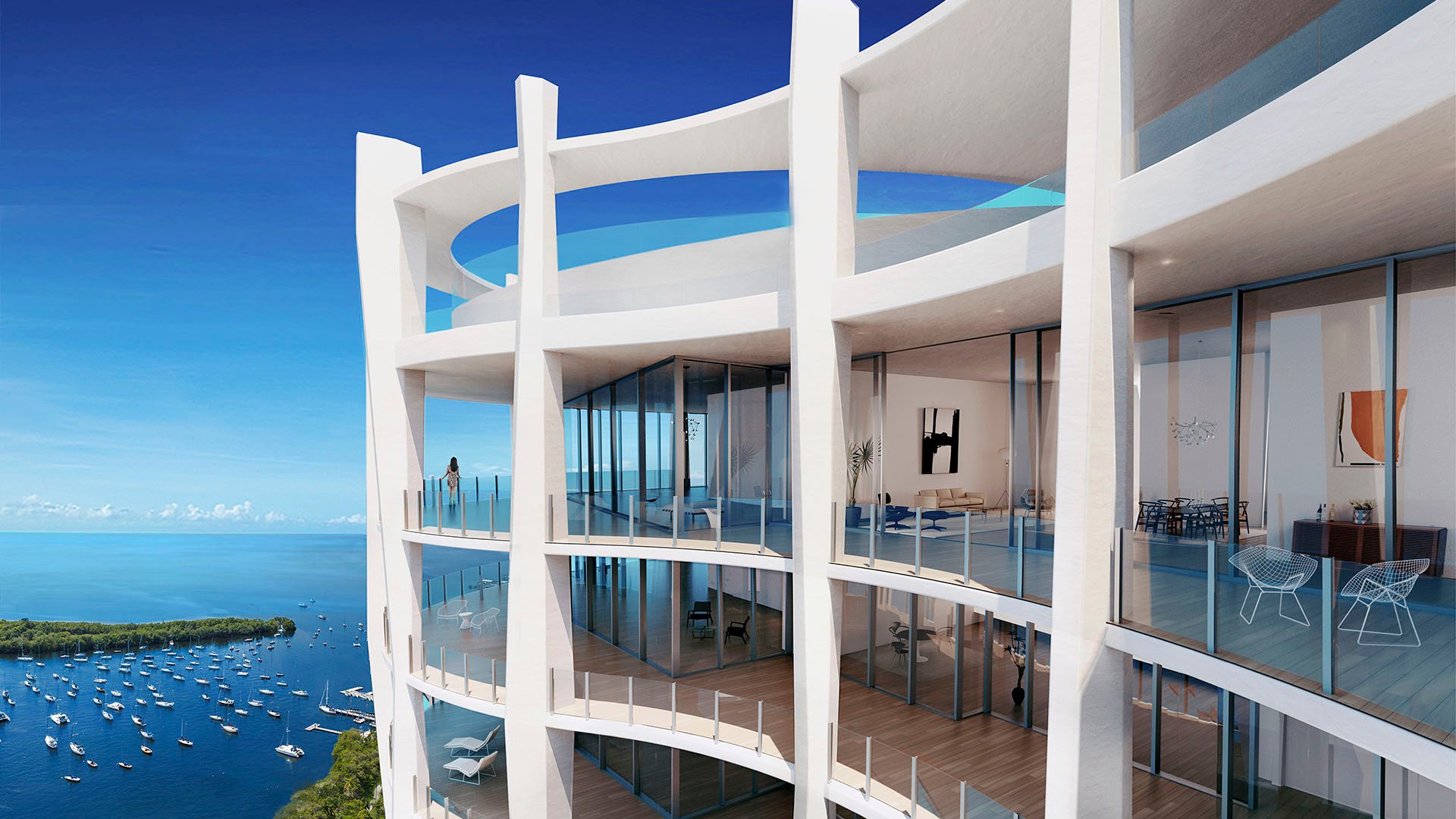
Coconut Grove’s full-bay-view universe is concentrated principally within Grove at Grand Bay, Park Grove, and Vita at Grove Isle. Elsewhere, “water view” may describe partial, angled, or framed exposure. The distinction matters because water-view marketing language does not establish scarcity.
A durable-view review should identify the viewing direction, width of visible water, interruptions from adjacent structures, marina activity, and mature landscaping. It should also consider whether a neighboring site could alter the sightline. When possible, inspect at different times of day and photograph the horizon from seated and standing positions in the principal rooms and on the terrace.
Vita’s private-island setting, low-rise seven-story format, and roughly 63 to 65 residences make its water exposure less replicable than that of a conventional waterfront tower containing both bay-facing and interior-facing stacks. Scarcity, however, must still be tested residence by residence.
Every offer should deconstruct the asking price into three components: the building or brand premium, the exact-line premium, and the durability of the view. This prevents an elegant amenity package from being mistaken for a permanent horizon-or a rare exposure from being discounted simply because broader inventory has increased.
The dispersion is substantial. Older or less differentiated Coconut Grove properties have traded in the mid-$400s per square foot, while Vita reached a median near $2,221. Mr. C, the Park Grove towers, and Grove at Grand Bay occupy distinct tiers between those points. Prospective buyers may also use the positioning of Four Seasons Residences Coconut Grove as a current-market reference without treating a new offering as a direct substitute for an established resale.
Miami luxury resale condos closed at an average discount of about 10% from original asking prices in 2025. That is a negotiating reference, not an automatic entitlement. A more defensible offer begins with adjusted, line-relevant closings, then accounts for condition, floor, exposure, terrace utility, and evidence depth.
A disciplined resale review should include governing documents, budgets, assessments, insurance information, reserve disclosures, recent meeting records, unit alterations, and the ownership costs attached to the residence. Confirm what transfers with the sale and whether any use restrictions affect the intended holding strategy.
Approximately 75% of condo deals in one 2025 market set were all-cash. Financing contingencies can therefore influence competitiveness, but liquidity should not replace diligence. The central principle remains simple: certainty of evidence has value, and uncertainty should be reflected in price or protection.
What is resale depth? It is the quantity and relevance of prior transfers available to support a unit’s valuation.
Is 10.9 months of supply automatically a buyer’s market? It signals greater choice, but scarce lines can behave differently from the broader market.
Why are same-stack sales so important? They best isolate the effects of orientation, layout, floor height, and terrace design.
Should buyers rely on price per square foot? Use it as a screen, then adjust for the residence’s exact line, condition, and view.
What makes a bay view scarce? Width, directness, elevation, limited obstruction, and long-term sightline durability create scarcity.
Are branded residences always worth more? Branding and service can support a premium, but they do not make every line equally valuable.
How should a penthouse be valued? Use the closest available evidence and a wider valuation range because comparable sales are thin.
Does an all-cash offer eliminate due diligence? No. Cash may improve execution, but document, condition, and sightline reviews remain essential.
Is a 10% discount a reasonable opening assumption? It is broad market context, not a substitute for line-specific comparable analysis.
What should a buyer verify before making an offer? Verify comparable sales, view permanence, building records, ownership costs, and unit condition.
For a confidential assessment and a building-by-building shortlist, connect with MILLION.
If branded residences are on your mind — as a home or as an allocation — we would be glad to share what we are seeing, privately.
Begin a quiet conversation