In South Florida’s luxury market, buying near a respected private school is often less about enrollment and more about durability. School-anchored neighborhoods tend to command stronger pricing, broader demand, richer amenities, and better resale liquidity, making them compelling for buyers with no immediate educational use for the campus itself.
For many affluent buyers, the instinct to avoid paying for a school-driven neighborhood when they do not have children seems rational at first glance. In practice, the opposite is often true. In South Florida, proximity to a respected private school signals far more than classroom access. It points to an established residential ecosystem, a dependable pattern of demand, and a location that remains easy for future buyers to understand.
Homes near highly regarded schools can carry a pricing advantage because buyers often associate them with neighborhood quality, reputation, and long-term desirability. That premium is not simply a reflection of parents competing for convenience. Buyers who never intend to use the school can still benefit from the signal it sends.
This is especially relevant in a region where luxury real estate is purchased for many different reasons: primary residence, seasonal use, intergenerational planning, relocation, portfolio diversification, and future resale optionality. In that context, buying near a major private school can be a disciplined decision rather than an emotional one.
At the top end of the market, buyers are rarely purchasing square footage alone. They are buying into a branded geography. Private-school corridors often become shorthand for a specific type of place: ordered, established, affluent, and well served by daily conveniences.
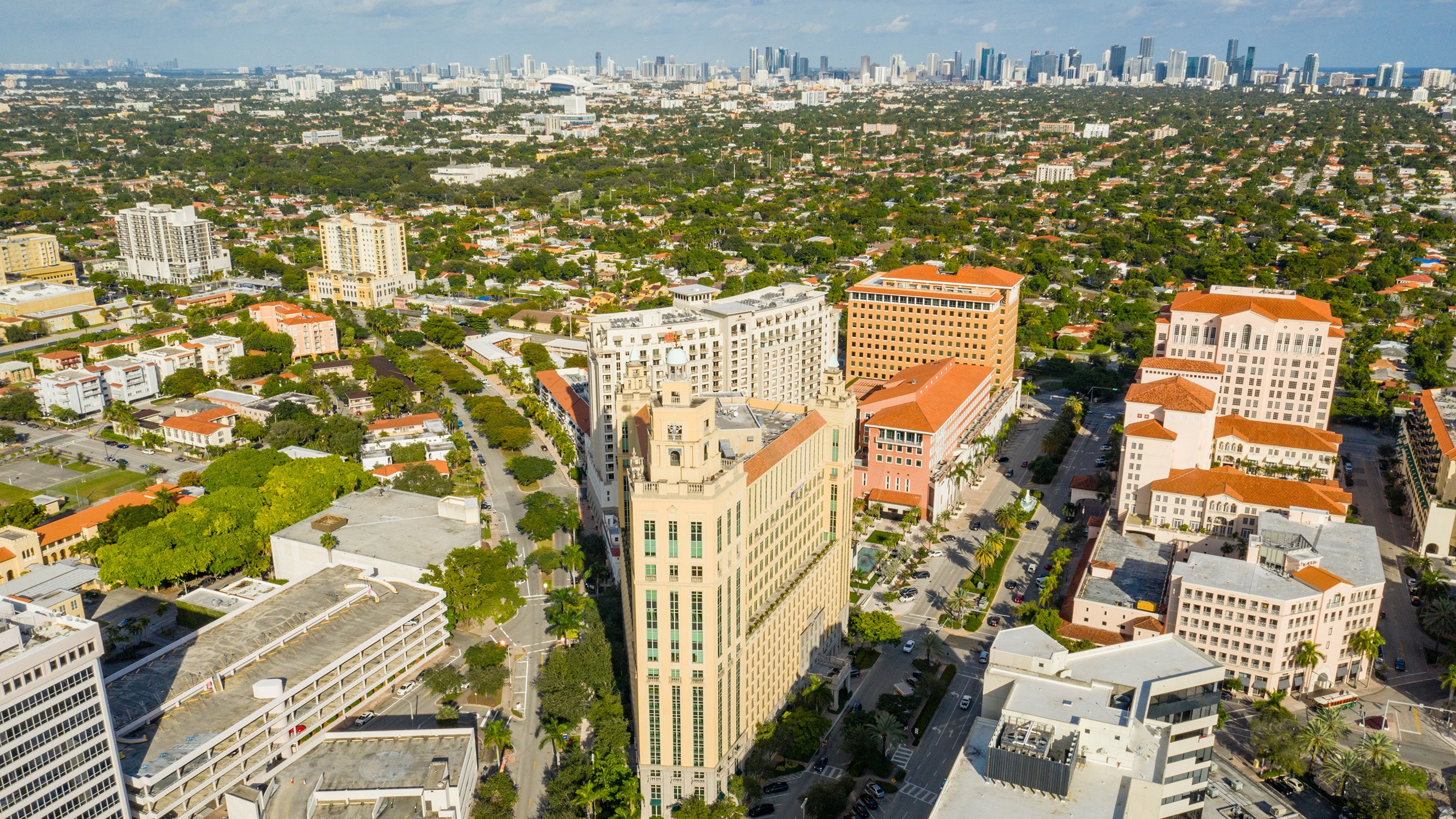
That helps explain why school-linked neighborhoods such as Coral Gables and Pinecrest continue to command attention as premium residential enclaves. The appeal is not limited to education. It extends to streetscape quality, civic identity, landscaping standards, and the kind of neighborhood stewardship that high-net-worth buyers tend to value.
A purchaser considering Ponce Park Coral Gables or Cora Merrick Park is not merely buying near institutions. The buyer is investing in Coral Gables as a refined urban village with enduring social and architectural cachet. That distinction matters because brand value often outlasts novelty across market cycles.
One of the clearest arguments for buying near a private school is simple: your future buyer pool is larger. When it is time to sell, the property may appeal not only to households with school-age children, but also to executives, international buyers, retirees seeking structure and services, and second-home purchasers who value a neighborhood with recognizable prestige.
In other words, these homes are not reliant on a single demand segment. They can appeal to family buyers who want convenience, but also to non-family buyers who want a stable and highly regarded address. That diversification can support better liquidity and a more resilient exit.
For luxury owners, that matters as much as appreciation. A beautiful property is one thing. A beautiful property in a neighborhood that multiple buyer profiles already understand is something else entirely. The latter often sells with less explanation.
This is part of the reason school-adjacent locations in Coconut Grove, Coral Gables, and Pinecrest retain such appeal. They are easy for buyers to interpret. A residence at The Well Coconut Grove or Arbor Coconut Grove benefits from Coconut Grove’s established identity, but the broader school-linked geography adds another layer of confidence to the surrounding submarket.
Private-school proximity can also improve daily life in ways that are easy to underestimate. Neighborhoods shaped by affluent year-round residents often attract a richer amenity mix: polished cafés, better fitness concepts, practical services, thoughtful retail, and a dining scene built for everyday use rather than only seasonal traffic.
That matters whether you have children or not. A buyer may never attend a school event and still enjoy the walkability, service density, and convenience that emerge around a well-supported residential corridor. Over time, these amenities reinforce the neighborhood’s desirability and help support values.
In South Florida, the best luxury enclaves are increasingly judged by how seamlessly they handle ordinary life. The glamour still matters, but consistency matters more. This is one reason buyers continue to favor places where institutional anchors help support everyday commerce and civic life.
For investors and part-time owners, school-adjacent property offers another advantage: flexibility. In the right submarket, a home near a respected private school may appeal to end users, long-term renters, relocation households, temporary executive stays, and families in transition between purchases or renovations.
That is a more diversified demand profile than an address that depends heavily on one buyer type. Lower vacancy risk becomes part of the thesis. So does the ability to reposition the asset over time, depending on market conditions.
In Brickell or nearby urban cores, buyers often focus on branding and service. Yet even there, the same principle holds: durable demand anchors matter. A residence at 2200 Brickell or St. Regis® Residences Brickell can benefit from the area’s luxury trajectory, but school-linked neighborhood logic remains useful when comparing submarkets for long-term hold quality and resale clarity.
Not every home near a school deserves a premium, and sophisticated buyers should be selective. The right question is not simply whether a campus is nearby. It is whether the broader neighborhood shows signs of durable demand and institutional depth.
Start with inventory and liquidity. If similar homes in the submarket are moving faster and holding value better than nearby alternatives, the neighborhood may be showing stronger buyer conviction. Next, study the amenity ecosystem. Are there quality restaurants, wellness concepts, and practical services that support year-round living? Finally, consider who your future buyer is likely to be. The more varied that answer, the stronger the investment case.
This framework is equally useful in Bay Harbor and adjacent prestige enclaves, where buyers may be balancing privacy, convenience, and optionality. A project such as The Well Bay Harbor Islands fits that conversation naturally because the buyer is evaluating not only the residence itself, but also the long-term resilience of the surrounding community.
Luxury buyers often talk about appreciation, but resilience may be the more important concept. Neighborhoods anchored by meaningful institutions, steady full-time residents, and practical infrastructure tend to recover more smoothly from disruption than places built around pure seasonality.
That does not make every school-adjacent district immune to volatility. It does suggest, however, that these neighborhoods often possess more internal strength than markets driven purely by trend. Major campuses, civic assets, and established service networks create continuity. In uncertain periods, continuity is valuable.
For buyers without children, that may be the real takeaway. You are not buying homework convenience. You are buying into a location with multiple reasons to matter, multiple groups willing to pay for it, and a stronger chance of remaining desirable over time.
In a region as dynamic as South Florida, the smartest luxury purchases are often those that combine beauty with broad usefulness. Private-school-adjacent homes do exactly that. They carry a prestige premium, but they also tend to offer better neighborhood identity, deeper amenities, stronger rental flexibility, and wider resale appeal.
For some buyers, the school itself will never be used. That is beside the point. In high-end real estate, the best assets are often the ones that communicate quality instantly and continue to attract demand from several directions at once. Near the right private school, that signal can be remarkably durable.
Why would a buyer without children pay for a school-adjacent location? Because the premium often reflects neighborhood quality, prestige, and resale depth rather than education alone.
Do homes near respected schools usually hold value better? They can be more resilient when the surrounding neighborhood attracts multiple buyer types and maintains strong overall demand.
Is this mainly a single-family-home strategy? No. The same logic can apply to luxury condominiums and branded residences in established South Florida submarkets.
Does private-school proximity help with resale? Yes. It can widen the buyer pool by attracting families, relocators, and second-home purchasers alike.
Why are Coral Gables and Pinecrest frequently part of this discussion? Both are widely viewed as prestige residential enclaves with durable neighborhood identity and consistent buyer appeal.
Can these homes work as rental properties too? In many cases, yes. They may attract long-term renters, relocation households, and part-time residents seeking stability.
Should investors prioritize school proximity over waterfront location? Not always. The better approach is to compare which location offers more diversified and durable demand.
What should buyers study before paying a premium? Focus on liquidity, inventory trends, amenity quality, and how many future buyer types the property may attract.
Are these neighborhoods only attractive during the school year? No. Their appeal usually extends year-round because the best ones function as complete residential ecosystems.
Is the real benefit convenience or reputation? It is usually both, but for many luxury buyers, long-term reputation and market clarity matter more.
For a discreet conversation and a curated building-by-building shortlist, connect with MILLION Luxury.
If branded residences are on your mind — as a home or as an allocation — we would be glad to share what we are seeing, privately.
Begin a quiet conversation