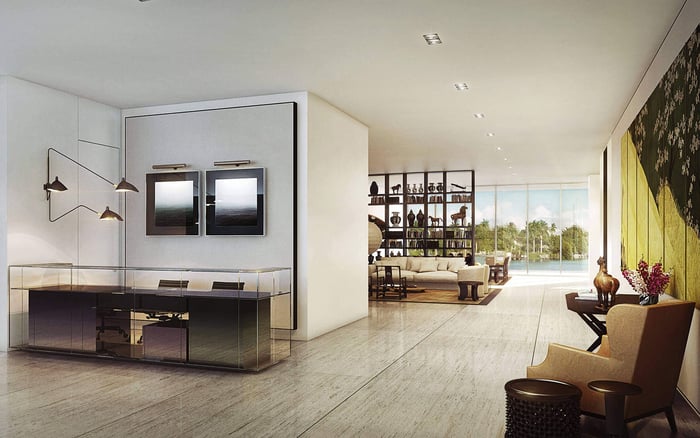
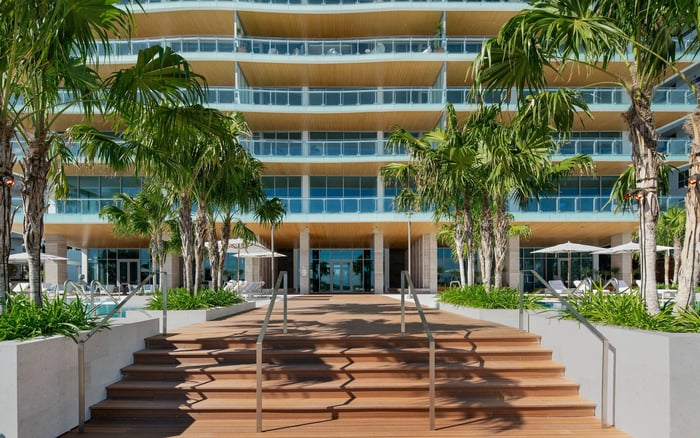
Faena House remains a singular Mid-Beach proposition, but a 2026 purchase should separate architectural appeal from building-specific resilience, insurance, reserve, and governance questions. The disciplined buyer reviews the condominium’s current records, models carrying-cost scenarios, and inspects the residence before treating storm-season confidence as established.

Faena House Miami Beach occupies a distinctive position in Mid-Beach: an oceanfront condominium conceived as the principal residential component of the broader Faena District. Envisioned by Argentine developer Alan Faena as an integrated luxury destination, the district extends along Collins Avenue around 32nd to 35th streets, combining residential, hospitality, cultural, retail, and dining uses. Faena Hotel and the Faena Forum are nearby components of this setting.
For a 2026 buyer, however, the address demands evaluation through two separate lenses. The first is experiential: architecture, privacy, views, outdoor living, and district context. The second is ownership discipline: insurance, reserves, inspections, assessments, maintenance history, and governance. The first creates desire. The second determines whether that desire can become a controlled, long-term commitment.
This distinction matters most during storm season. Architectural beauty should invite closer examination, not substitute for it.
Designed in collaboration with Norman Foster and Foster + Partners, Faena House is positioned as a boutique, low-density alternative to larger Miami Beach condominium towers. Its curved exterior and continuous terraces create a recognizable Collins Avenue profile, while the residences are oriented toward direct Atlantic Ocean views.
Deep wraparound verandas are central to the concept. They extend living and dining areas outdoors, while their depth provides shade that can help moderate direct solar exposure. Floor-to-ceiling glazing reinforces the visual continuity between the interiors and the ocean. Terrace living is not a secondary amenity here; it is integral to the residence’s spatial identity.
Buyers comparing architectural experiences might also consider 57 Ocean Miami Beach or The Perigon Miami Beach, but the useful exercise is not aesthetic ranking. It is determining which design, governance structure, and ownership profile best suit the buyer’s intended use.
The architectural story alone does not establish hurricane resistance, flood exposure, insurance pricing, reserve adequacy, inspection status, or regulatory compliance. Those matters require current, building-specific documentation. A prudent buyer should resist conclusions based on appearance, reputation, age, or price alone.
Storm-season diligence should begin with questions that produce records. What insurance policies are in force? What are their limits, deductibles, exclusions, and renewal dates? Which losses remain the unit owner’s responsibility? What does the condominium require of individual owners? Qualified insurance and legal advisers should review these questions rather than relying on informal summaries.
Flood exposure demands the same discipline. Obtain current government flood information for the property and discuss coverage requirements with appropriate professionals. The objective is not to predict an event, but to understand the financial and operational framework if one occurs.
A serious resale review extends beyond the unit. Request the declaration, bylaws, current budget, recent financial statements, reserve information, meeting minutes, insurance materials, inspection documents, pending litigation disclosures, and notices concerning contemplated work or assessments. Counsel and other advisers should determine the exact package.
Read the materials together, not in isolation. Meeting minutes may contextualize a budget line. An insurance renewal may affect future common expenses. Planned work may clarify whether reserves are expected to fund it or whether owners could face another form of contribution. None of these outcomes should be presumed before the documents are examined.
The buyer should also understand how decisions are made. Review approval procedures, leasing and use restrictions, renovation rules, emergency protocols, and the allocation of maintenance responsibilities. Ownership discipline is partly financial, but it is also administrative. In a boutique building, clarity around governance can be as consequential as the residence itself.
This document-first approach is the essential counterweight to emotion.
The unit inspection should reflect Faena House’s defining design. Floor-to-ceiling glazing, doors, seals, exterior transitions, drainage points, and visible interior finishes merit focused professional review. Terrace condition and maintenance responsibility should be understood precisely, including the boundary between association and owner obligations.
Buyers should request available records concerning prior leaks, water intrusion, repairs, alterations, and insurance claims affecting the residence, then verify what can be confirmed through the appropriate professionals. Furnishings, art, exterior objects, and seasonal occupancy plans should also be considered operationally. A second home requires a clear protocol for preparation, access, monitoring, and post-event inspection.
The relevant question is not simply whether a residence feels secure on a clear day. It is whether the owner has a workable plan while away from Miami Beach.
A disciplined shortlist should apply the same categories to every candidate: setting, density, architecture, service model, governance, financial documents, insurance structure, reserve position, physical condition, and projected carrying costs. The Ritz-Carlton Residences® Miami Beach can occupy the same comparison worksheet without any assumption that unlike properties carry equivalent risks or responsibilities.
Model more than one ownership scenario. Consider the effect of changing insurance costs, maintenance projects, assessments, and periods when the residence is unoccupied. Scenario planning is not pessimism. It is how a buyer preserves choice after closing.
Faena House’s appeal is clear: Atlantic views, expansive verandas, a low-density identity, and a place within an integrated district. The 2026 buyer’s advantage lies in treating those qualities as the beginning of diligence, not its conclusion.
Where is Faena House located? Faena House is an oceanfront condominium in Miami Beach’s Mid-Beach area.
What is the Faena District? It is an integrated district along Collins Avenue around 32nd to 35th streets, combining residential, hospitality, cultural, retail, and dining uses.
Who designed Faena House? Faena House was designed in collaboration with Norman Foster and Foster + Partners.
What defines the building’s architecture? Its curved exterior, continuous terraces, deep wraparound verandas, and floor-to-ceiling glazing shape its identity.
Do the verandas provide shade? Their depth can help moderate direct solar exposure while extending living and dining areas outdoors.
Is a specific hurricane-resistance rating established here? No. Buyers should verify building-specific performance through current technical records and qualified professionals.
What insurance information should a buyer request? Request current policies and review limits, deductibles, exclusions, renewal timing, and owner responsibilities with appropriate advisers.
Why review reserves and meeting minutes together? Together, they can provide context for planned work, funding decisions, and issues under discussion by the condominium.
What should a residence inspection emphasize? It should include glazing, doors, seals, exterior transitions, drainage points, visible finishes, and evidence of prior water intrusion.
What is the core ownership discipline for 2026? Separate lifestyle appeal from verified physical, financial, insurance, and governance information before committing.
When you're ready to tour or underwrite the options, connect with MILLION.
If branded residences are on your mind — as a home or as an allocation — we would be glad to share what we are seeing, privately.
Begin a quiet conversation