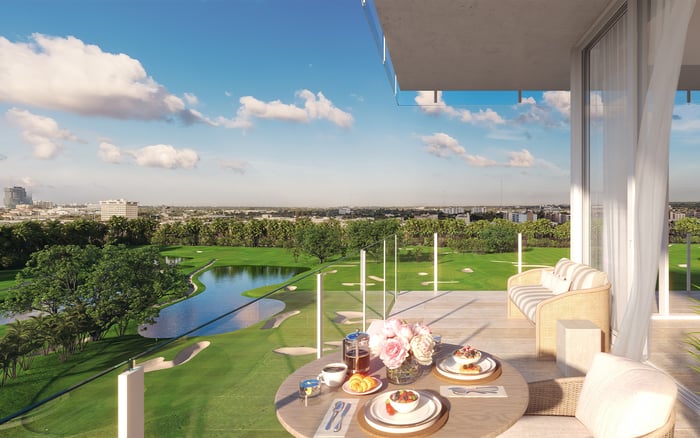
A collector-focused comparison of Shell Bay by Auberge in Hallandale Beach and Continuum Club & Residences in North Bay Village, centered on club-residence ownership, art installation diligence, freight access questions, and storage protocols.

For a South Florida buyer with serious artwork, a residence is never only a view, floor plan, or brand affiliation. It is a working environment for delivery teams, installers, conservators, insurers, designers, and property staff. That makes Shell Bay by Auberge Hallandale and Continuum Club & Residences North Bay Village a useful comparison-not because either should be presumed to offer museum-grade logistics, but because each reflects a different form of modern luxury ownership.
Shell Bay by Auberge Hallandale is positioned in Hallandale Beach as an ultra-luxury branded residential community tied to a private-club setting. Its identity is less about a conventional hotel-residence tower and more about private-club living, with a broader ecosystem of golf, racquet, yacht, wellness, dining, and social amenities. For collectors, that campus character raises precise questions about privacy, controlled access, service culture, and how specialized deliveries move through a lower-density environment.
Continuum Club & Residences North Bay Village, by contrast, is a bayfront, club-oriented residential development in a Miami-area setting between Miami Beach and the mainland. Its proposition draws from the Continuum brand’s resort-style condominium legacy, translated into North Bay Village with an emphasis on leisure, wellness, community, and membership-style living. For art owners, the central question is how a bayfront club-residence format manages vertical circulation, loading procedures, service access, and private storage without relying on the assumptions of a hotel-branded model.
Shell Bay’s clearest distinction is its broader private-club campus context. Hallandale Beach gives the project a less dense setting than many oceanfront condominium corridors while keeping it near South Florida’s waterfront amenities. That lower-density framing may appeal to end-users who value privacy, club access, and resort-level service, particularly buyers who prefer a controlled residential environment over transient hotel-style occupancy.
For art installation, this model calls for targeted diligence. A collector should ask how large-scale works are scheduled onto the property, who approves third-party handlers, where vehicles are received, and whether service routes can accommodate oversized crates without crossing sensitive residential or club-facing areas. None of those answers should be inferred from private-club positioning alone.
The Auberge Resorts Collection association adds hospitality influence, but the practical collector question is operational rather than symbolic. Does the residence support discreet installation timing? Are building teams accustomed to coordinating specialty vendors? What are the procedures for insurance certificates, protective coverings, elevator reservations, and after-hours access? A polished service culture matters only when it is translated into written procedures.
Storage is the second issue. Buyers should distinguish between ordinary owner storage and climate-controlled storage appropriate for artwork, wine, textiles, design objects, or sensitive materials. If storage is a priority, the relevant questions include HVAC specifications, humidity-control ranges, power redundancy, pest management, security protocols, and whether private storage areas are included, assigned, or separately handled.
Continuum Club & Residences brings a different geography and ownership feel. North Bay Village is a bayfront Miami-area market positioned between Miami Beach and the mainland, giving the project a waterfront residential identity without placing it directly in the most heavily trafficked oceanfront condominium corridors. For buyers who want a club-residence lifestyle near Miami’s cultural and social infrastructure, that location is central to the appeal.
The Continuum model emphasizes leisure, wellness, community, and membership-style living. For many owners, that is the point: a residential building that feels socially curated, amenity-rich, and less transient than a standard hotel-branded residence. For collectors, however, the bayfront vertical format requires a sharper review of logistics.
Freight access should be examined in exact terms. Elevator cab dimensions, door clearance, weight ratings, padding procedures, loading location, delivery hours, staging areas, and service staff coordination all matter. A painting that works in a brochure fantasy may not fit through an actual service path. A sculpture that looks appropriate in a great room may still require advance review for wall loads, floor protection, vibration, insurance approvals, and installer access.
The same applies to climate-sensitive storage. A buyer should not treat private storage as synonymous with art storage. The meaningful inquiry is whether any storage area maintains stable temperature and humidity, what systems support that stability, and how security and access are documented. Marina assumptions, waterview preferences, and bayfront lifestyle should remain separate from the technical realities of preservation.
The most sophisticated buyers will treat art logistics as part of pre-contract diligence, not as a design issue to solve after closing. The correct sequence is to identify the largest likely artwork, the most delicate likely material, and the most complicated future delivery, then test the building’s procedures against those facts.
The checklist is practical. Request freight elevator cab size, door width, ceiling clearance, weight rating, protective lining policies, and reservation procedures. Ask how loading areas operate, including delivery hours, truck access, waiting rules, and whether specialized art handlers need separate approval. Confirm the route from arrival to residence, including turns, thresholds, floor protection, and whether passenger areas are ever involved.
Inside the residence, review wall-load capacity, lighting strategies, humidity exposure near glazing, and locations where works may be affected by direct sun, airflow, or mechanical systems. On terraces and balcony-adjacent interiors, conservation risk can be more nuanced than a simple indoor-outdoor distinction. Even when a piece is never placed outside, proximity to heat, salt air, and repeated door openings may influence placement.
Storage requires the same discipline. Is storage conditioned or merely enclosed? Are temperature and humidity ranges specified? Is backup power connected to storage HVAC? Who can access the area, and how is access recorded? Are there cameras, alarms, or key-control procedures? What insurance language applies to art in residences, storage rooms, elevators, loading zones, or common areas during installation?
Investment value in this niche is tied not only to finishes and amenities, but also to frictionless ownership. A residence that makes complex installations easier can feel quietly superior over years of collecting, rotating, lending, and receiving works.
The comparison is not simply Shell Bay versus Continuum. It is private-club campus ownership versus bayfront club-residence ownership. Shell Bay’s advantage is the breadth of its club ecosystem and the privacy associated with a more controlled Hallandale Beach setting. Continuum’s advantage is its bayfront North Bay Village format, with a club-oriented residential concept close to Miami’s cultural orbit.
For a buyer whose collection includes large-format paintings, sculptural objects, or fragile materials, neither model should be evaluated through lifestyle language alone. The club atmosphere may suggest discretion, but discretion must be supported by building rules. The resort-style experience may suggest service, but service must be measurable in elevator access, delivery timing, staff coordination, and written protocols.
The best outcome is a residence where the physical plant, ownership culture, and building team all support the way the owner actually lives. For some, that will mean the more expansive private-club rhythm of Shell Bay. For others, it will mean Continuum’s bayfront club-residence energy in North Bay Village. The right choice is the one whose unseen infrastructure is as carefully considered as its public-facing amenities.
Is Shell Bay by Auberge Hallandale a traditional hotel-residence model? Shell Bay is framed around private-club living rather than a conventional hotel-residence tower model.
Where is Continuum Club & Residences North Bay Village located? It is in North Bay Village, a bayfront Miami-area market between Miami Beach and the mainland.
Does either project confirm museum-grade art storage? No confirmed technical specifications establish museum-grade art storage for either project, so buyers should request written details.
What is the most important freight-access question for collectors? Start with freight elevator cab dimensions, door clearance, weight rating, and the approved route from loading area to residence.
Why does Shell Bay appeal to privacy-focused buyers? Its positioning emphasizes low-density luxury, private-club access, resort-level service, and a controlled residential environment.
Why does Continuum appeal to club-residence buyers? Its model emphasizes bayfront living, wellness, leisure, community, and membership-style residential life.
Should buyers assume private storage is climate-controlled? No. Buyers should verify HVAC, humidity ranges, backup power, access controls, and insurance treatment before relying on storage.
Are wall-load and installation approvals important? Yes. Large or heavy works may require review of wall capacity, floor protection, installer access, and insurance documentation.
Which model is better for an art collector? The better model is the one with verified logistics that match the collection’s scale, fragility, access needs, and storage requirements.
What is the best way to shortlist comparable options for touring? Start with location fit, delivery status, and daily lifestyle priorities, then compare stacks and elevations to validate views and privacy.
To compare the best-fit options with clarity, connect with MILLION.
If branded residences are on your mind — as a home or as an allocation — we would be glad to share what we are seeing, privately.
Begin a quiet conversation