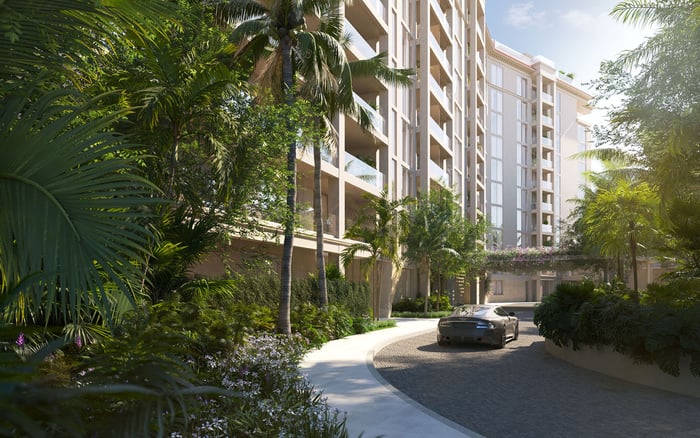
A buyer-oriented framework for separating Fisher Island carrying costs, calculating cost per occupied day, and judging whether privacy, infrastructure, amenities, and convenience create commensurate residential value.

At The Links Estates at Fisher Island, the relevant question is not simply whether a monthly charge appears high or low. It is what that expenditure secures, how often the household benefits, and which costs would exist under another ownership format.
The Links Estates at Fisher Island combines estate-style ownership with access to a private-island environment, making its expense profile inherently layered. Buyers should separate recurring residential obligations from club-related costs, insurance, taxes, and services billed according to use. Only then does a headline monthly figure become a meaningful measure of daily residential value.
Begin with a complete annual schedule rather than a single association line item. Potential layers include estate-level association charges, island infrastructure contributions, club dues, property insurance, and property taxes. Club privileges and individually consumed services may be governed and billed separately, so mandatory and elective expenses should never be blended without explanation.
Estate-level charges may support shared access areas, security, landscaping standards, architectural controls, and common infrastructure. Island-wide expenses help sustain the private systems underlying Fisher Island’s secluded setting. The private ferry is especially important: it is not a decorative amenity but infrastructure that shapes everyday arrivals, departures, staffing, deliveries, and guest access.
Repeat this exercise when considering The Residences at Six Fisher Island. Buyers should compare the scope of obligations rather than assume that two residences in the same market package services identically.
Once every recurring layer has been identified, total the annual carrying costs and divide that amount by expected occupied days. For a household using the residence 120 days annually, the denominator should be 120, not 365. Where useful, divide again by the number of household members who regularly enjoy the property.
The framework is simple:
Annual carrying costs ÷ occupied days = household cost per occupied day
Household cost per occupied day ÷ regular users = cost per person per occupied day
This is not a universal valuation formula. A primary resident, a seasonal owner, and an occasional visitor will produce very different results. A second-home buyer should also run low, expected, and high occupancy scenarios. The purpose is to reveal sensitivity to use, not manufacture a flattering daily rate.
Map daily value to specific benefits: privacy, controlled access, security, maintained infrastructure, visual order, recreation, and time saved coordinating outside vendors. At The Links Estates, the golf setting can provide both recreational utility and a maintained outlook near the residences.
Club-related value may extend to marina access, tennis, beach, spa, dining, and other resort-style facilities, subject to membership terms. Participation is the decisive variable. A household that frequently uses several amenities may perceive greater value than an owner who prefers a private routine and rarely enters the broader club ecosystem.
Convenience deserves its own line in the analysis. Owners should estimate the time and administrative effort avoided through organized access, security, infrastructure, and amenity operations. In an ultra-premium lifestyle, reduced friction can be as relevant as the physical facilities themselves.
A mainland estate may carry lower association dues while requiring separate contracts for security, grounds maintenance, recreation, yachting support, and hospitality services. An urban penthouse may consolidate more services but offer a different relationship to privacy, land, and access. Luxury hospitality can provide convenience without the continuity or control of ownership.
The comparison should therefore be system against system. Owners considering Palazzo del Sol or Palazzo della Luna can apply the same discipline: identify every mandatory and usage-based expense, then match each cost to the residential benefit it supports.
Do not compare association dues alone. Compare total annual outlay, expected use, staffing needs, amenity participation, and the value assigned to privacy and saved time.
Before translating costs into daily value, request the current budget, governing documents, insurance allocations, reserve information, club terms, and details of ferry-related charges. Confirm which obligations attach to ownership, which require separate membership, and which vary with consumption.
Review historical and projected fee escalation, special-assessment exposure, governance, insurance risk, and resale liquidity. Buyers should also ask how capital projects are approved, how reserves are funded, and whether club membership requirements can change. The objective is not merely to validate today’s payment, but to understand the durability, predictability, and control of the entire ownership structure.
A well-supported decision ultimately connects each dollar to a function the household values. At this level, service fees are best judged as the operating cost of a residential experience, not an isolated surcharge.
Is there one service fee at The Links Estates? The cost structure should be viewed in layers, potentially including estate, island, club, insurance, and tax obligations.
What may estate-level association charges support? They may support shared access, security, landscaping standards, architectural controls, and common infrastructure.
Why does the ferry matter to the analysis? The private ferry is part of the island’s daily infrastructure and affects access for residents, guests, staff, and services.
Are club dues necessarily included in association charges? Not necessarily. Buyers should distinguish mandatory ownership charges from separate memberships and usage-based services.
How should an owner calculate daily cost? Divide total annual carrying costs by expected occupied days, then, if useful, by the number of regular household users.
Should the calculation use 365 days? Only if the residence is expected to be occupied every day. Seasonal owners should use realistic occupied days.
Which amenities may contribute to value? Depending on membership terms, value may extend across golf, marina, tennis, beach, spa, dining, and other facilities.
What is the fairest mainland comparison? Compare total costs, including privately contracted security, landscaping, recreation, yachting, and hospitality support.
Which documents deserve close review? Review budgets, governing documents, insurance allocations, reserve information, club terms, and ferry-related charges.
What risks can change the value equation? Fee escalation, special assessments, insurance exposure, governance changes, amenity use, and resale liquidity can alter it.
For a discreet conversation and a curated building-by-building shortlist, connect with MILLION.
If branded residences are on your mind — as a home or as an allocation — we would be glad to share what we are seeing, privately.
Begin a quiet conversation