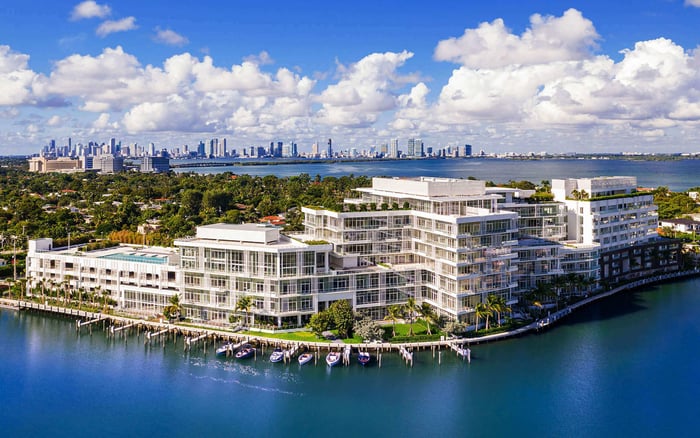
At The Surf Club Four Seasons, reserve analysis requires more than checking a single balance. Buyers should map association obligations, hotel services, shared operations, prospective capital needs, and unit-specific liabilities before converting financial diligence into an offer.

At The Surf Club Four Seasons Surfside, a buyer is evaluating more than an exceptional residence. Set on Atlantic oceanfront land in Surfside, between Miami Beach and Bal Harbour, the property combines private residences with a Four Seasons hotel, restored club spaces, dining, beach access, and hospitality operations.
That composition makes reserve exposure a question of structure-not simply the size of a reported reserve balance. Before pricing an offer, buyers should determine which entity is responsible for each major component, how shared expenses are allocated, what work is anticipated, and whether current funding aligns with those obligations. Without current property documents, no specific reserve surplus, deficit, assessment, or 2026 capital plan should be assumed.
The original Surf Club was founded in the 1930s as a private oceanfront gathering place for an international clientele. Fort Partners led its redevelopment in the 2010s, integrating restored historic spaces into a contemporary hotel and residential setting. Richard Meier was among the prominent designers involved, while Four Seasons operates the hospitality component.
This heritage supports the property's singular identity, but it does not replace financial diligence. The Surf Club is a hotel-residential development, not a conventional standalone condominium. A buyer must distinguish residential association obligations from hotel services and shared-property operations, then identify where those costs intersect.
That distinction is equally important when comparing Branded Residences. A residence at Four Seasons Hotel & Private Residences Fort Lauderdale may share a hospitality pedigree, but its legal structure, expense allocations, physical components, and capital planning must be reviewed independently.
Begin with the current budget, recent financial statements, reserve schedules, available reserve studies, governing documents, and any applicable engineering or inspection materials. Review meeting minutes and owner notices for discussions of repairs, deferred projects, insurance, contracts, litigation, assessments, or changes in recurring expenses. The objective is to connect every financial line item to a physical or operational responsibility.
Next, request a clear explanation of the entities within the mixed-use property. Buyers should understand which costs belong solely to the residences, which relate to the hotel, and which are shared. Allocation formulas, management arrangements, and the treatment of common facilities may matter as much as the aggregate reserve figure.
Unit-level review is equally essential. Obtain the estoppel and ledger, confirm whether any amounts are outstanding, and examine the seller's responsibility for approved or pending charges under the contract. Counsel and financial advisers should reconcile those materials with the purchase agreement before contingencies expire.
Reserve exposure should inform pricing through three lenses: amount, timing, and certainty. A documented obligation with a defined payment schedule can be modeled directly. A possible project with an incomplete scope requires a different response: a diligence condition, contractual allocation, escrow discussion, or price cushion proportionate to the uncertainty.
Do not automatically treat a low reserve figure as proof of weakness-or a high figure as proof of adequacy. Context matters: the components covered, their expected useful lives, planned work, insurance arrangements, and the division of responsibility across the property. The central question is whether available resources and future collections appear aligned with identified obligations.
This is where Pricing & Trends analysis must remain disciplined. Prestige, privacy, architecture, and service can support desirability, but they should not obscure liabilities that transfer with ownership. An Investment decision should separate the home's intrinsic appeal from the buyer's verified share of future costs.
Surfside offers several useful points of orientation. Arte Surfside and Fendi Château Residences Surfside can help buyers frame preferences around boutique scale and Oceanfront living, while The Delmore Surfside provides another local residential reference.
These comparisons can sharpen questions about the ownership experience and market positioning, but they cannot establish reserve adequacy at The Surf Club. Each property's documents, operating structure, physical condition, and obligations stand on their own. The same principle applies to Resale analysis: comparable asking prices provide context, not a substitute for reviewing the liabilities attached to the specific residence.
A well-priced offer should reflect what is known, what remains uncertain, and who bears each risk after closing. Buyers should seek a concise written schedule of recurring charges, reserves, shared costs, known projects, assessments, and unit-specific balances-all supported by current documents.
The Surf Club's history, architecture, Atlantic setting, and hospitality identity make it a distinctive South Florida asset. A disciplined buyer respects that rarity while underwriting ownership with precision. In 2026, sophistication is not skepticism. It is the ability to value the residence and its obligations as one complete proposition.
What does reserve exposure mean for a buyer? It is the buyer's potential share of capital obligations, including known charges and less certain future funding needs.
Is a large reserve balance automatically reassuring? No. The balance must be evaluated against the components covered, planned work, timing, and allocation of responsibility.
Why does the mixed-use structure matter? Residential, hotel, and shared-property operations may carry different obligations, making cost allocation central to diligence.
Which financial documents should a buyer request? Request current budgets, financial statements, reserve materials, governing documents, meeting minutes, notices, and relevant inspection or engineering records.
Should buyers review the unit estoppel? Yes. It can help confirm unit-level balances and charges that should be addressed within the transaction.
Can marketing materials establish reserve adequacy? No. Property positioning and amenities do not replace current association, financial, inspection, and contractual documents.
How should a possible assessment affect an offer? Evaluate its amount, approval status, timing, payment terms, and contractual responsibility before adjusting price or terms.
Are hotel services the same as association expenses? Not necessarily. Buyers should identify which entity provides each service and how the related cost is allocated.
Can nearby condominiums confirm fair reserve funding? No. Nearby properties offer market context, but each development has its own structure, condition, documents, and obligations.
Who should review the diligence package? The buyer's attorney, financial adviser, and qualified building professionals should review the materials within their respective areas of expertise.
When you're ready to tour or underwrite the options, connect with MILLION.
If branded residences are on your mind — as a home or as an allocation — we would be glad to share what we are seeing, privately.
Begin a quiet conversation