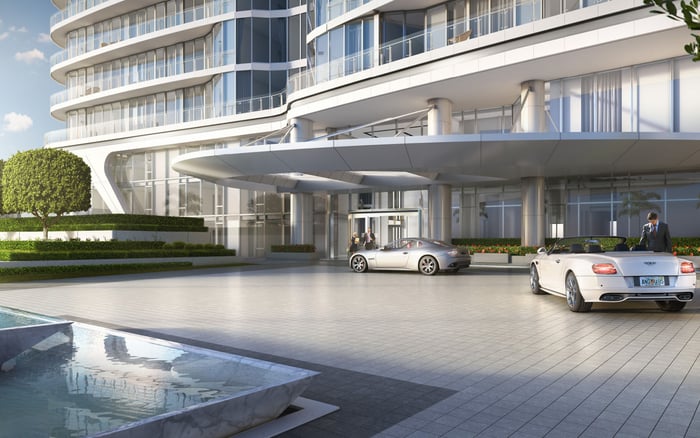
Parking diligence at a service-led residence should examine how family vehicles, guests, household staff, private drivers, deliveries, charging needs, and storm procedures interact. Buyers should obtain project-specific rules in writing rather than infer operating policies from the arrival experience.

At The Ritz-Carlton Residences® Palm Beach Gardens, prospective buyers should evaluate parking as part of the residence’s broader service experience. The important issue is not only where a vehicle is stored, but how arrivals, handoffs, waiting periods, retrievals, and overnight stays are managed.
This review is particularly relevant for households coordinating family members, visiting relatives, caregivers, nannies, house managers, private drivers, or seasonal vehicles. Buyers should avoid assuming that a polished arrival area answers every operational question.
The first step is to identify the legal and practical character of the parking provided with a residence. Purchase documents should explain whether spaces are deeded, assigned, licensed, or governed through another arrangement, as well as whether those rights transfer with a sale.
Buyers should also ask who may use the resident allocation. A household may need clarity on whether a family member, caregiver, employee, or driver can park there and whether access or registration requirements apply.
If additional parking may be available, confirm its current availability and terms in writing. It should not be treated as part of an acquisition plan until the applicable documentation has been reviewed.
Guest parking requires more than confirmation that visitors can reach the property. The practical sequence may involve advance authorization, arrival clearance, vehicle handoff, overnight permission, retrieval, and departure.
Ask management how temporary and overnight visits are handled, what occurs when ordinary guest capacity is unavailable, and whether time limits, fees, event controls, or overflow procedures apply. These details can become important during holidays, family gatherings, dinner parties, and overlapping houseguest stays.
The review should also distinguish among personal guests, service providers, recurring household employees, ride-share vehicles, and deliveries. Different categories may follow different access and staging procedures, so buyers should request project-specific guidance rather than assume a single rule covers every arrival.
A private driver may need to remain nearby between appointments, coordinate luggage, stage for a departure, or wait for a family member. Buyers should determine whether the property designates a waiting location and whether dwell-time or idling restrictions apply.
A porte cochère or arrival court should not automatically be treated as an unrestricted waiting zone. Its use may need to accommodate residents, visitors, valet activity, vendors, deliveries, and ride-share pickups.
Written guidance should address where a driver may wait, how long the vehicle may remain, whether the driver must leave the property between assignments, and how early-morning or late-night pickups are coordinated. Households should also confirm whether drivers and staff can retrieve vehicles directly or must use an assisted process.
Parking diligence is most useful when it reflects a household’s peak demand rather than a quiet sales visit. Model an hour in which resident vehicles, a caregiver, a private driver, houseguests, dinner guests, and a delivery arrive or depart close together.
The exercise can expose dependencies involving access approval, staging space, vehicle retrieval, charging, and staff coordination. Buyers should ask how procedures adapt during holidays, private gatherings, or other periods of concentrated demand.
A service promise is easier to evaluate when the operating sequence is documented. If an answer depends on future management discretion, buyers should understand that uncertainty before committing.
Request the condominium documents, parking schedule, rules and regulations, valet or vehicle-handling policy, current fee schedule, and written management guidance for access. The review should resolve these points:
The legal character and transferability of resident parking rights.
The terms and availability of any additional parking opportunity.
Guest authorization, overnight parking, overflow, retrieval, and applicable fees.
Rules for staff vehicles, private drivers, idling, ride-share pickups, and delivery staging.
Charging access, equipment responsibilities, and vehicle eligibility.
Storm procedures, including possible relocation requirements or temporary operating restrictions.
Buyers should also ask how recurring staff members and time-sensitive vendors are authorized. The objective is to learn what the governing documents and current procedures actually permit, not to presume that a particular access system exists.
The same diligence framework can be applied when considering The Ritz-Carlton Residences® West Palm Beach, Mandarin Oriental Residences, West Palm Beach, or Glass House Boca Raton. These links provide internal navigation to other Palm Beach County residences, not evidence that their parking policies are identical.
The strongest comparison considers the entire transportation arrangement: resident vehicles, visitors, employees, private drivers, charging needs, deliveries, and preferred service level. Each project’s current documents and written guidance should control the analysis.
What parking documents should a buyer request? Request the governing documents, parking schedule, rules and regulations, applicable vehicle-handling policies, current fee schedule, and written access guidance.
Why does the legal character of a parking space matter? It can affect a buyer’s rights, permitted use, and transfer terms. The controlling documents should explain the arrangement.
Should a buyer assume household staff may use resident parking? No. Staff access, registration, parking location, and shift-length restrictions should be confirmed in writing.
What should buyers ask about guest parking? Ask about authorization, arrival procedures, overnight permission, time limits, fees, retrieval, and overflow handling.
Can an arrival court be treated as a chauffeur waiting area? Not without written confirmation. Buyers should verify the designated waiting location and any dwell-time or idling rules.
How should recurring caregivers or employees be evaluated? Confirm how recurring access is authorized and whether their vehicles follow resident, guest, vendor, or separate procedures.
Why model the household’s busiest hour? A peak-demand scenario can reveal conflicts involving arrivals, staging, retrievals, guests, staff, and deliveries.
What charging questions belong in parking diligence? Confirm access, equipment responsibilities, eligible vehicles, operating rules, and any related fees in the project documents.
What storm-related parking issues should be reviewed? Ask about vehicle relocation requirements and any temporary restrictions affecting parking or vehicle-handling operations.
Should buyers compare parking policies across projects? Yes, but each residence should be assessed through its own current documents and written guidance rather than assumed to follow another project’s rules.
To compare the best-fit options with clarity, connect with MILLION.
If branded residences are on your mind — as a home or as an allocation — we would be glad to share what we are seeing, privately.
Begin a quiet conversation