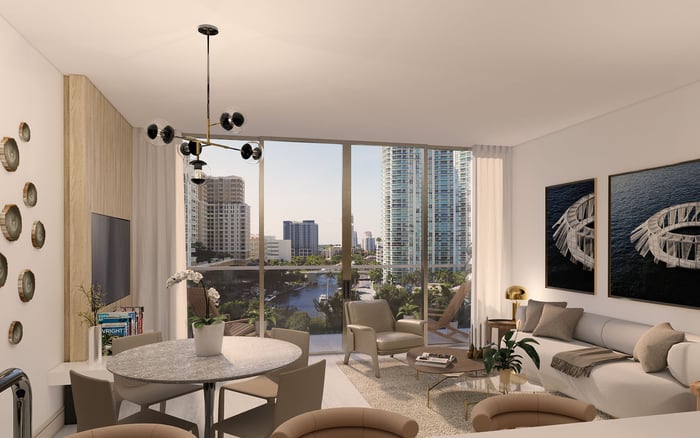
A buyer-focused framework for examining replacement-cost valuation, ordinance-and-law endorsements, and the boundary between association insurance and personally insured interiors at The Ritz-Carlton Residences® Fort Lauderdale.

For a buyer considering The Ritz-Carlton Residences® Fort Lauderdale, insurance diligence belongs alongside the review of ownership documents and the residence itself. The essential question is not simply whether the association carries insurance, but whether the building valuation, policy terms, and owner's coverage work together to address restoration costs.
A purchase price does not establish reconstruction cost. Nor does a branded address establish which policy would replace cabinetry, custom finishes, or personal property. Those distinctions warrant written answers before a buyer considers the insurance review complete.
This is a due-diligence framework, not a conclusion about this association's coverage or its adequacy. Counsel should interpret legal responsibilities, management should supply the relevant association documents, and insurance advisers should explain how the proposed coverage responds.
Florida's condominium insurance baseline requires adequate association property insurance regardless of the coverage requirements stated in the declaration. That insurance must be based on replacement cost determined by an independent insurance appraisal or appraisal update at least every 36 months.
The practical request is straightforward: obtain the latest appraisal, its effective date, its replacement-cost estimate, and the current policy declarations. Ask management and the broker to reconcile the appraised amount with the insured building limits, rather than present the documents as unrelated records.
The discussion should address three questions:
Does the appraisal describe the property being insured, including applicable association alterations or additions?
How does the current building limit compare with the appraised replacement cost?
Could coinsurance, a margin clause, or a property-specific sublimit reduce recovery despite an apparently sufficient headline limit?
Ask the broker to demonstrate the effect of any such provision using the actual policy wording. The objective is to understand potential recovery, not to seek reassurance from the size of the insured amount alone.
Required primary association coverage starts with condominium property as originally installed, or like-kind-and-quality replacements consistent with the original plans, subject to statutory exclusions. It also encompasses qualifying alterations or additions to condominium or association property under Section 718.113(2).
The exclusions matter especially in a carefully appointed residence. Specified owner-responsibility items include personal property, floor, wall, and ceiling coverings, electrical fixtures, appliances, water heaters, water filters, built-in cabinets, countertops, and window treatments serving only the unit.
Original installation does not override an express exclusion. Developer-installed cabinetry and countertops do not become part of the required association coverage merely because they were included in the original residence.
Ask counsel and the owner's insurance adviser to prepare an item-by-item allocation. For each component, identify the responsible party, the policy expected to respond, and any unresolved replacement-cost exposure. Treat descriptions such as “bare-walls,” “single-entity,” and “all-in” as starting points for questions, not substitutes for reading the contract.
For buyers also considering Four Seasons Hotel & Private Residences Fort Lauderdale, the same document-led approach applies. Neither branding nor a policy label establishes another association's interior coverage.
Next, examine restoration costs associated with ordinance or law requirements. Request the actual endorsement and ask the broker to identify its dollar limits, explain how those limits operate, and clarify its treatment of damaged and undamaged portions of the property.
Do not accept a percentage without its contractual context. The 25% and 50% figures discussed in a 2022 Florida homeowners-insurance provision do not establish this condominium association's purchased endorsement or limit. Nor should that provision's distinction involving damage exceeding 50% of replacement cost be assumed to govern a commercial condominium master policy.
Instead, ask for an explanation tied to the association's contract:
What costs would the ordinance-and-law endorsement address after a major casualty?
How would it treat an undamaged portion that must be altered or removed?
Which limits or exclusions could leave costs outside insurance recovery?
How might those uncovered costs translate into owner assessment exposure?
Counsel should address the allocation of any resulting obligation. The broker should explain the coverage response. Keeping those roles distinct helps prevent a legal allocation assumption from being mistaken for an insurance commitment.
An owner's HO-6 review should follow the interior allocation exercise, not precede it. Ask the adviser to distinguish original finishes, owner-installed improvements, and personal property, then compare their replacement costs with the proposed coverage.
For a customized residence, prepare an inventory of the relevant finishes and improvements. Ask which policy provisions would respond to each category, which limits apply, and where exclusions or valuation terms leave a gap. Do not assume an owner's policy fills every gap left by the master policy.
Florida's Condominium Act assigns specified interior responsibilities to owners without imposing a blanket requirement that every owner purchase unit insurance. That distinction is not a reason to leave the interior uninsured. Counsel should separately review whether the governing documents or the buyer's financing arrangements create applicable obligations.
The goal is a written explanation of what would fund restoration of the residence, not simply confirmation that two policies exist.
When comparing this purchase with Auberge Beach Residences & Spa Fort Lauderdale, carry the same questions across, but not the answers. Each association's appraisal, insured property schedule, endorsements, and ownership documents require a separate review.
If shared amenities, marine structures, or hotel and residential components are involved in a particular ownership arrangement, ask which entity insures them and how uncovered costs are allocated. Do not assume those features or arrangements exist at the subject property.
Also request an explanation of applicable deductibles and potential assessment allocation. Separately, Florida associations must maintain fidelity bonding or insurance for people who control or disburse association funds. That requirement should not be confused with building replacement coverage.
Before completing the review, ask counsel to explain when uninsured costs could become an individual owner's responsibility. Section 718.111(11)(j) can assign uninsured repair or replacement costs attributable to intentional conduct, negligence, or noncompliance by the owner and specified occupants or visitors.
The final diligence file should bring together the appraisal, policy declarations, relevant endorsements, deductible explanation, interior allocation, and proposed owner coverage. Each unresolved question should have a named adviser responsible for answering it.
The strongest conclusion is not that every conceivable loss is covered. It is that the buyer understands the contractual limits, the interior responsibilities, and the potential costs that remain outside insurance.
For a considered approach to South Florida residential ownership, explore MILLION.
If branded residences are on your mind — as a home or as an allocation — we would be glad to share what we are seeing, privately.
Begin a quiet conversationNo. It provides questions for evaluating coverage and does not make a finding about the association's policy terms, limits, or adequacy.
The statutory basis is replacement cost, not sales value. Buyers should ask management to reconcile the independent insurance appraisal with current building limits.
Replacement cost must be determined by an independent insurance appraisal or appraisal update at least every 36 months.
No. Cabinets and countertops are among the expressly excluded owner-responsibility items and do not enter required association coverage simply because the developer installed them.
No. The actual policy wording and applicable statutory exclusions must be reviewed rather than relying on a coverage label.
Request the endorsement, its dollar limits, and an explanation of its treatment of damaged and undamaged property. Ask counsel and the broker to address potential uncovered costs and assessment exposure.
No. The 25% and 50% figures discussed in the cited 2022 homeowners provision do not establish the association's purchased commercial master-policy coverage.
The Act assigns specified interior responsibilities without itself imposing a blanket unit-insurance purchase mandate. Counsel should separately review applicable governing documents and financing obligations.
Map original finishes, owner-installed improvements, and personal property against the master policy and proposed HO-6 coverage. Ask the adviser to identify replacement costs that remain uninsured.
Yes. Section 718.111(11)(j) can assign uninsured costs attributable to intentional conduct, negligence, or noncompliance by the owner and specified occupants or visitors.