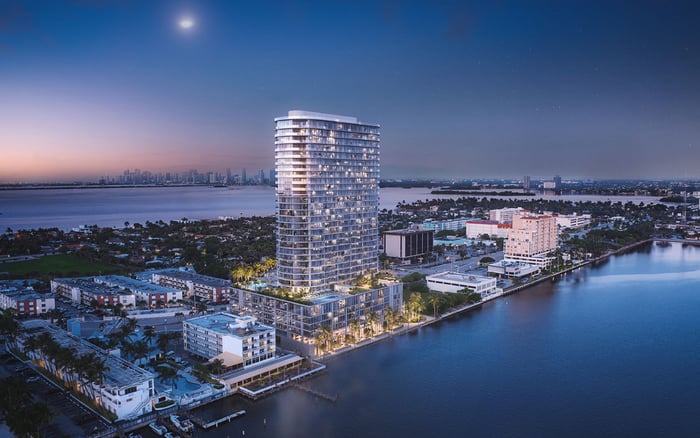
A buyer-focused framework for reviewing insurance documentation at Shoma Bay, from replacement-cost valuation and ordinance-and-law endorsements to the treatment of bespoke interiors.

At Shoma Bay North Bay Village, preparing a residence involves more than selecting finishes. For a buyer commissioning a highly personal interior, the essential insurance question is precise: which documents establish responsibility for restoring each part of the property?
Distinguish any proposed insurance arrangements from coverage effective at possession. This review does not establish Shoma Bay’s policy terms or identify a confirmed coverage gap; those conclusions require the actual documents.
Let the documents, not assumptions, guide the review. Neither the purchase price nor the sophistication of the design establishes what an insurer will pay. Request a coordinated review of the association’s coverage, governing documents and proposed unit policy before treating the residence as fully prepared.
Start by requesting the replacement-cost appraisal and insured-value schedule. Ask when the appraisal was prepared, which property it values and whether the policy schedule covers the same scope. Have the association’s insurance adviser explain any difference between the appraised value and proposed insured amounts.
Do not use a construction financing figure as a shortcut for judging coverage adequacy. Ask the adviser to distinguish financing amounts, replacement-cost estimates and insurance limits in the documents supplied for review.
Request a clear account of the assets included in the valuation. Does the appraisal address residential common areas, amenity spaces, building systems and any commercial components? Where ownership or insurance responsibilities differ, ask for those boundaries in writing rather than inferring them from the development’s presentation.
A buyer also considering Continuum Club & Residences North Bay Village can use the same document checklist. Compare the clarity of each property’s documentation without presuming equivalent policies or obligations.
Request the actual ordinance-and-law endorsement, its limits and the provisions governing when it responds. Rather than asking only whether coverage exists, have the broker explain how the wording would apply to reconstruction involving requirements imposed by the relevant authorities.
Have the adviser address three questions: how would the policy treat an undamaged portion that authorities require to be removed? How would it cover the associated demolition work? How would it address additional construction expense needed to satisfy applicable requirements? Ask whether separate limits, combined limits or other restrictions apply.
These are questions for policy review, not statements about Shoma Bay’s coverage. A general assurance that a building is insured does not resolve them. Request a written explanation tied to the endorsement, including exclusions and the relationship between these provisions and the principal property limit.
For a residence intended to be held over many years, also ask how the association plans to revisit valuation assumptions and endorsement limits. The objective is a documented review process-not an unsupported promise that every future reconstruction expense will be covered.
Before choosing a unit-policy limit, obtain the standard-finish schedule and ask counsel and the insurance advisers to map it against the governing documents and policy language. Avoid assigning a shorthand label to the master policy until that review is complete.
For each interior element, ask who is responsible for insuring it and which valuation basis applies. Flooring, cabinetry, plumbing fixtures, appliances, built-in lighting and installed technology provide a practical review checklist. These are possible items to examine, not a description of Shoma Bay’s delivered specifications.
Distinguish the contracted delivery condition from buyer-selected changes. Ask how the proposed unit policy treats developer upgrades, later alterations and custom installations. Keep specifications, invoices, photographs and change orders together so the adviser can evaluate the intended residence rather than a generic condominium interior.
If the search extends to The Perigon Miami Beach, apply the same discipline independently. Neither a Miami Beach address nor a different design vocabulary is a basis for assuming identical treatment of original finishes or improvements.
Ask whether any commercial components require a separate review of residential and commercial insurance responsibilities. Their presence would not, by itself, establish a coverage problem.
Request an explanation of the insured entities, covered property and any relevant agreements allocating responsibilities. Where residential and commercial areas are involved, ask who would coordinate a claim and whether the appraisal, policy schedule and governing documents describe those boundaries consistently.
Deductibles deserve a separate conversation. Request the hurricane deductible wording, the value against which any percentage is calculated and the circumstances that trigger it. Then ask counsel whether and how a deductible or uninsured expense could be allocated to an individual owner under the applicable documents and law.
Do not substitute a hypothetical assessment figure for that analysis. Have the unit-policy adviser review any proposed loss-assessment coverage against the identified scenarios, including its limits, exclusions and treatment of association deductibles. Each answer should be grounded in the actual wording.
Assemble one coordinated file containing the replacement-cost appraisal, insured-value schedule, full master-policy wording and endorsements, deductible schedule, standard-finish schedule and proposed unit-policy terms. Include the governing provisions used to interpret responsibilities.
For documents still in proposed form, record what must be reconfirmed before closing or possession. Ask which coverage is intended to apply at each relevant stage, including any owner-directed installation work, and who will provide evidence that it has taken effect. Do not treat a projected completion date as confirmation of an insurance commencement date.
Have counsel and the insurance advisers identify unresolved questions in writing, with a responsible party and next step for each. Revisit the unit-policy proposal once the final interior specification is settled; do not let an early estimate stand without review.
The aim is not to assume a gap, but to clarify the coverage boundary before committing to the finished home. A carefully prepared residence deserves equally careful documentation of what would restore it.
For a considered approach to South Florida residential ownership, explore MILLION.
If branded residences are on your mind — as a home or as an allocation — we would be glad to share what we are seeing, privately.
Begin a quiet conversationNo; it provides a document-review framework rather than a finding about Shoma Bay’s coverage. Any conclusion requires the actual policies, governing documents and advice tailored to the residence.
Reconfirm applicable coverage before closing or possession. Ask for evidence of the effective date rather than relying on a projected completion date.
Request the replacement-cost appraisal and insured-value schedule. Ask the association’s insurance adviser to explain their scope, dates and any differences between them.
Do not use a financing amount as a substitute for reviewing the appraisal and policy limits. Ask the adviser to explain the distinct figures in the supplied documents.
Request the endorsement and an explanation of its limits, triggers and restrictions. Ask how it would address required removal of undamaged portions, demolition and additional construction expense.
No such assumption should guide the review. Ask advisers to reconcile the standard-finish schedule, governing documents and actual policy wording.
Keep specifications, invoices, photographs and change orders together. Ask the unit-policy adviser to evaluate developer upgrades and later alterations against the proposed coverage.
Request written clarification of residential and commercial insurance responsibilities. Ask advisers to identify covered property, insured entities and claim-coordination arrangements.
Ask for the deductible wording, calculation basis and triggering circumstances. Have counsel explain whether and how relevant expenses could be allocated to an owner.
Revisit it when the final interior specification is settled and reconfirm applicable coverage before closing or possession. Ask advisers to resolve outstanding questions in writing.