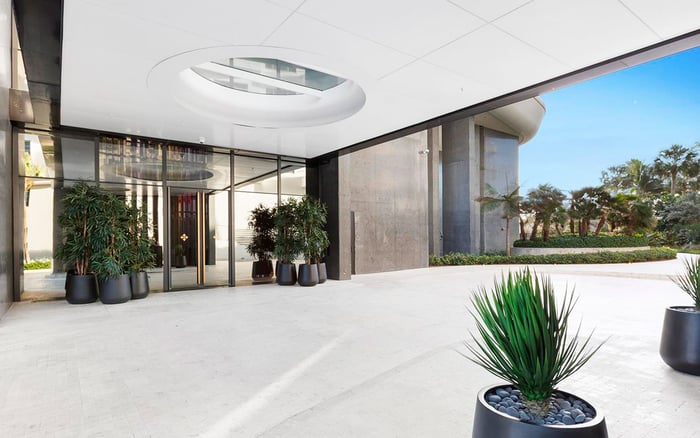
Shore Club’s advertised private arrival, secure parking and chauffeur room deserve close attention from buyers managing family, guests and household staff. The essential distinction is between an elegant facility and the written operating terms that make it useful every day.

An oceanfront residence should make a complicated household feel effortless. That depends not only on the apartment, but on what happens between the street, the vehicle and the front door. For families with children, visiting relatives and household staff, parking is part of the home's practical infrastructure.
At Shore Club Private Collections Miami Beach, the advertised arrival sequence deserves close attention. The development at 1901 Collins Avenue combines 49 private residences with a 75-key Auberge Resorts Collection hotel on approximately three oceanfront acres in South Beach's Art Deco Historic District. The advertised residential entrance is on 20th Street, within the landmarked Cromwell House, with a private porte-cochère entirely separate from the resort arrival.
That separation is meaningful, but it does not establish guest parking capacity or vehicle retrieval times. The question for a buyer is whether the eventual operating rules will support the household's busiest day-not simply its quietest arrival.
Advertised residential features include a double-height private lobby, secure underground parking with dedicated elevator access, and a driver and chauffeur room. Reception, concierge, valet and security are all advertised as 24-hour services.
These are advertised features, not verified operating conditions. A secure garage does not establish how many vehicles a particular residence may accommodate. A chauffeur room does not establish who may use it or how long a vehicle may remain nearby. Around-the-clock valet does not promise immediate retrieval.
Ask the sales team to distinguish physical provisions from contractual rights and proposed management policies. Request the residence's parking allocation, any additional-space arrangements and the rules governing access. Have counsel identify which commitments appear in the purchase documents and which remain subject to future operating decisions.
Before evaluating the parking arrangements, map the household's actual movements. Include resident vehicles, a school-run car, nannies, a housekeeper, security personnel and visiting relatives. Record arrival and departure windows, not merely the number of people employed or cars owned.
Consider an illustrative afternoon: a parent returns as a nanny prepares to leave, a driver waits for a child, and relatives arrive with luggage. The issue is not just vehicle storage. It is the overlap between occupied parking spaces, vehicles awaiting pickup and passengers needing a calm handover.
Prepare a simple schedule showing each vehicle's purpose, expected stay and access needs. Distinguish a brief drop-off from a full shift, and an overnight guest from a dinner visitor. Then ask management to work through that schedule against its proposed rules.
The same exercise is useful if The Perigon Miami Beach is also under consideration. Compare each property's documented response to the same household scenario rather than assuming similarly positioned residences offer equivalent parking arrangements.
Evaluate guest parking separately from resident parking. The advertised valet service does not establish a guaranteed visitor allocation, complimentary access, overnight permission or an entitlement to accommodate a large gathering.
Ask how visitors are registered and whether residents can authorize arrivals in advance. Clarify charges, validation arrangements, time limits and overnight-stay rules. Establish whether a guest vehicle occupies part of the residence's allocation or falls under a separate allowance, if one exists.
Peak-period rules deserve equal attention. Ask what happens when several households entertain at once, whether reservations are possible and what alternatives would apply if on-site parking were unavailable. None of these arrangements should be assumed from the presence of a porte-cochère.
For buyers also considering Setai Residences Miami Beach, use these questions as a consistent comparison framework. The purpose is not to presume a common service model, but to identify the terms that suit the way the family hosts.
The advertised driver and chauffeur room warrants a detailed plan review for any household employing a regular driver. A place for a person to wait and permission for a car to remain ready are separate matters.
Confirm eligible users, registration requirements and operating hours. Ask about seating, restrooms, Wi-Fi and the route between the room and vehicle pickup. Determine whether visiting chauffeurs, household security personnel or other staff may enter; the advertised amenity alone does not establish those permissions.
Then trace the vehicle's movements. Where does it remain while the driver waits? How is the driver summoned? What procedure applies when the family needs to leave earlier than planned? Ask whether advance requests are available and whether any retrieval standards will be documented.
The private porte-cochère should not be treated as unrestricted standing space. Its separation from the resort arrival does not establish whether garage facilities or valet personnel are shared or independent. Those are distinct operational questions requiring direct answers.
A residence used seasonally can have intensive staff requirements during occupied weeks. A housekeeper's full-day parking needs differ from those of a delivery, while a nanny arriving in a personal vehicle creates demand separate from the family car used for school runs.
Clarify whether staff parking is permitted, whether it requires sponsorship or registration, and whether charges vary by duration. Ask how credentials are updated when personnel change and what happens during overlapping shifts. Written rules should distinguish staff access from social visits rather than leaving the household to improvise.
Car charging stations are also advertised. Confirm charger quantity, eligible users, reservations, fees and procedures for moving vehicles after charging. For an electric school-run vehicle, access timing matters as much as the presence of a charger. Neither a dedicated charger nor immediate availability should be assumed.
The project is under construction, with completion and opening anticipated in 2027. That is a target, not a guaranteed delivery date. Buyers should seek current plans and proposed operating terms, then establish how subsequent changes will be communicated.
Before committing, assemble a residence-specific parking allocation, proposed guest and staff rules, driver-room access terms, valet procedures and EV arrangements. Where an answer remains provisional, identify who will decide it and when. Work with counsel to distinguish a service expectation from an enforceable commitment.
The strongest fit is not necessarily the most elaborate arrival. It is the residence whose documented arrangements accommodate the family's routines with the fewest unresolved dependencies. At Shore Club, the advertised separation of residential arrival and provision of a chauffeur room offer a useful starting point; the written terms must complete the picture.
For a discreet assessment of how a residence fits your household's daily operations, connect with MILLION.
If branded residences are on your mind — as a home or as an allocation — we would be glad to share what we are seeing, privately.
Begin a quiet conversationThe development is directly on the ocean at 1901 Collins Avenue in Miami Beach, within South Beach's Art Deco Historic District.
A private residential porte-cochère is advertised as entirely separate from resort arrival. The residential entrance is marketed on 20th Street within the landmarked Cromwell House.
The advertised facilities include secure underground parking with dedicated elevator access. Buyers should confirm the allocation attached to their residence and any additional-space arrangements.
The advertised valet service does not establish guaranteed guest capacity. Visitor allowances, charges, overnight permissions and peak-period rules require written confirmation.
A driver and chauffeur room is explicitly advertised. Its eligible users, hours, facilities and access procedures still need confirmation.
Unrestricted vehicle waiting is not established by the advertised private arrival. Buyers should ask where vehicles remain while drivers wait and how pickup is coordinated.
Valet is advertised as a 24-hour service, alongside concierge and security. That description does not establish retrieval times or whether self-parking is permitted.
Full-shift staff parking terms are not established by the advertised amenities. Confirm eligibility, registration, charges and arrangements for overlapping shifts.
Car charging stations appear in the advertised amenities. Charger quantity, access eligibility, reservations, fees and availability should be confirmed before purchase.
Completion and opening are anticipated in 2027. This is a target rather than a guaranteed delivery date.