The Perigon’s planned private dining and catering program invites frequent hosts to rethink how much entertaining space belongs inside their residence, without compromising privacy or everyday comfort.

For a frequent host, the most useful question is not simply how many people a residence can accommodate. It is how often the household wants to entertain them at home. At The Perigon Miami Beach, an oceanfront condominium project at 5333 Collins Avenue in Mid-Beach, the planned residents-only dining program makes that distinction especially relevant.
An oceanfront restaurant, a speakeasy, and advertised in-residence dining and catering offer several potential settings for hospitality. A host might welcome friends upstairs before dinner, dine within the building, and return home without arranging the entire evening around the apartment’s dining table.
The implication is not that private space becomes unnecessary. Rather, buyers can distinguish between space used every day and space maintained mainly for occasional entertaining. No measurable square-footage saving is established; the opportunity is to define purchasing requirements more precisely.
The Perigon’s restaurant and speakeasy are marketed for residents and their guests, rather than the public. The dining concepts are Nota, the oceanfront restaurant, and FiftyThree, the residents-only speakeasy. Michelin-starred chef Shaun Hergatt is associated with the dining program.
For a host who values a well-orchestrated evening without managing every detail, this arrangement could shift some entertaining outside the residence. The advertised conservatory with a daily breakfast bar, sunrise lounge with a catering kitchen, wine room, and private screening room broaden the possible settings. Poolside and beachside food-and-beverage service add further options.
These are planned shared amenities, not additional rooms owned by an individual buyer. Residents-only access does not establish exclusive use, guaranteed seating, or permission to hold a private party. That distinction matters most when a purchase decision depends on entertaining beyond the apartment.
Residences are marketed in two- to four-bedroom configurations. Plans include two-bedroom homes of approximately 2,700-3,000 square feet, a three-bedroom plan of approximately 4,253 square feet, and four-bedroom plans of roughly 6,048-6,411 square feet. Buyers should confirm current dimensions and layouts for the particular residence under consideration.
A two-bedroom home may suit a household whose entertaining centers on dinners rather than overnight stays, especially if building venues can accommodate its preferred occasions. A three-bedroom plan may offer a different balance between everyday living and visiting family. Neither conclusion follows from bedroom count alone.
Larger homes remain relevant when guests stay frequently, several household activities overlap, or gatherings require complete domestic privacy. An on-site restaurant cannot replace a bedroom, and advertised guest suites should not be treated as guaranteed accommodation. Their availability, booking terms, and charges require separate confirmation.
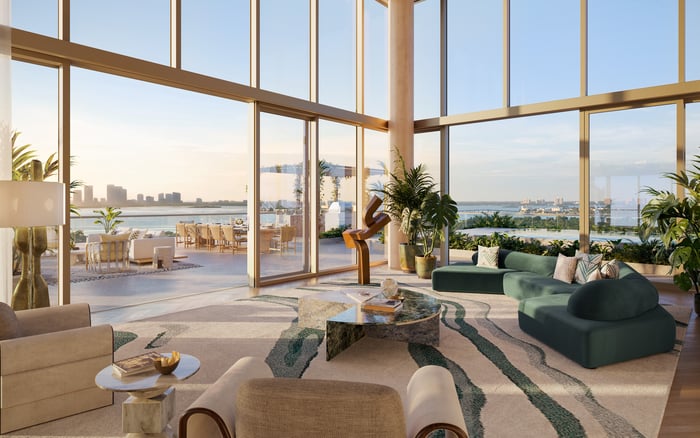
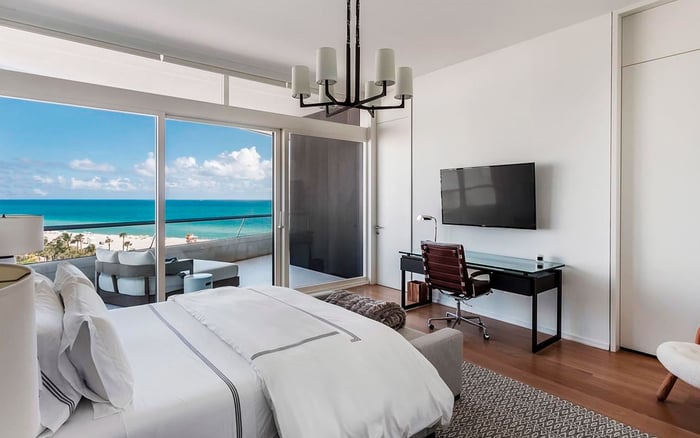
The residences emphasize expansive living, dining, and entertaining areas, with planned direct private elevator entry. Flow-through open layouts, floor-to-ceiling windows, and oversized terraces connect interior and exterior spaces. These features provide a promising framework, but the furniture plan determines how comfortably a particular household can host.
Start with the dining table the buyer actually intends to use. Check chair clearance, passage between dining and seating areas, and the route guests would take to a bathroom. Consider whether arriving guests can pause comfortably without blocking circulation or immediately entering the working kitchen.
Custom Italian kitchens with integrated Sub-Zero and Wolf appliances are part of the advertised specification. Even with restaurant catering, buyers should assess where deliveries, serving dishes, glassware, and clearing can be handled. Catering may reduce cooking demands; it does not eliminate the need for usable counter space and discreet storage.
An oversized terrace is most valuable when its intended use is clear. A host who prefers aperitifs outside may prioritize conversational seating and an easy connection to the living room. Someone planning outdoor meals should evaluate the proposed table arrangement, access, and the practicalities of moving food between spaces.
Avoid counting every exterior square foot as dependable dinner-party capacity. Test furniture placement and circulation against the actual plan, and ask about building rules relevant to the intended use. The question is whether the terrace supports the household’s recurring occasions, not whether it looks generous in isolation.
For buyers also considering 57 Ocean Miami Beach, the same exercise provides a consistent basis for comparison: separate interior dining needs, outdoor entertaining preferences, and expectations of building services. Evaluate each property on its own documented offering rather than assuming an equivalent hospitality program.
The Perigon’s advertised in-residence dining and catering are particularly relevant to owners who want to entertain privately without preparing every course themselves. Before treating those services as substitutes for additional space, establish how they would work for the household’s usual gatherings.
Ask about menus, ordering notice, service hours, catering charges, and whether service includes setup, staff, or clearing. For Nota, FiftyThree, and the shared lounges, confirm capacity, reservation procedures, guest limits, private-event availability, and any restrictions on exclusive use. Confirm delivery status and operating arrangements as well; a marketed amenity is not proof of an available service today.
A comparison that includes Faena House Miami Beach should apply the same discipline. Keep the household’s hosting requirements constant, then establish which private rooms and documented services meet them. Amenities are most useful when their actual terms align with the owner’s habits.
Before choosing a residence, describe three recurring occasions: an informal dinner, a larger celebration, and a visit involving overnight guests. Assign each to the apartment or a building venue, then identify what must remain entirely private. This turns a broad wish to entertain into a practical space requirement.
If most dinners can comfortably take place downstairs, a buyer may place greater weight on an elegant everyday living area than on a rarely used formal dining arrangement. If celebrations must remain behind the residence’s own doors, internal capacity remains central regardless of the amenity program.
The Perigon’s proposition is therefore not simply more hospitality. It is the possibility of choosing where hospitality happens, while preserving the rooms, storage, and privacy that cannot be shared.
Explore a residence strategy shaped around your own hosting habits with MILLION.
If branded residences are on your mind — as a home or as an allocation — we would be glad to share what we are seeing, privately.
Begin a quiet conversationThe Perigon is an oceanfront condominium project at 5333 Collins Avenue in Miami Beach’s Mid-Beach area.
The oceanfront restaurant and speakeasy are marketed as exclusive to residents and their guests, rather than public dining venues.
The dining concepts are identified as Nota, the oceanfront restaurant, and FiftyThree, the residents-only speakeasy.
Michelin-starred chef Shaun Hergatt is associated with the project’s private restaurant and speakeasy program.
Yes. In-residence dining and catering from the signature on-site restaurant are advertised resident services, with operating details and charges to be confirmed.
Residents-only access does not establish exclusive reservation rights. Buyers should confirm private-event availability, capacity, guest limits, and charges.
Residences are marketed in two- to four-bedroom configurations. The appropriate choice depends on overnight guests, privacy needs, and the household’s preferred way of entertaining.
They may reduce the need to accommodate every gathering inside the residence. No measurable square-footage saving is established, and the decision depends on confirmed service terms and personal habits.
Evaluate dining-table capacity, terrace usability, kitchen staging space, guest bathrooms, storage, and circulation. Catering does not eliminate the need to receive, serve, and clear food comfortably.
Guest suites are advertised, but buyers should confirm their availability, booking terms, and charges. They should not be treated as guaranteed accommodation for visiting family or friends.