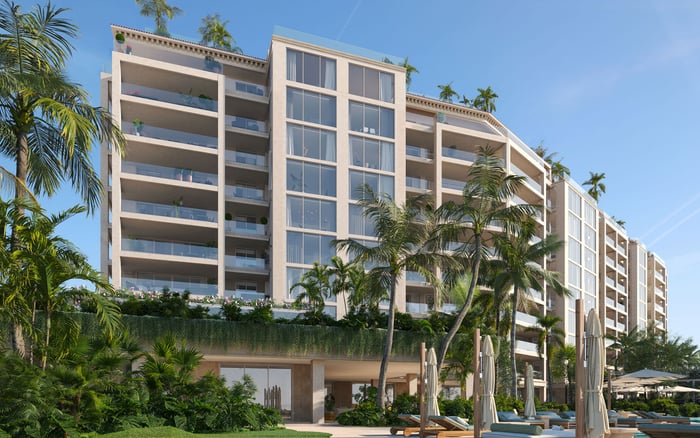
A discreet framework for preparing liquidity evidence, documenting the origin of purchase money, limiting irrelevant disclosure, and transmitting sensitive records securely when pursuing a Palazzo del Sol resale.

A purchase at Palazzo del Sol is not simply a matter of price and timing. At this level, a buyer must also demonstrate financial capacity in a way that satisfies the seller and transaction team without circulating an unnecessary portrait of private wealth.
The 43-residence condominium at 7000 Fisher Island Drive in Miami Beach was delivered in 2016, marking Fisher Island’s first major new construction in more than a decade. Developed by PDS Development LLC, with architecture by Kobi Karp and interiors by Antrobus + Ramirez, it is now a resale market in which each residence is presented through an individual listing.
That distinction matters. The evidence requested may vary with the seller, offer structure, financing plan, title process, and origin of the purchase money. Privacy is best preserved not by resisting legitimate questions, but by preparing a precise response before documents begin circulating among parties.
The discreet buyer shares enough to verify the transaction, but no more than the transaction requires.
Proof of funds answers a narrow question: does the buyer control enough accessible money to complete a cash purchase or cover the portion that will not be financed? A recent bank, brokerage, or investment statement-or a letter on a financial institution’s letterhead-may establish that capacity.
The strongest evidence ordinarily shows the account owner, institution, document date, and sufficient available liquid assets. A statement dated within the preceding 30 to 60 days generally provides clearer evidence than an older record. Illiquid holdings may not answer the same question as cash or readily accessible investments.
Source of funds addresses a different issue. It traces how the money was earned, acquired, sold, gifted, or transferred into the buyer’s control. A buyer can therefore prove ample liquidity and still receive a separate request to explain the path the specific closing funds will take.
Before sending anything, ask the broker, attorney, title company, lender, or other designated transaction professional four questions: Which records are required? How current must they be? Which fields may be redacted? Where should the documents be delivered?
This step prevents overproduction. It may also establish whether a concise bank letter will be accepted in place of complete statements. A well-framed letter can confirm ownership and sufficient liquid funds without revealing balances across unrelated accounts or a detailed transaction history.
The same discipline applies when comparing Fisher Island opportunities. A buyer considering Palazzo della Luna or The Residences at Six Fisher Island should not assume that a prior document package will automatically satisfy a different seller or closing team. Each acquisition deserves its own disclosure protocol.
Begin with the least expansive document that fully answers the request. If a bank letter is acceptable, it may be preferable to several pages of account activity. If statements are required, buyers can ask whether account numbers, unrelated transactions, and nonqualifying holdings may be redacted while leaving the owner’s name, institution, statement date, and qualifying balance visible.
Redaction must never obscure the facts being verified. The buyer’s identity, ownership of the funds, available liquidity, and relevant dates should remain clear. A heavily edited page that cannot be authenticated may invite further questions and delay the transaction rather than protect it.
A practical file can include photo identification, a current liquid-account statement or bank letter, documentation supporting the origin of funds, and any additional records specifically requested by the closing team. Labeling files by purpose, rather than sending a single unstructured financial archive, keeps the review focused.
This is especially valuable for a second-home buyer whose wealth may be distributed among operating accounts, investment portfolios, and sale proceeds. The objective is not to expose the entire balance sheet, but to present the qualifying assets and their ownership in a legible, controlled sequence.
When money comes from the sale of another property, the supporting chain may include the signed sale contract and, once available, the settlement or closing statement documenting the proceeds. Transfer records can then connect those proceeds to the account from which the Palazzo del Sol purchase will be funded.
International buyers may face a broader request. Several months of bank statements, foreign tax returns, employment evidence, sale agreements, deeds, and transfer records may be needed to establish how funds were accumulated and moved. Translations or other transaction-specific materials should be coordinated with the professionals handling the closing rather than improvised after a deadline appears.
Complexity is manageable when every movement has a corresponding record. Difficulty arises when funds pass rapidly through multiple accounts, ownership names differ without explanation, or a large deposit appears without supporting documentation. A direct, documented route into the closing account is easier to review and requires less follow-up.
For financed acquisitions, deposited funds may also require verification. Statements should show that the relevant account balance can support the deposit amount, while the lender may request further documentation based on the file.
Sensitive records should travel only through the secure channel designated by the broker, attorney, title company, lender, or financial institution. Emailing full statements broadly to every participant defeats the purpose of thoughtful redaction and increases the number of uncontrolled copies.
Ask who needs access, who will retain the records, and whether a secure portal or encrypted delivery method is available. Keep a dated copy of exactly what was submitted. If revised evidence is requested, replace the prior file cleanly rather than creating several conflicting versions.
Buyer’s guides often focus on what to provide, but custody is equally important. On Fisher Island, where alternatives such as The Links Estates at Fisher Island may involve different property and transaction structures, a disciplined document channel should be established anew for every purchase.
Palazzo del Sol’s active inventory demonstrates the scale at which preparation matters. Unit 7085 has been advertised at $28.9 million, with five bedrooms plus service quarters, 6.5 bathrooms, 7,630 square feet of interior space, and 2,471 square feet of terraces. Unit 7025 has been advertised at $23.5 million, with five bedrooms plus a study, 6.5 bathrooms, two parking spaces, two golf-cart spaces, and storage.
These examples also show why a generic letter may be insufficient. Proof should correspond to the proposed price, planned financing, deposit, and anticipated cash contribution. If an offer changes materially, refreshed evidence may be appropriate.
For buyers considering Palazzo del Sol Fisher Island, discretion is therefore an exercise in preparation: define the request, select the narrowest sufficient proof, preserve the money trail, agree on permitted redactions, and control delivery. The result is a file that communicates readiness without making private financial life part of the negotiation.
For discreet guidance on a Palazzo del Sol acquisition, connect with MILLION.
If branded residences are on your mind — as a home or as an allocation — we would be glad to share what we are seeing, privately.
Begin a quiet conversationIt shows that a buyer controls enough accessible money to complete a cash purchase or cover the portion that will not be financed.
Source of funds examines how the purchase money was earned, acquired, sold, gifted, or transferred into the buyer’s control.
Common options include recent bank, brokerage, or investment statements and a letter issued on a financial institution’s letterhead.
Statements dated within the preceding 30 to 60 days generally provide the clearest evidence.
Permitted redactions may cover account numbers and unrelated information, while the owner, institution, date, and qualifying balance should remain visible.
It can be, because an acceptable letter may confirm sufficient liquid funds without revealing a complete transaction history.
The file may require the signed sale contract and ultimately a settlement or closing statement showing the proceeds.
Requests may include several months of statements, foreign tax returns, employment records, sale documents, deeds, and transfer records.
They should be sent through the secure channel designated by the relevant broker, attorney, title company, lender, or financial institution.
No. The exact documents, acceptable age, permitted redactions, and delivery method can vary by transaction.