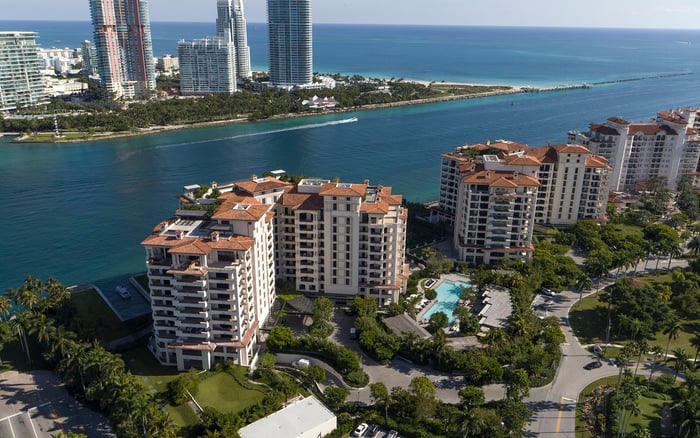
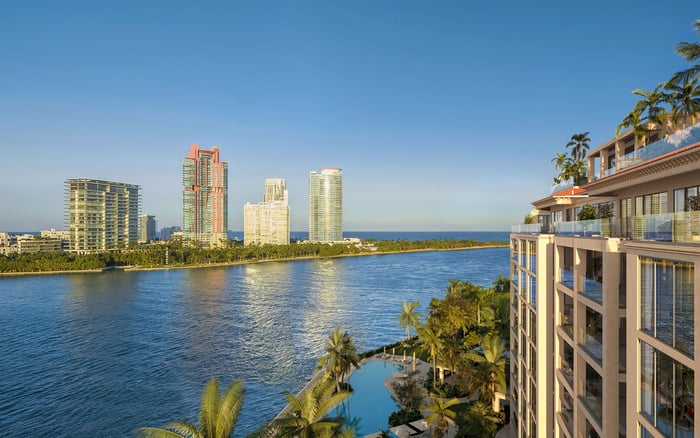
At Palazzo del Sol, a marketed parking count confirms access, not legal ownership. Buyers should trace each vehicle and golf-cart space through recorded condominium, deed, title, plat, and assignment materials before valuing it as part of a residence.

At Palazzo del Sol on Fisher Island, parking is a deceptively consequential element of residential due diligence. A marketing description may state that a home has one, two, or three spaces, perhaps supplemented by golf-cart parking or valet service. That language establishes how the property is presented, but it does not, by itself, establish the legal character of the buyer's rights.
The distinction matters because a deeded parking unit, a limited common element, and a license can all provide practical access while creating materially different outcomes for control, transfer, reassignment, assessments, and resale. For an ultra-prime buyer, the correct question is not simply, "How many spaces come with the residence?" It is, "What legal interest, if any, will be conveyed for each space?"
A parking count describes utility, while recorded documents determine the right.
This distinction is especially important in a private, car-dependent setting such as Fisher Island, where vehicle and golf-cart arrangements can shape daily convenience. Public descriptions of individual Palazzo del Sol residences do not resolve whether advertised spaces are separately owned, reserved as limited common elements, or used through an assignment or license.
A deeded space is generally structured as a separate parking unit owned in fee simple. It may have its own legal description, parcel identifier, tax bill, and assessment obligations. Depending on the condominium documents, it may also be transferable independently of the residence, although restrictions can limit who may acquire it or require it to travel with a residential unit.
A limited common element, often called an LCE, remains part of the condominium's common elements but is allocated for the exclusive use of one or more units rather than all owners. Exclusive use can feel similar to ownership in daily life, yet the holder does not own the space separately in the same manner as a deeded parking unit. The declaration, amendments, plat, plans, or schedules should identify the allocation and the residence it serves.
A license is different. It grants permission to use a space, not title to that space. Its duration, transferability, exclusivity, and susceptibility to reassignment or revocation depend on the governing language. A designation such as "assigned" does not settle the issue: assignment can describe an LCE allocation, an administrative arrangement, or another use right.
That hierarchy should frame any investment analysis. A buyer should not attribute the same permanence or independent value to all three structures merely because each permits a car to occupy a designated location today.
Available descriptions show meaningful variation in the number and type of spaces marketed with particular residences. Unit 7055 is described with one space, golf-cart parking, and valet service. Its displayed public-record information identifies a residential parcel with a 0.776% undivided interest in common elements, without displaying a separate parking parcel.
Unit 7066 is marketed with two garage spaces, assigned parking, and an electric-vehicle charging station. Unit 7061 has been described with three total or garage spaces, together with assigned, covered, golf-cart, and valet parking. Its displayed legal description addresses the condominium residence and a 1.582% undivided interest in common elements rather than identifying a separate parking unit. Unit 7043 is advertised with three vehicle spaces plus one golf-cart space, along with assigned and valet parking.
These details help establish represented utility. They are not conclusive evidence of title. The absence of a separately displayed parking parcel in a public-facing record section does not prove that a right is an LCE or a license. Nor do terms such as "garage," "covered," or "assigned" establish fee-simple ownership.
The defensible conclusion is narrow: the precise legal status of parking at Palazzo del Sol remains unconfirmed until the recorded and transaction documents connect each claimed space to the residence.
A sophisticated review begins with the condominium declaration and all relevant amendments. The buyer's Florida attorney or title professional should then reconcile the declaration with the condominium plat and plans, the proposed deed, the title commitment and exceptions, and every parking or limited-common-element schedule.
For each vehicle and golf-cart space, the file should answer several concrete questions:
Does the space have a distinct legal description and parcel identifier?
Is it shown as a parking unit, an LCE allocated to the residence, or an assigned-use area?
Is a specific space number stated consistently across the documents?
Will the right pass automatically with the residence at closing?
Can the owner sell, lease, exchange, or reassign it separately?
Can the association relocate or revoke the space, and under what conditions?
Does the space carry separate taxes, assessments, maintenance duties, or insurance consequences?
Are an EV charger, valet access, and golf-cart parking governed by separate permissions?
The answers should appear consistently in the purchase agreement and closing package. If marketing materials describe three spaces but the recorded allocation identifies fewer, the discrepancy should be resolved before the buyer treats the full count as part of the bargain.
A deeded parking unit may represent a discrete property interest, subject to transfer restrictions and separate financial obligations. An LCE can provide durable exclusive use but will generally remain tied to the condominium regime and its allocation procedures. A license may depend more heavily on association control and the precise language governing its duration or revocation.
These differences can influence financing review, title coverage, estate planning, and future buyer expectations. They can also affect how confidently a seller may later advertise a space. For resale positioning, the cleanest file allows the next buyer to trace every parking representation to an operative document.
The same discipline applies across Fisher Island. Buyers comparing Palazzo della Luna, The Links Estates at Fisher Island, or The Residences at Six Fisher Island should conduct the same project-specific inquiry rather than assume nearby properties use identical structures.
It also belongs within broader buyer's guides for Miami Beach luxury property. Parking terminology can appear standardized across listings even when the underlying rights remain highly dependent on each declaration and closing file.
Before assigning value to parking, the buyer should request a written, space-by-space explanation identifying the legal form, number, location, transfer mechanics, association authority, and financial obligations. Counsel should confirm that explanation against recorded instruments and title materials rather than simply repeat the listing description.
If the right is deeded, the conveyance and title coverage should identify it correctly. If it is an LCE, the allocation should be explicit and properly attached to the residence. If it is a license, the buyer should understand who controls it, how long it lasts, whether it follows a sale, and when it may be changed or revoked.
The objective is not to prefer one structure automatically. It is to price and negotiate the residence with an accurate understanding of what the buyer will control after closing. In luxury real estate, precision is itself an amenity.
For discreet guidance on South Florida luxury acquisitions, consult MILLION.
If branded residences are on your mind — as a home or as an allocation — we would be glad to share what we are seeing, privately.
Begin a quiet conversationNo. A listing can confirm represented parking access, but the deed, title materials, declaration, plat, and schedules must establish ownership.
It is generally a separately owned parking unit that may have its own legal description, parcel identifier, taxes, and assessments.
It is part of the condominium's common elements allocated for the exclusive use of one or more specified residences, rather than separately owned like a parking unit.
A license is permission to use a space rather than ownership. Its duration, transferability, and revocability depend on the governing documents.
No. Assigned parking may reflect an LCE allocation, an administrative assignment, a license, or another use arrangement.
Unit 7055 is described with one space, golf-cart parking, and valet service. That description does not establish the legal form of the parking right.
Unit 7061 has been described with three spaces and assigned, covered, golf-cart, and valet parking. Its displayed legal description does not identify a separate parking unit.
It may generally be transferred independently, but the condominium documents can impose restrictions on separate sales or eligible purchasers.
Review the declaration, amendments, plat, plans, deed, title materials, purchase agreement, and parking or limited-common-element schedules.
The legal form affects how confidently a seller can describe control, exclusivity, transferability, and permanence to a future buyer.