Oceana Key Biscayne offers exceptional privacy across a 10.3-acre oceanfront setting, but its expansive amenities and service model require meaningful annual spending. Buyers should evaluate unit-specific dues, inclusions, reserves and assessment history rather than assuming that fewer residences translate into lower carrying costs.
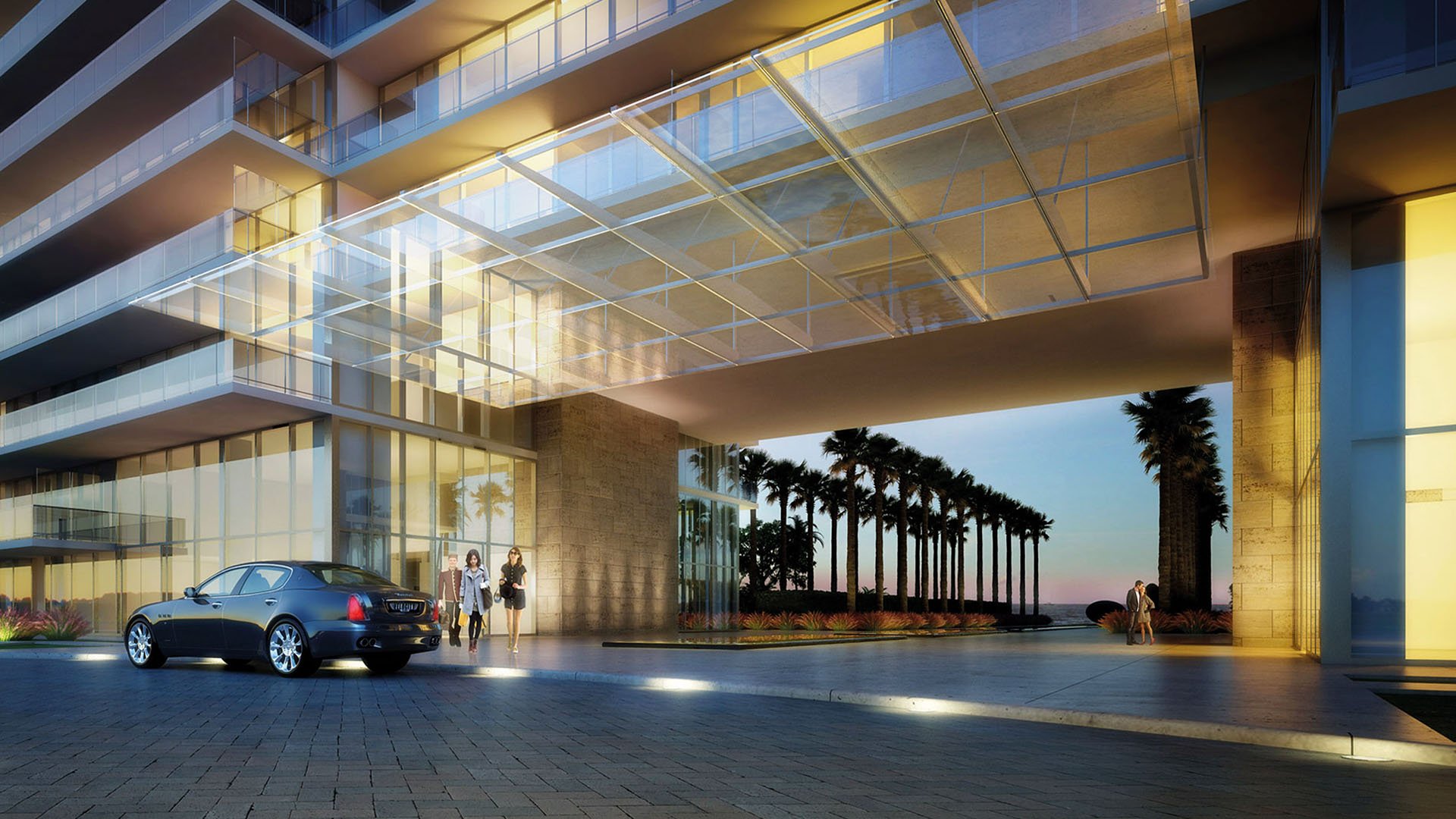
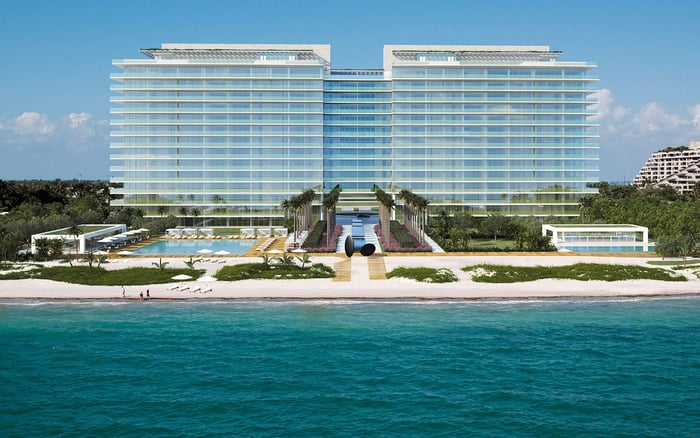
The appeal of Oceana Key Biscayne begins with space. Set on 10.3 oceanfront acres at 350 and 360 Ocean Drive, the property comprises two 14- to 15-story towers with 142 residences, plus 12 standalone villas. In total, roughly 154 homes share a substantial private realm on Key Biscayne.
For buyers accustomed to equating fewer residents with a lighter condominium budget, the arithmetic deserves closer scrutiny. Low density can deliver privacy, quieter common areas and fewer neighbors. It does not, however, make a private beach, multiple pools, full-time staffing, security or extensive landscaping less expensive to operate.
At Oceana, low density is best understood as a lifestyle benefit rather than a promise of low carrying costs.
This buyer’s-guide perspective is particularly important in South Florida, where service intensity can define the ownership experience as much as architecture. At Oceana Key Biscayne, the central question is not simply how many residences share the property, but how much infrastructure and hospitality those residences support.
The association’s annual operating budget is approximately $9 million. Divided evenly among roughly 154 residences, that would equal about $58,400 per home annually. This is only a broad mathematical average-not a forecast for any specific owner-because actual obligations depend on the condominium’s allocation formula and the residence involved.
Still, the calculation illustrates the essential point. A relatively small ownership base funds the care of 10.3 acres, approximately 500 feet of private beach and a professionally managed service platform. In a denser tower, certain fixed or semi-fixed costs may be distributed among hundreds of residences. At Oceana, fewer owners share the expense of preserving a highly private environment.
The result is an oceanfront ownership model in which exclusivity and operating costs are closely connected. Privacy has economic value, but it also reduces the number of households available to absorb the costs of staffing, insurance, maintenance and recreation facilities.
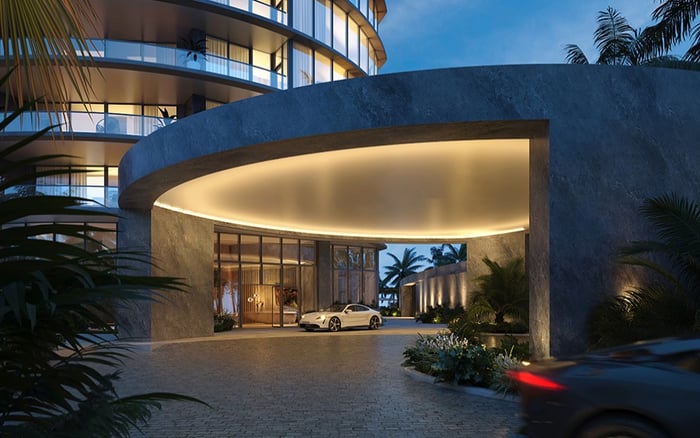
Oceana’s amenity program includes lap and relaxation pools, poolside dining, a spa, fitness facilities, tennis, a children’s center, a media room and a putting green. Its service structure also encompasses 24-hour concierge and security, gated access, beach and cabana service, valet operations, golf-cart parking and extensive landscaping.
These are not passive design features. Pools require routine care, landscaped acreage demands sustained attention and beach service depends on labor. Concierge, security and valet programs create recurring staffing obligations, while an on-site management office reflects a professionally administered property rather than a self-managed condominium.
The dues have been described as covering common-area, grounds and building maintenance, roof work, community pools and security. Other identified inclusions encompass master insurance, water, sewer, trash removal, pest control, cable and internet, common-area climate control, parking and recreation facilities. Basic cable, water, sewer and trash removal are also identified as included.
That scope matters when comparing buildings. A lower quoted fee elsewhere may exclude services or utilities included at Oceana. Conversely, in-unit electricity, contents insurance and property taxes generally fall outside the association charge and should remain separate lines in a buyer’s ownership model.
Published estimates for Oceana range from approximately $1.10 to $1.95 per square foot per month. Within that range, figures of about $1.19, $1.67 and $1.95 per square foot have circulated. The variation is too material to treat any single building-wide estimate as definitive for a purchase decision.
At $1.67 to $1.95 per square foot monthly, a 3,000-square-foot residence would imply dues of roughly $5,010 to $5,850 per month, or $60,120 to $70,200 annually. Yet individual examples demonstrate why size alone may not settle the calculation. Unit 406N has carried a stated monthly fee of $3,452, while lower penthouse LPH2S and penthouse PH1S have carried stated monthly fees of $7,175 and $8,254, respectively.
A separate building-level schedule has estimated monthly fees of $3,024 for two-bedroom residences, $4,103 for three-bedroom residences and $4,388 for four-bedroom residences. Another summary has placed condominium fees at approximately $2,818 to $3,600 per month and townhome fees at approximately $5,712 to $5,759.
These figures may reflect different dates, residence categories, allocation percentages or listing information. They should serve as orientation, not underwriting. The governing documents and current estoppel-related information for the chosen residence should control the buyer’s final model.
A prudent review begins with the latest association budget, the precise fee assigned to the residence and a clear schedule of included services. Buyers should then examine reserve information and assessment history, while separating association dues from property taxes, contents insurance and in-unit electricity.
Penthouse, villa and standard-tower residences may carry materially different obligations. Buyers should therefore resist multiplying a generic per-square-foot figure by interior area and considering the analysis complete. The unit’s allocation, parking arrangements, residence type and current association schedule warrant direct confirmation in the transaction documents.
For a broader pricing-and-trends comparison, service levels should remain constant. The relevant question is not whether another building has more homes or a lower headline fee. It is whether that fee supports a comparable level of beach access, security, staffing, insurance, utilities, maintenance and reserves.
Buyers considering Oceana Bal Harbour or Eighty Seven Park Surfside may include them in a coastal comparison set, while Park Grove Coconut Grove can provide another reference point for luxury condominium ownership. Each comparison should be normalized for what the association actually provides rather than reduced to a single monthly number.
Oceana Key Biscayne presents a distinctive lifestyle proposition: a limited number of residences, substantial grounds, private beach frontage and a broad amenity and service program. The same qualities that preserve privacy also concentrate operating responsibility among roughly 154 homes.
That does not make the fees inherently excessive or inappropriate. It means they should be understood as the price of a particular ownership structure. For the right buyer, the combination of acreage, beach service, recreation and professional management may justify the carrying cost. The disciplined approach is to value those benefits explicitly and verify the residence-specific obligation before signing a contract.
For confidential guidance on evaluating Oceana and comparable South Florida residences, connect with MILLION.
If branded residences are on your mind — as a home or as an allocation — we would be glad to share what we are seeing, privately.
Begin a quiet conversationThe property has 142 tower residences and 12 standalone villas, for roughly 154 homes in total.
Oceana occupies approximately 10.3 oceanfront acres at 350 and 360 Ocean Drive.
The condominium association has an annual operating budget of approximately $9 million.
A simple division across roughly 154 homes equals about $58,400 annually per residence, although actual charges depend on the applicable allocation formula.
Published estimates range from approximately $1.10 to $1.95 per square foot per month, making unit-specific verification essential.
At $1.67 to $1.95 per square foot monthly, estimated dues would be about $5,010 to $5,850 per month.
The property supports private beach service, pools, dining, spa and fitness facilities, tennis, children's spaces, a media room and a putting green.
The service program includes 24-hour concierge and security, gated access, valet, beach and cabana service, landscaping and on-site management.
In-unit electricity, property taxes and contents insurance generally are not included and should be budgeted separately.
Buyers should obtain the latest budget, reserve information, assessment history, inclusion schedule and fee assigned to the specific residence.