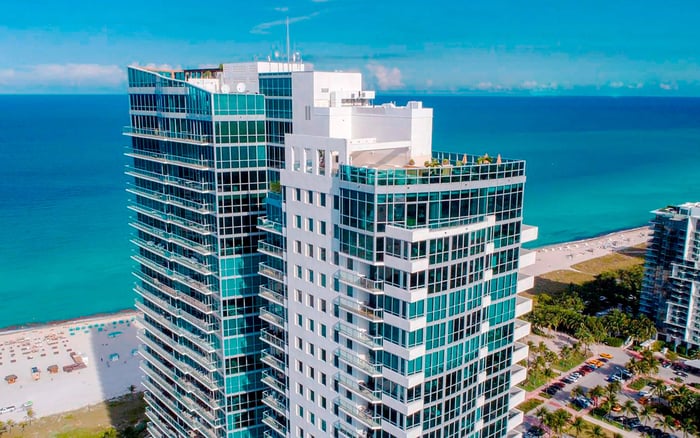
An Apogee South Beach purchase calls for a coordinated review of the association’s master policy, owner-responsible interiors, and loss-assessment wording. The essential distinction is between an assessment the association can levy and a loss the owner’s insurer will reimburse.

A purchase at Apogee South Beach deserves an insurance review as deliberate as the evaluation of the residence itself. The question is not simply whether the association carries insurance, but how the master policy, the buyer’s HO-6 policy, and its loss-assessment provisions respond to the same event-and which expenses remain with the owner.
Treat this as a Florida condominium insurance framework for an Apogee purchase, not confirmation of the building’s current coverage. Before committing to limits, have your insurance adviser review the actual master policy and endorsements alongside the proposed unit-owner policy. Insured values, deductible calculations, exclusions, and assessment allocation all belong in that review.
The essential distinction is between an assessment the association can levy and a loss the owner’s insurer will reimburse. Those amounts are not necessarily the same, even when both policies respond to the underlying damage.
Florida’s condominium insurance framework generally places the structure, roof, common elements, and originally installed building components within the association’s required property coverage, subject to specified interior exclusions. Calling that arrangement “walls-in” is insufficient. The excluded items-not the shorthand-establish the starting point for a buyer’s review.
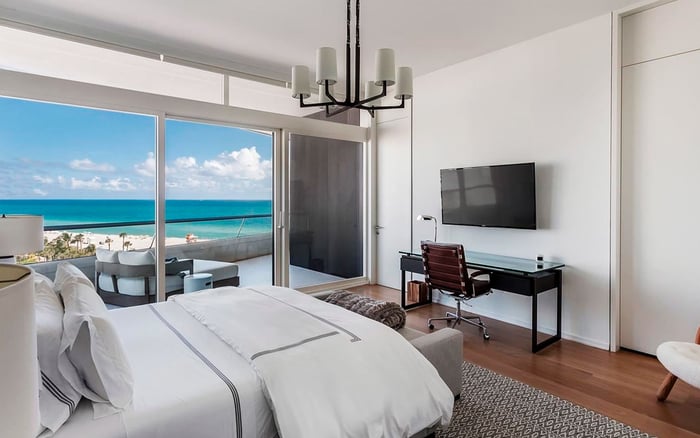
Floor, wall, and ceiling coverings; cabinets; countertops; appliances; water heaters; and window treatments are excluded from the association’s required property coverage. In a carefully finished residence, these categories warrant an itemized replacement-cost review. A generic interior allowance may bear little relationship to the cost of replacing owner-responsible finishes and upgrades.
Furniture, electronics, art, and other personal belongings also fall outside the association’s master property coverage. Review contents protection separately from the amount allocated to interior finishes. A substantial interior limit does not confirm that every possession is adequately insured.
For buyers also considering Faena House Miami Beach, the same discipline applies: value each residence’s owner-responsible property rather than applying a generic insurance allowance across a Miami Beach shortlist. This is a purchasing principle, not a comparison of the buildings’ policies.
An association may assess owners for their share of a master-policy deductible or a covered loss exceeding the master policy’s limits. Associations also have statutory authority to levy and collect assessments to maintain, repair, and replace common elements. Insurance proceeds therefore do not necessarily settle an owner’s entire financial obligation after damage.
Percentage-based hurricane or windstorm deductibles require particular attention. The percentage is only part of the calculation; the insured value to which it applies determines the dollar exposure. Ask the association’s insurance representative to identify the calculation basis and explain the resulting deductible exposure.
Next, establish how an assessment would be allocated to the residence under review. Do not assume an equal division among units or infer the allocation from the purchase price. Request the applicable allocation and have your adviser connect it to the deductible calculation.
Keep deductible exposure separate from losses above the master limit. Both can create an assessment, but they may receive different treatment under an HO-6 endorsement. That distinction is why the policies must be read together, not merely compared by their headline limits.
Florida Statute §627.714 requires residential condominium unit-owner policies issued or renewed on or after July 1, 2010, to include at least $2,000 in property loss-assessment coverage. This coverage is included in qualifying policies; it is not a separate mandatory insurance purchase.
The statutory minimum applies to all assessments arising from the same direct property loss, regardless of how many assessments are issued. The loss-assessment deductible may be no greater than $250 per direct property loss. Multiple assessment notices following one event do not each create a new statutory minimum benefit.
For a single loss, the applicable insurance recovery limit is the loss-assessment limit in effect one day before the occurrence. That limit restricts insurance recovery, not the association’s authority to assess an owner. The statutory coverage is also excess over amounts recoverable under other policies covering the same property.
The $2,000 minimum may be inadequate for a major condominium loss. An appropriate limit should reflect potential exposure and available policy terms-not an assumption that statutory compliance means sufficient protection.
A higher loss-assessment limit can be useful, but only within the protection the endorsement actually grants. Wording limited to losses exceeding the master policy’s limits can exclude an assessment imposed solely to satisfy the master deductible. A higher limit does not remove that restriction.
Ask your adviser to identify the language addressing deductible assessments separately from the language addressing losses above master limits. Request an explanation tied to the actual master deductible and proposed HO-6 endorsement, rather than a general assurance that loss-assessment coverage is included.
If Continuum on South Beach is another purchase candidate, repeat that paired review with its documents. A satisfactory answer for one residence should not be carried over to another association without examining its policy and allocation terms.
Loss-assessment coverage is not blanket protection against special assessments. Payment depends on an insured loss and the unit-owner policy’s terms. Routine maintenance, reserve replenishment, and milestone-related repairs without a covered loss generally fall outside this protection.
The cause of damage matters as much as the assessment’s purpose. Loss-assessment coverage does not automatically overcome a flood exclusion or another excluded peril in the unit-owner policy. A larger limit cannot turn an excluded cause of loss into a covered one.
Depending on the wording, loss-assessment provisions may address damage to shared facilities and certain association liability claims. Florida’s $2,000 statutory requirement, however, concerns property loss assessments. Keep property and liability questions distinct when asking what an endorsement provides.
Before completing a purchase, assemble the master policy, endorsements, insured values, deductible schedule, and applicable owner-assessment allocation. Review them alongside a proposed HO-6 policy that reflects the residence’s replacement-cost needs. Ask your insurance adviser to explain how the documents interact, with legal guidance on assessment obligations where needed.
For buyers weighing Apogee against Five Park Miami Beach, this provides a disciplined way to evaluate insurance exposure without presuming equivalent coverage. The objective is not to eliminate every ownership risk, but to distinguish insured protection from the financial obligations you may retain.
For a discreet conversation about your next South Florida residence, connect with MILLION.
If branded residences are on your mind — as a home or as an allocation — we would be glad to share what we are seeing, privately.
Begin a quiet conversationNo. It presents a Florida condominium insurance framework; the building’s actual master policy, endorsements, deductible schedule, and allocation terms must be reviewed for a purchase.
The framework generally assigns the structure, roof, common elements, and originally installed building components to the association’s required property coverage, subject to specified interior exclusions.
The exclusions include floor, wall, and ceiling coverings; cabinets; countertops; appliances; water heaters; and window treatments. Owner-responsible finishes and upgrades should be evaluated at replacement cost for HO-6 coverage.
Furniture, electronics, art, and other personal belongings are outside the association’s master property coverage. They require appropriate unit-owner contents protection.
Qualifying residential condominium unit-owner policies issued or renewed on or after July 1, 2010, must include at least $2,000. That statutory minimum may be inadequate for a major loss.
No. The statutory minimum applies to all assessments arising from the same direct property loss, with a loss-assessment deductible no greater than $250 for that loss.
The applicable insurance recovery limit is the limit in effect one day before the occurrence. It is not a cap on the association’s assessment against an owner.
Not necessarily. Wording limited to losses exceeding master-policy limits can exclude assessments imposed solely to satisfy the master deductible.
Assessments for reserve replenishment, routine maintenance, or milestone-related repairs without a covered loss generally fall outside loss-assessment protection.
No. The cause of damage must be covered under the unit-owner policy, and a higher limit does not eliminate a flood or other peril exclusion.