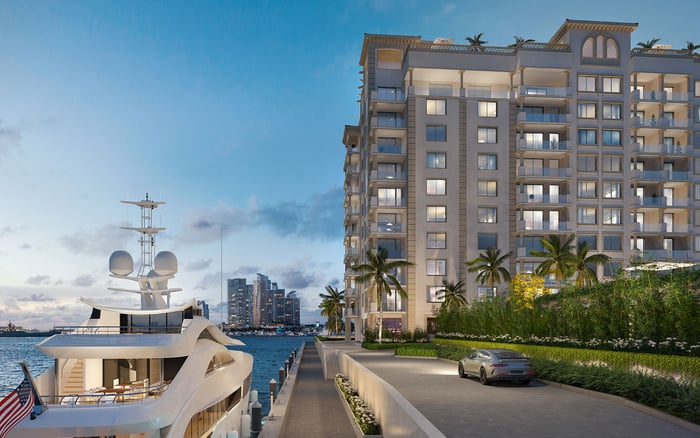
For Milan-based buyers, Fisher Island due diligence should treat replacement cost, association assessments, and personal umbrella liability as distinct but coordinated decisions.

A move from Milan to Fisher Island involves more than selecting a residence and arranging a transatlantic household. The property decision should begin with a clear allocation of risk among the condominium association, the unit owner, and any personal excess-liability program. Each layer responds to different events; none should be expected to compensate for weaknesses in another.
Florida condominium associations must maintain adequate property insurance for condominium property. That obligation applies regardless of contrary language in a declaration, and adequate coverage may be based on full insurable value or replacement cost established through an independent insurance appraisal or updated appraisal. For a buyer, however, the existence of a master policy is only the starting point. Limits, deductibles, exclusions, valuation dates, and ordinance-or-law protection determine how the arrangement may perform after a loss.
This Buyer's Guides perspective is particularly relevant when comparing condominium offerings such as The Residences at Six Fisher Island with an estate proposition such as The Links Estates at Fisher Island. The form of ownership and governing documents shape the insurance questions that must be resolved before contract and closing.
The correct insurance structure begins with reconstruction exposure, not purchase price.
A Fisher Island acquisition price reflects location, scarcity, views, privacy, amenities, and market demand. An HO-6 dwelling limit serves a different purpose: it should reflect the cost of reconstructing unit components that the association policy does not insure, including high-end finishes and other owner-responsible property, rather than the residence's market value.
The association policy generally covers condominium property and components originally installed or replaced with like kind and quality. It generally excludes unit-specific floor, wall, and ceiling coverings; electrical fixtures; appliances; water heaters; built-in cabinets; countertops; window treatments; and personal property. In a highly customized interior, these exclusions can amount to a substantial reconstruction commitment.
Before committing to a residence at Palazzo del Sol or Palazzo della Luna, a buyer should commission a room-by-room replacement-cost analysis. The exercise should account for bespoke cabinetry, stone, millwork, lighting, integrated appliances, window treatments, and the logistics of sourcing comparable materials. It should also distinguish insurable reconstruction from furniture, art, jewelry, wine, and other personal property that requires separate treatment.
The latest replacement-cost appraisal should be reviewed alongside the master-policy declarations, wind deductible, exclusions, ordinance-or-law coverage, and assessment history. A large headline policy limit does not, by itself, reveal the owner's probable out-of-pocket exposure.
Post-hurricane assessments can arise from master-policy deductibles, inadequate insured values, coinsurance consequences, or code-upgrade costs beyond available ordinance-or-law coverage. Unit owners also bear reconstruction costs for the portions they are required to insure. If the association performs work on those portions, it may charge the cost to the owner as an assessment.
The review should test both the building's insurance and the association's capacity to absorb uninsured costs. Request evidence of the appraisal supporting the insured value, policy schedules, deductible-allocation language, open or recent claims, and the history of insurance-related assessments. An owner is liable for assessments coming due during ownership regardless of how title was acquired, making timing and pending association action important closing issues.
For a Waterfront property approached as an Investment or Second-home, this review warrants the same attention as title, condition, and ownership structure. Insurance is not merely an annual expense; it is part of the residence's potential capital-call profile.
Loss-assessment coverage is property coverage for association assessments resulting from damage to collectively owned property caused by an insured peril. Florida unit-owner residential property policies issued or renewed on or after July 1, 2010, must include at least $2,000 of property loss-assessment coverage. The required coverage carries a deductible of no more than $250 per direct property loss, with no additional deductible when the owner has already paid one for the same loss.
That minimum should not be mistaken for an assessment forecast. It can be materially lower than an assessment at a coastal condominium, so the buyer should evaluate higher optional limits against the building's deductible structure, unit count, governing documents, and assessment history.
Coverage is also conditional. The assessment must arise from a covered type of direct loss to property collectively owned by association members. Multiple assessments generated by the same direct loss share the applicable policy limit rather than producing a new limit for each assessment. Further, the maximum recoverable amount is controlled by the limit in effect one day before the underlying loss, even when the association levies the assessment later. Adequate limits must therefore be in place before an event, not added in response to it.
Loss-assessment coverage does not replace personal excess or umbrella liability protection. The former addresses qualifying property assessments; the latter is designed around liability exposures and should be coordinated with the underlying policies above which it sits.
There is no supplied Florida minimum personal umbrella limit that provides a universal answer. The appropriate structure should be tailored to whether the Fisher Island residence is primary or seasonal, the limits carried on home and auto policies, watercraft use, household staff, entertaining, and other personal exposures. Ownership through an entity does not eliminate the need for this analysis. Insured names across underlying and umbrella policies should align with the legal ownership and household arrangements.
The association's liability insurance is another distinct layer. It protects association interests connected with association property, funds, and common elements. It should not be interpreted as personal umbrella protection for an individual unit owner.
Before the due-diligence period expires, the buyer's Florida insurance adviser and counsel should review the declaration, insurance provisions, current master policies, appraisal, deductible allocation, excluded property, ordinance-or-law limits, assessment history, and any known claim activity. The unit reconstruction estimate can then inform HO-6 dwelling coverage, personal-property schedules, temporary living arrangements, and optional loss-assessment limits.
Prompt reporting procedures also matter. An association may avoid treating repairs as a common expense when an owner knew of damage but failed to report it until after the association's claim was settled or denied as untimely. A Milan-based owner should establish who will inspect the residence, receive notices, document damage, and notify the appropriate parties during absences.
Italian tax, estate, and ownership-structure advice should be coordinated with Florida legal and insurance advice before buying personally or through an entity. The objective is not to force different jurisdictions into a single solution, but to ensure that title, succession planning, policy names, and liability protection do not contradict one another.
A disciplined comparison looks beyond premium quotations. It asks what the association insures, what the owner must rebuild, how a major deductible could be allocated, which assessments would qualify for coverage, and which personal liabilities require a separate umbrella. The most suitable Fisher Island residence is one whose design appeal and ownership structure are matched by an intelligible, fundable risk plan.
For discreet guidance on aligning a Fisher Island search with informed property due diligence, connect with MILLION.
If branded residences are on your mind — as a home or as an allocation — we would be glad to share what we are seeing, privately.
Begin a quiet conversationMarket value includes location and demand, while the HO-6 dwelling limit should reflect the replacement cost of owner-insured finishes and unit components.
It generally covers condominium property and components originally installed or replaced with like kind and quality, subject to the policy and governing documents.
Common exclusions include unit-specific coverings, electrical fixtures, appliances, water heaters, cabinets, countertops, window treatments, and personal property.
Review the latest replacement-cost appraisal, master-policy limits, wind deductible, exclusions, ordinance-or-law coverage, and assessment history.
It is property coverage for qualifying association assessments caused by an insured direct loss to collectively owned property.
Applicable unit-owner residential property policies must include at least $2,000 of property loss-assessment coverage.
No. Multiple assessments arising from the same direct loss share the applicable loss-assessment limit.
An increase after the event will not change the maximum for that loss, which is governed by the limit in effect one day before the underlying loss.
No. Loss-assessment coverage addresses qualifying property assessments, while umbrella protection addresses personal liability exposures.
The owner should establish local inspection, notice, documentation, and prompt claim-reporting procedures for the residence.