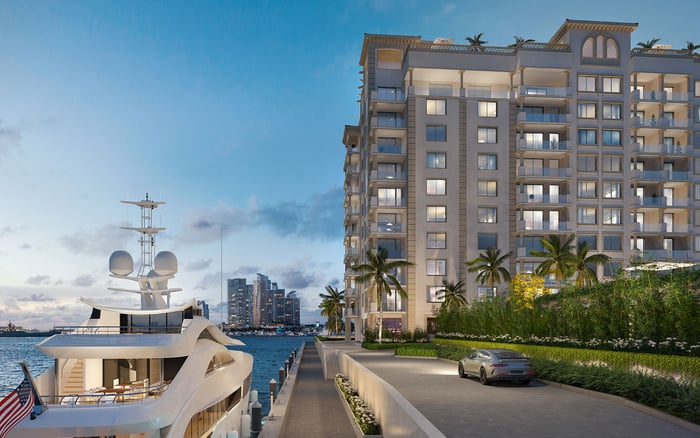
A disciplined acquisition plan for Kuwait-based buyers aligning KWD/USD conversion, proof of funds, escrow deadlines, association documents, and island access.

A move from Kuwait City to Fisher Island is not simply a residence search followed by a wire. It is a coordinated exercise in currency conversion, documentary clarity, escrow control, association timing, and physical access. An elegant result depends on bringing those workstreams together without forcing any one of them into a last-minute decision.
For a cash acquisition, the buyer should begin by confirming what the seller, title company, closing agent, and, if relevant, lender will accept as proof of funds. There is no single universal Fisher Island form. A recent bank statement showing liquid assets or a bank letter on official letterhead is commonly accepted. Ideally, the document should be dated within 30 days and identify the account owner, institution, and available balance.
This first package establishes capacity. A second file should establish provenance: statements from the originating Kuwait account and records explaining how the capital accumulated or entered that account. International transfers can trigger source-of-funds and anti-money-laundering review, so a clear documentary chain is not administrative excess. It is essential to protecting the closing timetable.
The strongest strategy separates the market decision, currency decision, and closing deadline.
The exchange-rate decision deserves its own plan. The official U.S. dollar rate against the Kuwaiti dinar gives buyers a benchmark for comparing the rate, spread, and execution terms offered by their bank. The relevant question is not merely whether the displayed rate appears favorable. It is how much USD will reach escrow after conversion costs, transfer charges, and any intermediary-bank deductions.
Large conversions may require a bank treasury desk rather than an ordinary retail transfer channel. At some Kuwait banks, foreign-exchange deals above USD 100,000 or the equivalent receive treasury handling. Exchange companies are also prohibited from accepting cash for transactions above KD 3,000, or its foreign-currency equivalent, in one day; larger amounts must move through a bank-account deduction or another permitted method. A Fisher Island acquisition should therefore be structured from inception as a documented banking transaction.
A practical policy defines the target USD requirement, the acceptable conversion window, the person authorized to approve execution, and a reserve above the expected closing figure. That reserve can prevent a minor fee or adjustment from creating a funding shortfall. Buyers should decide with their banking, legal, and tax advisers whether to convert in one transaction or in stages. The strategy does not depend on a rate forecast. It favors decision rules over speculation.
The cleanest proof-of-funds file answers four questions without ambiguity: who owns the account, where the funds are held, how much is liquid, and when the evidence was issued. If privacy is a concern, the buyer’s advisers can ask whether irrelevant account activity may be redacted while preserving the information required for review. The recipient’s approval should be obtained before anything is obscured.
A residence strategy for this market should distinguish proof of funds from source of funds. The former demonstrates purchasing capacity. The latter explains the capital trail and may become relevant when the international wire is reviewed. Names and ownership structures should remain consistent across the offer, escrow record, bank account, and closing documents-or be explained early through the appropriate advisers.
The chosen residence also shapes coordination. A buyer considering Palazzo del Sol or Palazzo della Luna should have counsel and the closing agent confirm the precise association, approval, estoppel, and document requirements applicable to that transaction. Project selection does not replace transaction-specific diligence.
International closing funds are generally wired to the closing agent’s escrow account and disbursed only after the required documents and conditions are satisfied. Cross-border wires should be initiated several business days early because intermediary banks and compliance checks can cause delays. The contractual deadline-not the buyer’s instruction date-is the controlling operational concern.
Before releasing funds, verify wire instructions by telephone using a previously known number. Do not rely solely on emailed instructions, even if the message appears familiar. The buyer’s team should then confirm that the correct net amount has reached escrow and determine whether any balance remains due.
A disciplined closing sequence is straightforward:
Assemble current proof of funds and the complete source-of-funds file.
Confirm the USD amount, conversion authority, banking route, and reserve.
Approve final closing figures with the closing agent and advisers.
Verify escrow instructions by telephone through a known contact.
Initiate the international transfer several business days before it is due.
Confirm cleared receipt and satisfaction of all disbursement conditions.
For an investment or second-home purchase, this discipline also keeps the acquisition decision separate from currency emotion. A favorable residence negotiation should not be undermined by waiting for an ideal exchange-rate moment that may conflict with the contract.
The financial closing is only one calendar. A Fisher Island association estoppel should be requested early because the association has 10 business days after a written or electronic request to issue it. The title company or closing agent should track the estoppel alongside escrow, documents, approvals, and other conditions rather than treating it as an end-stage formality.
Buyers evaluating The Residences at Six Fisher Island or The Links Estates at Fisher Island should also separate project evaluation from broader island diligence. Fisher Island’s governance environment includes active federal land-use litigation concerning an attempted public acquisition of island land. Separately, a development venture paid $180 million for a 9.6-acre waterfront property in 2025. Neither point determines the merits of a particular home, but both reinforce the value of current legal, title, association, and planning review.
Fisher Island has no road or highway connection to the mainland. Access is by yacht or private 24-hour passenger ferry, which departs from Terminal Island Road along the MacArthur Causeway. Inspections, appraisers, designers, vendors, movers, and closing-related visits therefore require authorization and transport planning. Ferry schedules and access details can be coordinated through FICA Public Safety at 305-535-6022.
A waterfront residence here should be approached as both a private-home acquisition and a logistics plan. The island’s gated-community character affects the handover itself. Keys, staff entry, deliveries, insurance inspections, contractor visits, and move-in dates should be scheduled independently of the funds transfer. Financial completion does not automatically mean every vendor can arrive without prior coordination.
The buyer’s representative should maintain one master calendar covering document expiry, conversion approval, wire initiation, estoppel delivery, association steps, inspection access, closing, and possession. Each item needs an owner and a fallback. That structure preserves discretion while reducing avoidable urgency.
For a Kuwait-based buyer, the most controlled sequence is to document capital first, set the KWD/USD execution policy second, negotiate with current proof of funds, open association and title work promptly, fund escrow early, and organize island access on a separate track. The objective is not speed at any cost. It is a composed closing in which the residence, currency, documents, and arrival plan align.
For discreet guidance on Fisher Island opportunities and acquisition planning, connect with MILLION.
If branded residences are on your mind — as a home or as an allocation — we would be glad to share what we are seeing, privately.
Begin a quiet conversationA recent bank statement showing liquid assets or a bank letter on official letterhead is commonly used. It should preferably be dated within 30 days and identify the owner, institution, and available balance.
No. Proof of funds demonstrates purchasing capacity, while source-of-funds records explain how the capital accumulated or entered the originating account.
The buyer should establish a conversion window and approval process before the contractual funding deadline. The decision should account for the benchmark rate, bank pricing, fees, and timing risk.
Not always. Large foreign-exchange transactions may require advance coordination with a bank treasury desk, depending on the institution's procedures.
They should generally be initiated several business days early. Intermediary banks and compliance reviews can delay cross-border wires.
Closing funds are generally wired to the closing agent's escrow account. They are disbursed after the required documents and closing conditions are satisfied.
Verify them by telephone using a previously known number. Do not rely solely on instructions received by email.
The association is reported to have 10 business days after a written or electronic request to issue it. Early ordering protects the broader closing schedule.
There is no road or highway connection to the mainland. Access is by yacht or the private 24-hour passenger ferry departing from Terminal Island Road.
They should be coordinated on a parallel track. Vendor authorization, ferry access, deliveries, inspections, and possession can require separate scheduling.