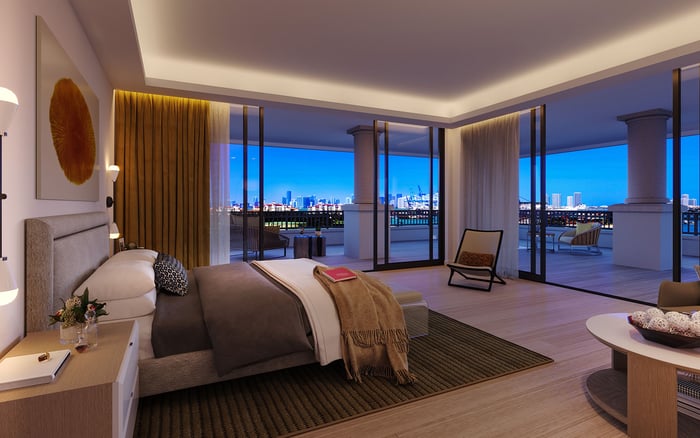
A buyer-focused analysis of how rental restrictions at Palazzo del Sol align with full-time, privacy-minded ownership on Fisher Island.

At Palazzo del Sol, the rental conversation is not a side note. It is central to the larger question a serious Fisher Island buyer should ask before committing: do the building’s rules reinforce the way you actually intend to live?
For a full-time or majority-time owner, rental restrictions can feel less like a limitation and more like a quiet luxury. The appeal of Palazzo del Sol is tied to its private-island setting, controlled access, security culture, and expectation that daily life remains residential rather than transient. In that context, lease policy is not simply about whether income can be produced during unused months. It shapes who circulates through the lobby, how predictable the elevator experience feels, how amenities are used, and whether neighbors remain familiar over time.
This is the practical distinction. A mainland condominium may absorb brief waves of tenant turnover with relative anonymity. A private-island condominium makes change more visible. Arrival, access, guest handling, service coordination, club use, ferry movement, and amenity demand all become part of the lived environment. For the Palazzo del Sol Fisher Island buyer who expects continuity, that distinction matters.
Fisher Island is not a conventional waterfront address where ownership begins and ends at the building entrance. It is a broader ecosystem of access, security, services, club life, and shared infrastructure. That makes rental-rule fit a lifestyle issue as much as a legal or financial one.
A buyer comparing Palazzo della Luna, The Residences at Six Fisher Island, or other island residences is often choosing a rhythm, not just a floor plan. The strongest fit tends to favor owners who want privacy, low turnover, and a measured residential atmosphere. The less suitable buyer is one who needs frequent leasing flexibility as a primary part of the acquisition thesis.
As a search category, Fisher Island ownership is less about maximizing optionality and more about preserving control. That does not mean a buyer should assume rentals are prohibited, unrestricted, or simple. It means diligence should focus on the exact framework: minimum lease terms, lease frequency, application procedures, approval rights, association discretion, move-in rules, and enforcement history.
Full-time owners typically experience rental restrictions differently from investors. If a residence is your primary home, or a key base for much of the year, the value of predictability can be substantial. A stricter leasing culture can reduce the hotel-like feeling that sometimes emerges when occupants change often, especially in buildings where amenities and staff are central to the ownership experience.
That predictability extends beyond the front desk. It affects how residents use pools, fitness spaces, service elevators, valet areas, package rooms, private dining, and shared social spaces. On Fisher Island, it can also influence the broader cadence of ferries, restaurants, club facilities, and recreation areas. Higher transient occupancy can place subtle pressure on systems designed for a private residential community.
This is where the rental-restriction question becomes highly personal. If you want occasional flexibility because you travel, lease rules may still be compatible with ownership. If your plan depends on frequent or short-duration occupancy changes, Palazzo del Sol may feel misaligned with the private-island promise that attracted you in the first place.
Second-home buyers often sit between full-time residents and pure investors. They may spend meaningful time in South Florida while still wanting the option to lease during select periods. For this group, the right question is not, “Can I rent?” It is, “Can I rent in a way that fits the building’s culture, approval process, and practical calendar?”
Long-term rentals, if contemplated, should be evaluated with the same care as carrying costs, club obligations, insurance, and maintenance expectations. A lease that looks attractive on paper may be less useful if approval timelines, minimum terms, or annual limits do not align with the owner’s travel schedule. Conversely, a more restrictive structure may be entirely acceptable if the residence is intended primarily for personal use.
The best fit is the buyer who views restrictions as a feature of ownership. In that framing, rules help protect privacy, continuity, and the residential character that private-island buyers often prioritize. This is also why a gated-community mindset is useful here. The value is not just inside the residence; it is in the controlled nature of the environment around it.
Investment analysis at Palazzo del Sol should be disciplined. Rental income may be relevant, but it should not be the only pillar supporting the purchase. Buyers seeking maximum leasing flexibility may find more permissive luxury buildings in Miami or Miami Beach better aligned with their objectives.
Residential logic asks a different set of questions. Will the building feel calm when you arrive after a long flight? Will staff recognize residents and recurring guests? Will amenity spaces feel curated rather than overrun? Will access protocols support privacy without becoming inconvenient? These are not abstract preferences in an ultra-prime private-island market. They are part of the reason buyers consider Fisher Island in the first place.
For some purchasers, The Links Estates at Fisher Island may enter the conversation as a broader island comparison, particularly when privacy and a more estate-like ownership profile are priorities. The same principle applies: leasing flexibility should be weighed against the desired daily experience, not treated as a separate spreadsheet line.
Before signing, a buyer should review the current condominium declaration, bylaws, rules and regulations, lease application procedures, minimum lease terms, annual lease-frequency limits, approval rights, and any applicable move-in or administrative requirements. These documents can change, and informal impressions should never replace current association materials and legal review.
The most useful diligence is practical. Ask how long lease approvals typically take, what information prospective tenants must submit, whether board or management consent is required, how renewals are handled, and how strictly violations are addressed. Also ask how leasing interacts with Fisher Island access, club privileges, guests, service providers, and amenity use.
A refined buyer does not need to fear restrictions. The goal is alignment. If the residence will be used frequently, and if privacy, security, and a stable neighbor environment are central to the purchase, the rules may support the very lifestyle being acquired. If the residence is expected to operate like a flexible rental asset, the fit deserves closer scrutiny.
Palazzo del Sol is best understood as an ultra-prime private-island condominium for buyers who value control, privacy, and a consistent residential atmosphere. Rental restrictions should therefore be interpreted through the lens of use. For full-time owners, they may preserve quality of life. For majority-time owners, they may be manageable with careful planning. For income-driven investors, they may reduce flexibility.
The strongest buyer profile is someone who wants Fisher Island to feel like home, not a rotating hospitality environment. In that case, a tighter leasing culture is not merely a rulebook constraint. It is part of the architecture of discretion.
Is Palazzo del Sol better suited to full-time owners than frequent renters? Yes. The ownership profile is more naturally aligned with residents who prioritize privacy, stability, and controlled access over frequent leasing.
Are rentals allowed at Palazzo del Sol? Buyers should confirm the current rules in the condominium documents. The key issue is not only whether rentals are allowed, but how they are limited and approved.
Why do rental restrictions matter more on Fisher Island? The island setting makes access, security, ferry movement, club use, and resident privacy part of the ownership experience. Turnover can be more noticeable than in open-access mainland buildings.
Should a buyer rely on verbal guidance about lease rules? No. Current condominium documents, rules, application procedures, and legal review should guide any purchase decision.
Can rental restrictions be a positive feature? For full-time owners, yes. Restrictions can help reduce transient activity and preserve a more residential atmosphere.
What documents should be reviewed before buying? Review the declaration, bylaws, rules and regulations, lease procedures, minimum terms, annual lease limits, and approval rights.
Is Palazzo del Sol ideal for rental-income investors? It may be less suitable for buyers who require maximum leasing flexibility. The building is better matched to personal-use and privacy-driven ownership.
How should second-home buyers think about leasing? They should test whether the rules align with their travel patterns and intended use. Occasional flexibility may differ greatly from frequent leasing dependence.
Do lease rules affect amenities? They can. Lower turnover may support more predictable use of shared amenities, staff services, and island infrastructure.
What is the core buyer fit for Palazzo del Sol? The best fit is a buyer who values privacy, controlled access, low turnover, and residential stability more than rental optionality.
To compare the best-fit options with clarity, connect with MILLION.
If branded residences are on your mind — as a home or as an allocation — we would be glad to share what we are seeing, privately.
Begin a quiet conversation