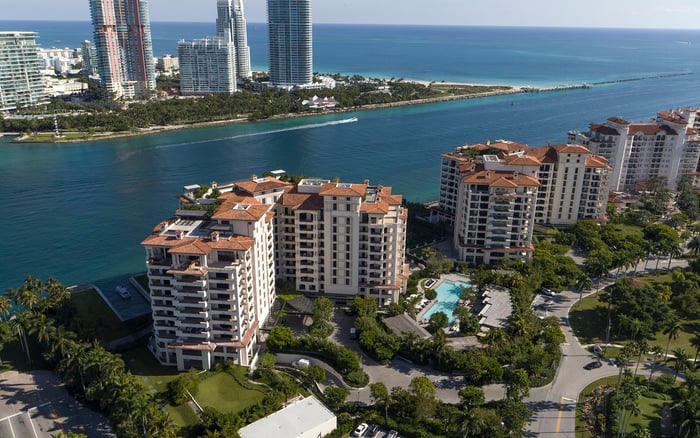
At Palazzo della Luna, a buyer’s dispute strategy begins well before a claim arises. The decisive provisions may sit across several contracts, defining whether a matter proceeds in court or arbitration, where it must be heard, which law applies, and who bears the procedural cost.

A residence at Palazzo della Luna is physically situated on Fisher Island in Miami Beach. Miami-Dade may therefore seem like the intuitive setting for any ownership dispute. Contractually, however, geography and forum are separate questions. A valid agreement can direct litigation to another county, state, or country-or to a private arbitral seat.
That distinction matters before a buyer signs, not merely after a disagreement arises. A forum-selection clause identifies the court and location for resolving covered claims. It may also establish consent to personal jurisdiction and venue. If a claim is filed in the wrong place, the buyer could face dismissal without a decision on the merits, then bear the cost and delay of starting again.
The location of the residence and the location of the dispute can be entirely different.
For a Palazzo della Luna Fisher Island acquisition, current recorded instruments and contractual documents must be reviewed directly. The building’s location alone does not establish that every potential claim will remain in Miami-Dade.
Florida law distinguishes between mandatory and permissive forum language. A mandatory clause confines proceedings to the designated forum. A permissive clause generally confirms consent to a jurisdiction without necessarily excluding every alternative.
Words such as “shall,” “must,” “only,” “solely,” and “exclusively” often signal a mandatory commitment. Yet no single formula is required. The full sentence must clearly show whether the parties intended to restrict venue. Even language stating that all disputes are to “be resolved” in a named location can be treated as mandatory.
This is not semantic housekeeping. Mandatory forum-selection clauses are generally enforceable in Florida when they clearly require litigation in a specified forum. Such provisions are presumptively valid, placing the burden on the challenging party to show why enforcement would be unreasonable.
A careful review should identify the named county and determine whether state court, federal court, or both are permitted. Counsel should also check for express waivers of objections to venue or personal jurisdiction. “Florida” is less precise than “Miami-Dade County,” while a county designation may still leave the available court system unresolved.
Arbitration is not simply a more private version of courtroom litigation. It is a contractually selected forum with its own rules, decision-makers, economics, remedies, and standards of review. A clause requiring binding arbitration may remove covered claims from court altogether.
The headline question-“Is there arbitration?”-is only the beginning. Buyer’s counsel should identify the legal seat, administering institution, procedural rules, hearing location, arbitrator-selection method, and whether the tribunal comprises one or three arbitrators. The seat can carry legal significance even when hearings occur elsewhere.
The financial analysis also extends beyond travel. Filing deposits, arbitrator compensation, discovery limits, confidentiality, emergency relief, fee allocation, attorneys’ fees, and appeal rights can materially alter the practical value of a claim. A three-member tribunal may offer broader deliberation, for example, but it also changes the expense profile.
One-sided language warrants particular scrutiny. If only the buyer must arbitrate while another party preserves access to court, counsel should assess scope, mutuality, available remedies, and practical negotiating leverage. The objective is not to assume arbitration is favorable or unfavorable, but to understand the process being purchased alongside the residence.
Choice of law and forum selection perform different functions. One determines which jurisdiction’s substantive law governs; the other determines where, and sometimes how, a proceeding must occur. An agreement can apply Florida law while requiring a dispute elsewhere, or apply foreign law while selecting a foreign forum.
Combined governing-law and forum provisions can move a dispute abroad. The lesson for an international buyer is direct: ownership of Miami real estate does not guarantee a Miami courtroom. If Miami-Dade is a priority, the documents should say so expressly rather than leaving that expectation to the property’s address.
The same precision is appropriate when evaluating nearby Fisher Island opportunities such as Palazzo del Sol. This does not suggest that separate properties share the same clauses. It underscores that each acquisition has its own contractual architecture and requires an independent review.
The purchase contract is only one layer. A buyer should compare dispute provisions across condominium instruments, management terms, club documents, service agreements, and every other contract connected to ownership or use. Different agreements can select different procedures, venues, or governing laws. Claims involving several parties may then trigger a threshold dispute over which clause controls.
This wider lens is particularly relevant within the Fisher Island ownership ecosystem, where a previously disputed club agreement required controversies to proceed exclusively through binding arbitration under specified institutional rules. That example does not establish the terms governing Palazzo della Luna. It shows why ancillary agreements should never be treated as administrative afterthoughts.
Entity structure adds another layer. Buyers taking title through spouses, trusts, LLCs, or family-office entities should determine exactly who signs and who is bound. Counsel should also consider whether related non-signatories could enforce a clause or be compelled into arbitration. The ownership vehicle, guaranties, club membership, management engagement, and personal rights may not align automatically.
The same diligence applies to The Links Estates at Fisher Island and The Residences at Six Fisher Island. Their inclusion in a buyer’s search should prompt separate document reviews, not assumptions based on location or market positioning.
A concise clause matrix can turn dense drafting into a practical decision tool. For each agreement, counsel can record:
Governing law and any mandatory pre-suit mediation
Mandatory or permissive court language
Permitted court system and geographic venue
Arbitration seat, hearing location, rules, and panel size
Emergency and interim remedies
Filing costs, fee shifting, and attorneys’ fees
Confidentiality, discovery limits, and review rights
Signatories, covered claims, and treatment of non-signatories
The matrix should also flag conflicting provisions and identify any contractual hierarchy stating which document controls. A buyer may prefer local court access for urgent property relief while accepting arbitration for a narrower service dispute. The important point is to recognize that distinction before leverage shifts.
This is a Buyer's Guides issue as much as an Investment or Resale question. A sophisticated buyer evaluates not only the residence, amenities, and carrying obligations, but also the procedural framework governing enforcement. A favorable substantive right can lose practical force if it must be pursued in an inconvenient forum, under costly rules, or against parties not bound to the same process.
Before closing, counsel should confirm the precise language in the current executed and recorded documents, test each clause against the intended ownership structure, and explain the likely path to urgent relief and final resolution. The result is not a prediction of conflict. It is a clearer understanding of the asset’s legal operating environment.
For discreet guidance on South Florida’s finest residences, connect with MILLION.
If branded residences are on your mind — as a home or as an allocation — we would be glad to share what we are seeing, privately.
Begin a quiet conversationNo. The property’s location makes Miami-Dade a natural local forum, but a valid contract may select another court, jurisdiction, or arbitral seat.
It identifies where covered disputes must or may be resolved and can establish consent to personal jurisdiction and venue.
Terms such as “shall,” “must,” “only,” “solely,” and “exclusively” often indicate that proceedings are restricted to a named forum.
No magic words are required, but the language must clearly demonstrate an intent to limit venue.
The claim may be dismissed without a decision on its merits, creating additional expense and delay before it is refiled correctly.
Yes. Arbitration replaces judicial litigation with a private process selected by contract for covered disputes.
Counsel should examine the seat, administering institution, rules, hearing location, arbitrator selection, panel size, remedies, costs, and review rights.
No. One determines which jurisdiction’s law applies, while the other determines where or through what process the dispute proceeds.
Club, management, service, and condominium documents may contain separate dispute provisions that select different procedures or forums.
Counsel should confirm which entity or individual is bound and whether related non-signatories may enforce or be compelled under the clause.