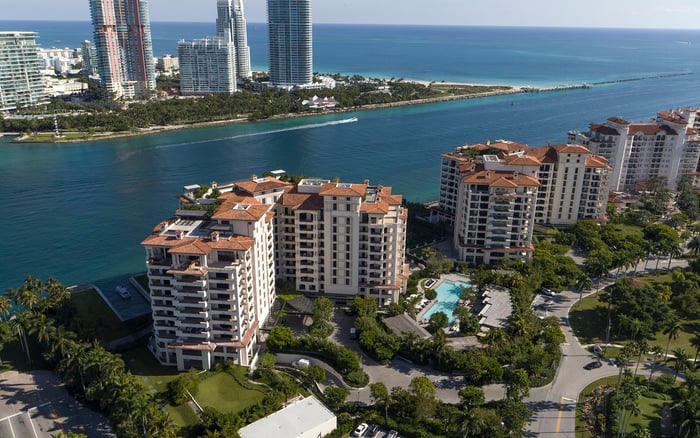
Privacy at Palazzo della Luna deserves a layered review: public property records, ownership structures and internal resident information serve different purposes. Here is what buyers should examine before closing, without mistaking discretion for anonymity.

For a buyer considering Palazzo della Luna, privacy deserves the same precision as the residence itself. The essential distinction is between discretion in daily life and anonymity in the ownership record. A preference for quiet living does not determine what a property record, entity filing or resident directory may reveal.
These are three separate questions. Public property information concerns the residence and its transactions. Entity records concern the structure taking title. Building directories and operational records concern information held or used within the residential community. Understanding one does not resolve the others.
The practical objective is not a blanket promise of confidentiality. It is to establish what will be public, what requires counsel’s review and what the association will collect, display or share. That distinction belongs in the purchase process, not in a conversation after closing.
Palazzo della Luna transactions demonstrate that public records can connect specific residences with named purchasers. Jeff Martin and Lisa Bicker were identified as the buyers of unit 6831 at 6800 Fisher Island Drive. Other transactions connected Lucille R. Zanghi and James M. Dow with unit 6853, and David and Pamela Berkman with units 6813 and 6826.
These examples establish a precise point: ownership can be publicly associated with individuals at the unit level. They do not establish that every beneficial owner behind every purchasing structure is readily identifiable.
The property itself also has a distinct identifying trail. Unit 6842 is publicly identified by Miami-Dade parcel 02-42-10-018-0580. Unit 6893 has a separate parcel, 02-42-10-018-0700. These identifiers distinguish residences without requiring access to a building directory.
For unit 6842, the publicly displayed annual tax amount was $164,658 for 2024. That is historical listing information, not an estimate of a purchaser’s future tax bill. The distinction matters: property details and financial history can be visible regardless of an owner’s preferences about resident contact information.
Entity ownership should not be confused with an invisible purchase. At Palazzo della Luna, Delaware limited partnership DOVFAM FI LP was identified as the buyer of unit 6885. The transaction remained identifiable even though the named purchaser was an entity rather than an individual.
The same residence illustrates the visibility of sale history. Roger and Sloan Barnett sold it for $23 million four months after purchasing it for $17.4 million. An entity name in the ownership trail did not prevent the residence’s transaction sequence and prices from becoming public.
A neighboring example offers a separate caution. At Palazzo del Sol, corporate purchaser Masterpiece Property Holdings Corp. was publicly linked to Maria De Carvalho Klabin and Roberto Leme Klabin. This was a Palazzo del Sol transaction, not a Palazzo della Luna purchase. Its relevance is narrow but useful: an entity purchaser can still become publicly associated with individuals.
Before selecting a structure, ask counsel to review the actual filings and closing documents contemplated for the purchase. Which names and addresses would appear? Which records would be public? What information would be required privately? The answers should be specific to the structure, jurisdiction and transaction-not a general assurance that an LLC or partnership provides anonymity.
A resident directory is distinct from a parcel record, deed or entity filing. Equally, the absence of a publicly accessible owner directory does not mean ownership is untraceable.
Do not assume that Palazzo della Luna offers directory opt-outs, restricted display settings or family-office contact substitutions. Obtain written answers about current arrangements before relying on any of those possibilities. A useful association inquiry should address:
Whether a resident directory exists and which information it contains.
Who may access it, including residents, staff and outside service providers.
Whether participation or particular fields are optional, and how corrections are handled.
Whether a professional mailing address or family-office contact may be used, and for which purposes.
How emergency contacts and access credentials are maintained, and whether they are separate from directory information.
These are questions to resolve, not established privacy options. Request the applicable policy and relevant forms rather than relying solely on an informal description. Distinguish information displayed to neighbors from information required for administration or emergency use. A single request to “keep everything private” is too imprecise to establish those boundaries.
The condominium’s recorded identity matters. Unit legal descriptions reference “PALAZZO DEL SOL/DELLA LUNA AT FISHER ISLAND CONDO” and “OFF REC 29908-447.” Those references are a starting point for counsel’s review of the recorded condominium documents; they do not themselves establish directory permissions.
Similarly, developer disclosure materials address documents to be furnished to buyers or lessees under Florida statutes. They do not confirm current resident-information practices. Request the governing documents and operational policies relevant to the particular question.
Keep organizational responsibilities distinct. The condominium association, Fisher Island Community Association and Fisher Island Club should not be treated as interchangeable. Confirm which organization receives each form and administers each relevant record.
Court records are another distinct channel. A public federal docket names Palazzo Del Sol/Della Luna at Fisher Island Condominium Association, Inc. as plaintiff against Planet 2 Reaching, Inc. That establishes a court-record trail involving the association-not wrongdoing, an adverse judgment or a resident-directory policy.
For a Fisher Island search that also includes The Residences at Six Fisher Island, carry the same questions into each review. Do not transfer a privacy assurance from one project to another simply because both appear on the same shortlist.
A buyer also considering The Links Estates at Fisher Island should request the documents applicable to that ownership arrangement rather than importing conclusions from a condominium review. The same discipline applies to a broader Miami Beach search: compare written practices, not impressions of exclusivity.
Before closing, complete three separate reviews: the residence’s public-record identity and transaction history, counsel’s assessment of the proposed purchasing structure, and written clarification of resident-information practices. Together, they provide a more useful basis for a decision than an unsupported promise of anonymity.
The strongest privacy position is an informed one: know what the transaction reveals, understand what the ownership structure does not conceal, and clarify how the community will handle your information.
For a discreet conversation about your South Florida property search, connect with MILLION.
If branded residences are on your mind — as a home or as an allocation — we would be glad to share what we are seeing, privately.
Begin a quiet conversationYes. Public records have connected specific residences with named purchasers, including Jeff Martin and Lisa Bicker for unit 6831.
No. DOVFAM FI LP was identified as the purchaser of unit 6885, demonstrating that an entity purchase can remain publicly identifiable.
The transaction examples do not establish that every beneficial owner is readily identifiable. Counsel should assess the specific structure and relevant records.
Ask counsel which names and addresses would appear in the proposed filings and closing documents, and which information would be public rather than privately required.
Public listing pages can display unit identification, parcel numbers, tax information and legal descriptions. These details exist separately from internal resident contact information.
No. It is the historical 2024 annual tax amount displayed for unit 6842, not an estimate of a future purchaser’s tax bill.
Do not assume an opt-out is available. Request written confirmation of current directory participation rules, displayed fields and access permissions.
Ask the association whether that is permitted and for which purposes. Treat directory information, administrative contacts and emergency contacts as separate questions.
No. The Masterpiece Property Holdings Corp. transaction occurred at neighboring Palazzo del Sol and serves only as a comparative example.
It establishes a public court-record trail naming the condominium association and Planet 2 Reaching, Inc. It does not by itself establish wrongdoing, an adverse judgment or directory practices.