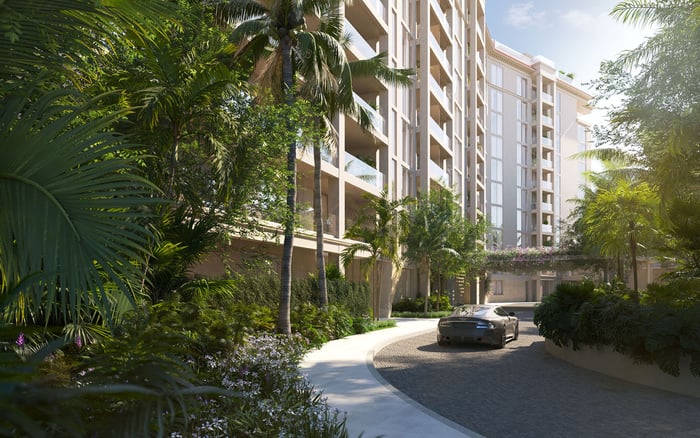
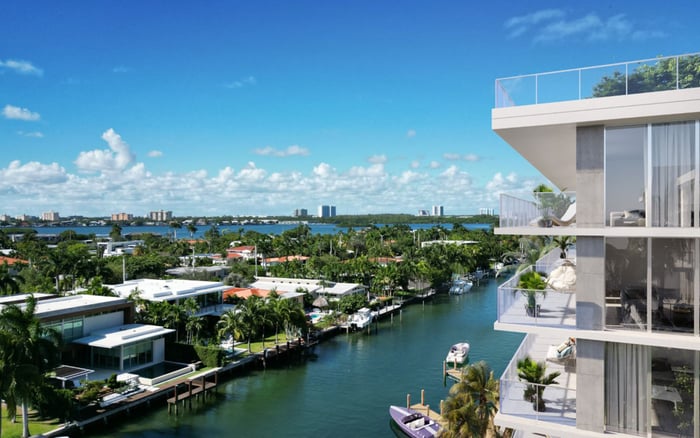
At Palazzo della Luna, marine infrastructure diligence begins with identifying who owns each asset, who maintains it, and how any expense reaches an individual residence. Buyers should reconcile governing documents, surveys, budgets, reserves, minutes, inspections, permits, contracts, and the estoppel before assigning value to waterfront access or estimating future carrying costs.
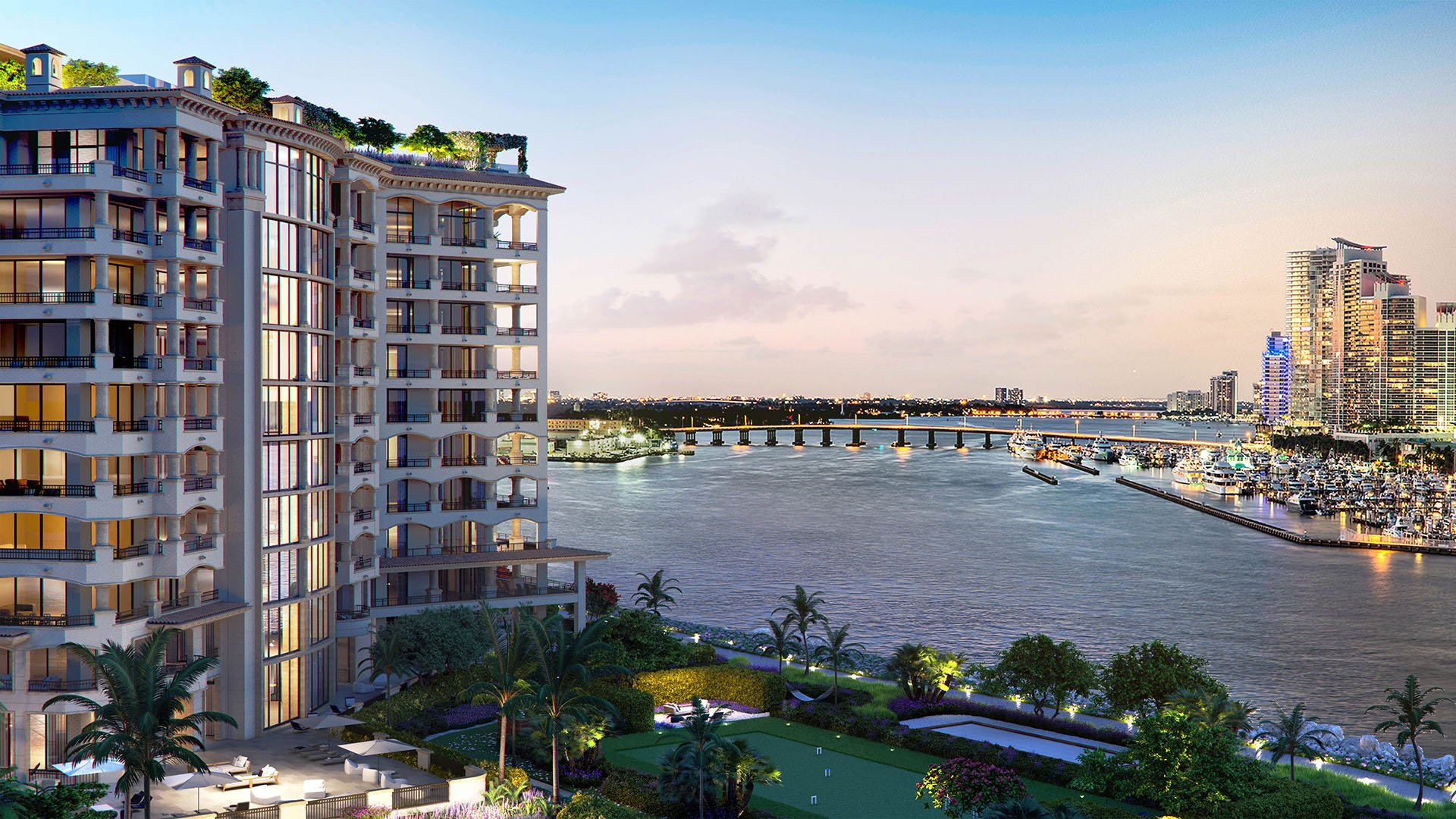
At Palazzo della Luna, the water defines the setting, but buyers should separate the shoreline’s beauty from the legal and financial architecture supporting it. The 10-story condominium comprises 50 residences across approximately 8.1 acres, creating an intimate ownership profile with consequential common-property questions.
The first question is not simply whether a seawall, dock, or navigable approach exists. It is which entity owns the improvement, which entity controls access, and which party is responsible for maintaining, repairing, replacing, insuring, or permitting it. The condominium association, a broader island association, a club, or another entity may play distinct roles. The allocation at Palazzo della Luna remains unresolved without the transaction documents.
The property is associated with an address range of 6800 to 6895 Fisher Island Drive and is also listed at 6800 Fisher Island Drive. That distinction elevates the importance of the legal description, recorded survey, declaration, amendments, and exhibits over any marketing or listing address.
Waterfront value is clearest when ownership, access, and payment obligations align.
A seawall review should begin with a marked survey identifying the condominium parcel, common elements, limited common elements, easements, and adjacent property. Counsel can then compare those boundaries with the declaration and amendments, while a qualified marine professional evaluates the physical structure within the relevant scope.
The condition inquiry should be documentary as well as visual. Request available inspection reports, engineering correspondence, repair proposals, permits, contracts, warranties, insurance communications, board minutes, and reserve materials related to the shoreline. The objective is to establish what has been observed, what has been recommended, what work has been authorized, and how the association expects to fund it.
Buyers should not assume that proximity creates responsibility. A seawall directly in front of the building may not be owned or funded by the same entity that operates the condominium. Conversely, covenants or shared arrangements can create an obligation even when the asset lies outside the condominium parcel. A Palazzo della Luna Fisher Island acquisition therefore requires coordinated legal, engineering, and financial review.
Dredging warrants its own diligence track. The buyer’s team should identify the water area involved, any access or easement rights, the party authorized to seek permits, the entity responsible for contracting the work, and the formula for allocating expenses. A right to use waterfront infrastructure does not, by itself, determine who pays to preserve navigability.
Request any recorded agreements, permits, applications, surveys, depth information, maintenance contracts, budgets, reserve schedules, and minutes referring to dredging or sediment management. The absence of a current budget line item does not prove that no future obligation exists. Responsibility may sit elsewhere, the work may be episodic, or the governing documents may use broader terminology.
The available documentation does not establish a current dredging project or pending related assessment at Palazzo della Luna. Due diligence should remain precise: determine whether an obligation exists, identify its trigger, and understand the approval and allocation mechanism without presuming a problem.
Marina and dock infrastructure can extend well beyond decking. A Fisher Island Guest Marina capital project completed in 2018 replaced fixed concrete piers that had served for approximately three decades with concrete floating docks. The scope encompassed demolition, design, construction, installation, greenheart pilings, seawall and outer-dock repairs, and increased dockside power capacity.
That historical project does not establish that Palazzo della Luna owners paid those costs or prove a present obligation. It does illustrate how marine work may arrive as a bundled capital program rather than a narrow dock repair. Structural components, utilities, pilings, shoreline work, demolition, and installation can converge within a single capital cycle.
For the subject property, request documents identifying any docks serving residents, along with their ownership, access rights, operating rules, maintenance contracts, inspections, utilities, reserves, and cost-sharing provisions. If a residence is marketed with a particular waterfront privilege, the purchase contract and diligence file should distinguish a recorded property right from a revocable amenity or separate membership benefit.
Comparable island choices also require project-specific review. Palazzo del Sol may share the Fisher Island setting, while The Links Estates at Fisher Island and The Residences at Six Fisher Island represent different residential formats. Neither names nor geography should be used to infer identical marine rights, ownership boundaries, or expense structures.
Once ownership and maintenance duties are established, the buyer can trace each obligation through the association’s finances. Review current and prior budgets, available financial statements, reserve studies, reserve balances, approved contracts, meeting minutes, notices, and assessment history. Track terminology carefully: shoreline work may appear under marine facilities, structural repairs, common-area maintenance, utilities, or a broader capital category.
Unit size can affect allocation analysis. Residences at Palazzo della Luna range from 613 to 10,194 square feet, a substantial spread. Buyers should not infer assessment shares from area alone. The declaration and its schedules should identify the percentage interests or other formula applicable to the specific unit and expense category.
The estoppel is essential to confirming current account status, regular charges, and disclosed amounts due. It should be read alongside-not instead of-the declaration, budgets, reserves, minutes, and inspection materials. An estoppel is a point-in-time transaction document, not a substitute for understanding long-range capital responsibility.
A focused waterfront review should include the condominium declaration and amendments; all relevant surveys and exhibits; easements and shared-use agreements; recent budgets and financials; reserve materials; board and owner minutes; marine inspection and engineering records; permits; contracts; warranties; insurance correspondence; notices; and the estoppel. Counsel, the marine consultant, and the financial reviewer should work from the same asset map so that no structure falls between scopes.
From an investment perspective, the key output is not a speculative repair number. It is a documented chain connecting the asset to its owner, the owner to a maintenance duty, the duty to a funding source, and the funding formula to the residence being acquired. Resale buyers can then distinguish known current charges from contingent exposure and unresolved document questions.
This disciplined approach belongs at the center of Fisher Island due diligence, particularly where marina systems and shoreline improvements contribute materially to the ownership experience. It allows luxury buyers to preserve discretion while evaluating the infrastructure beneath an exceptional address.
For private guidance on South Florida luxury real estate, connect with MILLION.
If branded residences are on your mind — as a home or as an allocation — we would be glad to share what we are seeing, privately.
Begin a quiet conversationThe provided facts do not establish ownership. Buyers should verify it through the declaration, amendments, surveys, easements, and related agreements.
No current defect is established by the provided documentation. Physical condition should be evaluated through available inspections and a transaction-specific marine review.
No current dredging project is established by the provided facts. Buyers should review permits, minutes, budgets, agreements, and reserve materials.
No. Access rights, permitting authority, maintenance duties, and payment responsibility can be allocated separately.
A survey can help identify parcel boundaries, common elements, easements, and the relationship between the residence and nearby marine infrastructure.
The 2018 project shows that marine capital work can combine docks, demolition, pilings, seawall repairs, outer-dock repairs, and utility upgrades. It does not establish a cost obligation for Palazzo della Luna owners.
Not by itself. Palazzo della Luna has a wide reported size range, but the governing documents should control the applicable percentage or allocation formula.
Review budgets, financial statements, reserve studies, reserve balances, contracts, minutes, assessment notices, and the estoppel together.
No. It can confirm point-in-time charges and account information, but it does not replace a review of long-term duties, reserves, and capital plans.
No. Each project's declarations, boundaries, easements, amenities, and cost-sharing provisions require independent review.