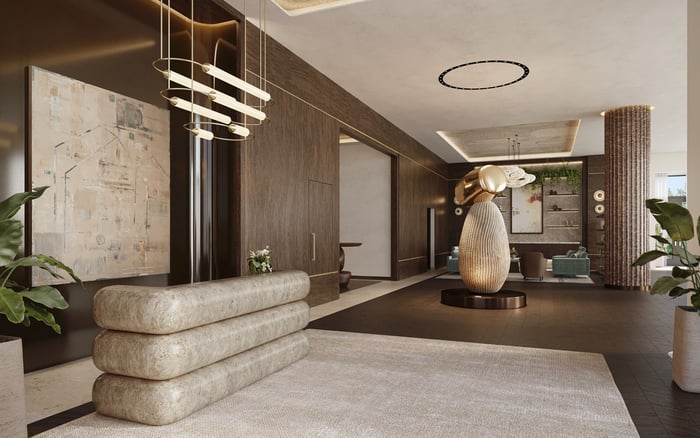
Art collectors evaluating Cora Merrick Park should make freight access, structural review, installation procedures, and governing documents central to ownership due diligence. Written verification can reveal practical constraints before a purchase becomes binding.

For an art collector, evaluating a residence requires more than deciding whether a work fits visually within a room. At Cora Merrick Park, due diligence should test whether the collection can move from the delivery vehicle to its intended placement, whether the structure can support it, and whether the proposed installation can satisfy the applicable documents and approvals.
The correct reference point is the largest packed object rather than the uncrated artwork. Crates, protective framing, handling equipment, bases, display cases, and mounting assemblies can change the dimensions and weight that the delivery and installation teams must accommodate.
Collectors should seek written specifications and document unresolved issues before making a binding purchase decision. The same disciplined approach can inform comparisons with Ponce Park Coral Gables and other South Florida residences.
A useful access review follows the work through every stage of delivery. The collector should verify the unloading position, staging area, service entrance, elevator approach, elevator interior, door clearances, corridor turns, residence entry, and final path within the home.
Request the freight elevator’s clear height, width, depth, door opening, and rated capacity in writing. Those measurements should be checked against the packed dimensions and total handling weight of each unusually large or heavy work. Turning clearances can matter as much as the elevator car itself, particularly where a long crate must pass through a vestibule or change direction.
The review should also determine how environmental exposure will be managed during unloading and staging. Sensitive works may require a plan for heat, humidity, rain, and transitions between exterior and interior conditions. When comparing The Village at Coral Gables, collectors should apply the same end-to-end test rather than treating elevator dimensions as the only access question.
Total artwork weight does not answer every structural question. A broad base and a narrow pedestal can impose different demands even when they support objects of similar weight. The relevant review should consider both distributed and concentrated loading at the exact proposed location.
Provide the reviewer with the weight and footprint of the artwork, base, case, mounting system, and handling equipment. Temporary loads created during installation should also be considered. If the piece is unusually heavy, seek written confirmation from an appropriately qualified professional and identify any association review that may apply.
If reinforcement or a custom support system is contemplated, clarify who may design and install it, what documentation must be submitted, and whether the work would affect structural elements or property outside the residence’s defined boundaries. Assumptions based on plans or renderings should not replace that review.
The purchase and condominium documents should be examined for provisions governing unit boundaries, structural components, walls, ceilings, terraces, alterations, deliveries, and contractor access. Collectors should also determine whether separate rules, alteration standards, or resident procedures will control installations after closing.
Operational questions include reservation procedures, delivery windows, elevator protection, vendor insurance, supervision, deposits, work hours, debris removal, and restoration obligations. These issues can affect not only the initial move-in but also later acquisitions, loans, rotations, conservation work, and lighting changes.
A collector comparing Cora Merrick Park with Park Grove Coconut Grove or another South Florida property should not assume that procedures will be identical. Each residence requires its own document and access review.
Artwork that requires anchoring, reinforcement, reconstructed walls, specialized lighting, or concealed wiring should be reviewed before installation. The collector should identify every approval that may apply and avoid treating one approval as a substitute for another.
A practical collection schedule can organize the review. For each significant work, record its dimensions, packed dimensions, total weight, base footprint, proposed room, mounting method, handling needs, and environmental sensitivities. That schedule gives the relevant professionals and decision-makers a consistent basis for evaluating access, loading, and installation.
Any constraint material to the purchase should be addressed in writing before the transaction becomes binding. Legal, structural, conservation, logistics, and installation professionals can each assess a different part of the plan; general marketing materials should not be treated as a substitute for their project-specific review.
Are Cora Merrick Park’s freight-elevator dimensions confirmed here? No. Buyers should request the applicable dimensions, door clearances, turning clearances, and rated capacity in writing.
Which dimensions should be used for access planning? Use the dimensions of the fully packed work, including its crate and protective components, rather than the artwork alone.
Why should the entire delivery route be measured? A crate that fits inside an elevator may still be blocked by unloading conditions, staging limits, door openings, corridors, turns, or the residence entry.
What weights should be included in a structural review? Include the artwork, base, display case, mounting assembly, handling equipment, and any temporary installation loads.
Why does a sculpture’s base footprint matter? The footprint affects how weight is transferred to the floor, so total weight alone may not describe the relevant loading condition.
Who should assess an unusually heavy artwork? An appropriately qualified professional should evaluate the proposed placement, with any required association review addressed separately.
Do plans or renderings establish installation rights? No. Installation authority and property boundaries should be evaluated through the controlling purchase and condominium documents.
Which operating procedures should collectors investigate? Investigate delivery scheduling, elevator protection, vendor requirements, supervision, deposits, work hours, cleanup, and restoration obligations.
Should future collection changes be part of due diligence? Yes. The review should consider later acquisitions, loans, rotations, conservation work, and changes to lighting or mounting systems.
When should material access and installation issues be resolved? Resolve them in writing before the purchase becomes binding whenever they could affect whether the residence works for the collection.
For a tailored shortlist and next-step guidance, connect with MILLION.
If branded residences are on your mind — as a home or as an allocation — we would be glad to share what we are seeing, privately.
Begin a quiet conversation