An owner-focused review of planned services at 619 Brickell, with practical diligence on service circulation, domestic-staff credentials, independent vendors and the agreements behind hospitality access.

At 619 Residences by Foster + Partners + Nobu Hospitality, the owner-operations question is straightforward: can an extensively serviced home remain genuinely private? Planned for 619 Brickell Avenue, Miami, the waterfront condominium is also marketed as Nobu Residences Miami. Its advertised hospitality offering makes the relationship between resident arrival, household staffing and service delivery especially important.
13Th Floor Investments and Key International are developing the project in partnership with Nobu Hospitality, with Foster + Partners designing the tower alongside Sieger Suarez Architects. Planned as Nobu's first residential project in Miami, it carries distinct creative and hospitality credentials. Those credentials do not establish the final operating rules. Separate staff circulation, employee credentials and owner-selected vendor access require their own review.
The planned program includes 24-hour concierge and lifestyle management, in-residence dining, private chef services, housekeeping-style support, turn-down and butler support. Approximately 90,000 square feet of private amenities are marketed. For an owner, the decisive distinction is between services available through the building and access granted to people employed directly by the household.
A building-provided housekeeper does not establish permission for an independently hired housekeeper. Private chef service does not establish where an owner's chef may unload groceries, store equipment or enter before the owner returns. Buyers should request written distinctions between hospitality personnel, domestic employees, visiting guests and contractors, including who authorizes access for each category.
For buyers also considering Cipriani Residences Brickell, the same review framework applies: compare documented permissions and operating commitments rather than assuming that branding creates equivalent household flexibility. This is a diligence comparison, not a claim about either project's access policy.
A dedicated employee entrance, service lobby, loading dock, freight-elevator bank or independent back-of-house corridor network has not been established in the available project descriptions. That does not mean these features will be absent. Buyers should obtain plans and operating explanations before treating service separation as settled.
Request a route review from arrival to residence for meals, groceries, housekeeping carts, fresh and used linens, waste and maintenance equipment. Identify every point where these movements would intersect with the main lobby, resident elevators or residential corridors. Ask whether separation is physical, scheduled or dependent on staff supervision.
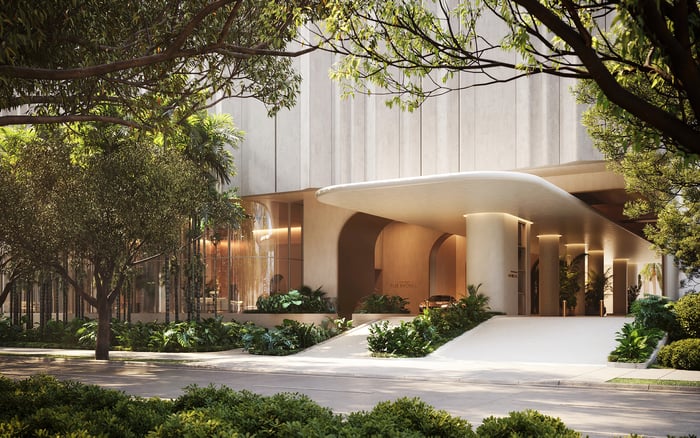
The advertised private porte-cochère, valet, self-parking and private garages address arrival and parking. They do not, by themselves, resolve service circulation. An elegant vehicle arrival can coexist with shared internal routes; the owner needs to understand both.
A useful test is a dinner-party scenario: a chef arrives with ingredients as housekeeping departs and guests approach the residence. Ask management to explain the proposed sequence, holding areas and elevator access. Treat the exercise as a request for clarification, not a description of confirmed infrastructure.
Begin with the proposed check-in location. Ask whether recurring domestic employees must present identification at every visit, complete screening, receive advance owner authorization or obtain concierge approval. Confirm how substitutions, temporary workers and unexpected arrivals would be handled.
A marketed keyless-entry system does not establish credential permissions. Request the proposed limits by time, floor and unit, along with procedures for issuing, renewing and immediately deactivating access. Ask who can authorize changes and whether access records would be available to the owner, subject to applicable policies.
The most important test is termination: when employment ends, how quickly can building and residence access be cancelled? Clarify procedures for lost credentials, after-hours changes and a household employee arriving while the owner is away. These questions distinguish convenient entry from accountable entry.
Owners should establish whether they may select their own cleaners, chefs, pet-care providers and maintenance specialists. Ask whether an approved-vendor list applies, whether recurring access requires concierge approval and whether building-provided services are optional or subject to contractual restrictions.
For contractors, request insurance and licensing requirements, permitted work hours, escort obligations, elevator reservations, parking arrangements, delivery procedures and common-area damage rules. Distinguish recurring domestic support from repair or installation work: a regular housekeeper and an equipment installer should not be assumed to follow identical procedures.
The same questions can structure a review of The Residences at 1428 Brickell without implying that its rules match those proposed here. The comparison should reflect the owner's actual household, including staff frequency, absence patterns and the scale of deliveries.
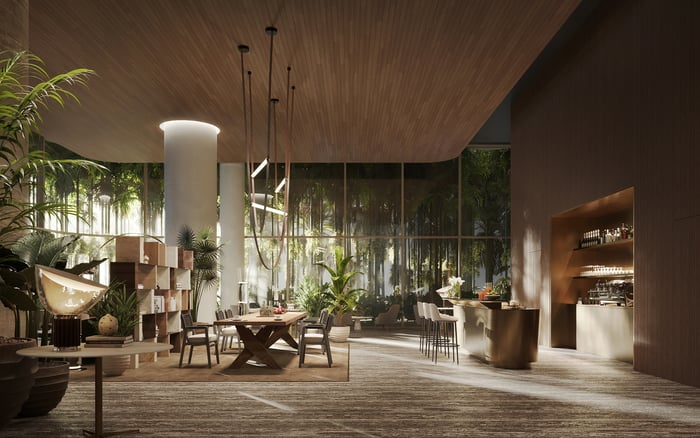
The planned dining program includes a ground-level Nobu restaurant, poolside café and in-residence dining. The proposed structure may place restaurant and café spaces in commercial units sold to third parties, while some common-area Nobu dining depends on an association license agreement. Buyers should clarify which entity controls each service and what the relevant agreements commit it to provide.
That distinction matters for restaurant deliveries, employee entry, grease and refuse removal, pest control and after-hours activity. Request an explanation of how commercial operations would remain distinct from residential access and who would resolve conflicts involving noise, deliveries or shared circulation.
The marketed wellness program includes cryotherapy, hyperbaric oxygen, IV therapy and peptide therapy. These offerings warrant separate questions about specialist-provider access, operating arrangements, scheduling and responsibility. Amenity availability should not be treated as automatic permission for an owner's outside practitioner to enter or provide services.
619 Brickell is planned rather than operating, with closings indicated to begin in 2031. Treat that timing as a planning indication, not a guaranteed handover date or evidence that operating procedures are finalized.
Request the declaration, bylaws, rules and regulations, purchaser disclosures, operating budget, vendor-access policy and hospitality service agreements. Ask advisers to distinguish binding obligations from advertised offerings and identify which access arrangements could change. Clarify whether each service is included, separately charged or subject to availability.
Buyers weighing St. Regis® Residences Brickell alongside 619 should apply the same document-led discipline. Compare what each household can rely on, rather than making unsupported assumptions about either project's service standards.
The strongest owner review translates lifestyle preferences into written operating questions. A discreetly managed residence should accommodate the owner's staff, deliveries and maintenance needs without leaving access decisions to improvisation. At 619, the advertised hospitality ambition is clear; the buyer's task is to establish how it would function at the residence door.
For a considered review of South Florida residences through the lens of household operations, connect with MILLION.
If branded residences are on your mind — as a home or as an allocation — we would be glad to share what we are seeing, privately.
Begin a quiet conversationThe project is also marketed as 619 Brickell and Nobu Residences Miami. It is planned for 619 Brickell Avenue, Miami.
13th Floor Investments and Key International are developing it in partnership with Nobu Hospitality. Foster + Partners is designing the tower in collaboration with Sieger Suarez Architects.
No, it is a planned condominium. Closings are indicated to begin in 2031, but that timing should not be treated as guaranteed.
The available project descriptions do not establish a dedicated employee entrance or independent service-corridor network. Buyers should request plans and written operating explanations.
No; arrival and parking features do not establish how staff, vendors or deliveries would move through the building.
Advertised offerings include in-residence dining, private chef services, housekeeping-style support, turn-down and butler support. These do not establish access rules for independently hired staff.
Confirm credential limits by time, floor and unit, along with authorization and renewal procedures. Immediate deactivation after employment ends is an important review point.
The supplied project descriptions do not establish that permission. Buyers should clarify approved-vendor requirements, recurring-access approval and any contractual restrictions.
Restaurant and café spaces may be held in third-party commercial units, while some common-area dining depends on an association license agreement. Owners should clarify control, service commitments and commercial access responsibilities.
Request the declaration, bylaws, rules and regulations, purchaser disclosures, operating budget, vendor-access policy and hospitality service agreements. Review them for binding obligations, access permissions and service charges.