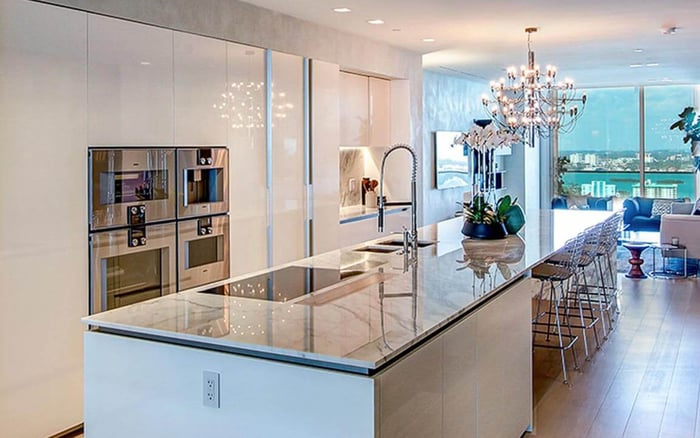
A buyer-focused guide to evaluating secondary-bedroom quality at Oceana Bal Harbour, from floor-plan testing and light exposure to privacy, acoustics, flexible rooms, and resale implications.

Oceana Bal Harbour can quickly focus a buyer’s attention on the larger lifestyle promise of a luxury residence. That first impression is important, but it should not replace a careful room-by-room review before contract.
Secondary bedrooms deserve their own disciplined evaluation because they determine how the residence actually lives for children, visiting family, staff, remote-work routines, and multigenerational stays. The primary suite often receives the clearest design emphasis, while non-primary rooms may vary more meaningfully by line, stack, exposure, and adjacency.
The right question is not whether the residence is beautiful. It is whether every bedroom supports the life the buyer expects to lead there.
The first step is to move from project-level admiration to unit-specific diligence. A building’s broader reputation does not mean every bedroom receives the same light, view, privacy, or sense of openness.
Buyers should compare the exact apartment line and stack. Some plans may offer stronger exposure or more useful room proportions, while others may place secondary bedrooms deeper within the layout or near more active circulation areas. A room that appears adequate in a marketing image may feel different once its window placement, depth, columns, door swings, and circulation path are reviewed in detail.
Professional floor plans should be treated as essential, not optional. Brochure renderings can communicate mood, finish level, and lifestyle, but they rarely answer the practical questions that matter before signing: where the bed fits, what wall remains for storage, how far the room sits from a bathroom, and whether the door opens into useful furniture space.
A secondary bedroom should be tested with real furniture, not assumptions. Begin with usable width, then identify the most logical bed wall. A queen bed, pair of nightstands, desk, dresser, and luggage bench can quickly reveal whether a room is comfortably proportioned or merely labeled as a bedroom.
Closet location matters as much as square footage. If closet doors conflict with bedroom doors, bathroom doors, or the only reasonable bed wall, the room may live smaller than expected. The same is true for column intrusions, awkward window returns, or narrow passages between the bed and wall. A luxury residence should not require guests to sidestep furniture to reach a closet.
Door swings are often underestimated. Review the entry door, closet doors, bathroom door, and any connecting door together. If multiple swings compete in a tight corner, the room may become visually and functionally cluttered. For buyers planning children’s rooms, staff quarters, or long-stay guest suites, these small conflicts can become daily irritants.
Luxury ownership naturally raises expectations for light and outlook. Yet secondary bedrooms may sit away from the most dramatic living areas, especially when the main entertaining spaces and primary suite command the best exposures. A room can belong to a premier building and still require careful review for brightness, window size, and the character of its view.
View appeal should be evaluated honestly. Does the window provide a meaningful outlook when seated or lying in bed, or only when standing close to the glass? Is the exposure bright in the way the buyer expects, or is it more subdued because of orientation and plan depth?
For families relocating from larger homes, natural light can be the difference between a room that feels like a true bedroom and one that functions better as an office or occasional guest space. At this level of the market, every bedroom should earn its role.
Privacy is a bedroom-level issue, not only a residence-level issue. Buyers should review whether secondary bedrooms are buffered from the living room, kitchen, elevator lobby, service zones, and the primary suite. A guest room opening directly into active social space may be convenient, but it may not feel restful during entertaining.
Acoustic exposure deserves equal attention. Rooms near mechanical shafts, elevators, corridors, service rooms, or other building-core elements should be evaluated with particular care. If possible, visit during different times of day and listen from inside the room with doors closed. A beautiful finish package cannot fully compensate for a bedroom that feels exposed to circulation or building noise.
This is especially important when a secondary room is intended for a child, an elder relative, or a remote-work user who needs quiet. Luxury is not only finish quality and amenity access. It is the ability to sleep, concentrate, and retreat without compromise.
Dens, staff rooms, and other flexible spaces should not be accepted at face value as bedrooms unless they meet the buyer’s actual expectations for light, size, privacy, closet storage, and bathroom access.
A den can be extremely valuable when it functions as a media room, office, homework area, or overflow sleeping space. But if a buyer needs a true additional bedroom, the test is stricter. Does the room have a proper sense of enclosure? Is there practical storage? Is bathroom access dignified for overnight use? Can the space hold a bed without sacrificing the work or lounge function that made it attractive in the first place?
Staff rooms require the same clarity. Some buyers value staff accommodation, while others may see the space as storage, office, or occasional guest overflow. The contract decision should reflect the room’s real utility, not an optimistic label.
Resale strength often turns on the rooms buyers use every day. Future purchasers may discount layouts where secondary bedrooms feel cramped, dark, noisy, or inflexible, even if the primary suite and living room are impressive. In family-oriented luxury ownership, the second, third, and fourth bedrooms can become decisive.
Within a private buyer brief, practical search labels may include Oceana Bal Harbour, Bal Harbour, Surfside, Oceanfront, Waterview, and Resale. But labels alone do not establish value. Value resides in the specific line, the stack, the bedroom proportions, and the way each room supports actual use.
Before contract, any weakness should be translated into negotiation language. A compromised secondary bedroom may not be a reason to walk away, but it should be recognized, priced, and understood. In a rarefied building, precision is the buyer’s advantage.
Before signing, walk each non-primary room with the floor plan in hand. Confirm usable width, bed-wall placement, closet access, window size, door swings, bathroom relationship, and the likely furniture layout. Test the room for its intended use rather than for a generic bedroom label.
Then move beyond measurements. Stand in the room at different angles. Sit where a desk might go. Mentally lie down from the bed position and consider light, view, and privacy. Listen for elevator, corridor, service, or mechanical noise. Trace the route from the room to the kitchen, living area, laundry, and bathroom.
Finally, compare alternatives within the same building whenever possible. A slightly different line or stack may offer a materially better secondary-bedroom experience. At Oceana Bal Harbour, the contract decision should be made at the room level, not only at the building level.
Why should secondary bedrooms be reviewed separately at Oceana Bal Harbour? They often determine daily livability for children, guests, staff, or remote work, while the primary suite may receive the most favorable design treatment.
Is a professional floor plan necessary before contract? Yes. It helps verify usable width, bed placement, closets, door swings, windows, and circulation in ways marketing imagery cannot.
Do all secondary bedrooms have the same quality in a luxury building? No. Quality can vary by line, stack, orientation, plan depth, glazing, and proximity to building-core elements.
What is the most important furniture test? Confirm that the intended bed size, nightstands, storage, and desk or dresser fit without blocking movement or closet access.
How should buyers evaluate natural light? Review window size, exposure, room depth, and whether the room sits away from the main living areas.
When is a den suitable as a sleeping space? Only when it meets the buyer’s expectations for privacy, size, light, storage, and bathroom access.
Why does acoustic exposure matter? Bedrooms near elevators, corridors, service rooms, shafts, or mechanical areas may feel less restful even in a premium residence.
Can a weaker secondary bedroom affect resale? Yes. Future buyers may discount layouts where non-primary rooms feel cramped, dark, noisy, or difficult to furnish.
Should different lines or stacks be evaluated separately? Yes. Similar bedroom counts can live very differently depending on exposure, room shape, door placement, and adjacency.
What is the best final step before contract? Compare the actual residence against at least one alternative line or stack, then price any bedroom-level compromise accordingly.
If you'd like a private walkthrough and a curated shortlist, connect with MILLION.
If branded residences are on your mind — as a home or as an allocation — we would be glad to share what we are seeing, privately.
Begin a quiet conversation