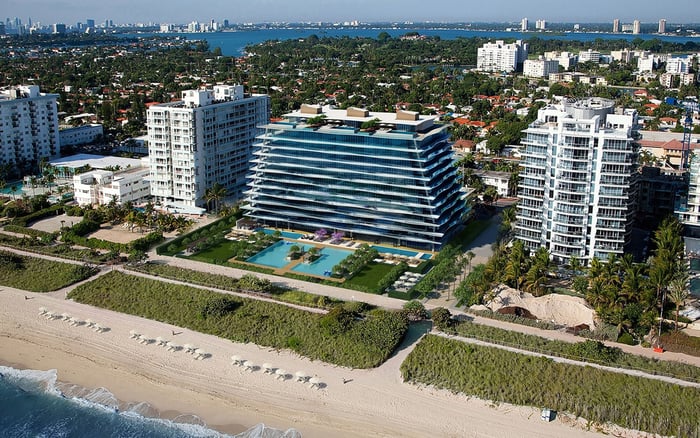
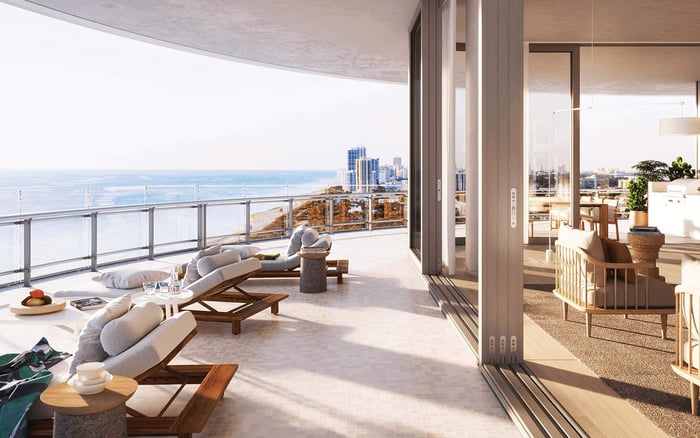
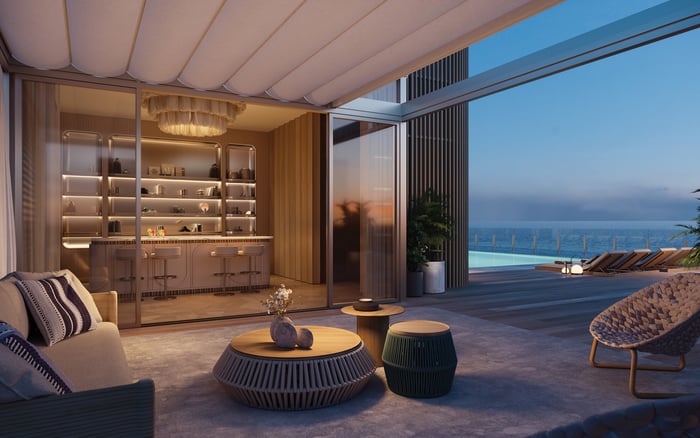
A discreet buyer’s guide to evaluating sightlines, tower adjacency, terraces, glazing, and daily privacy when moving from New York to Surfside.
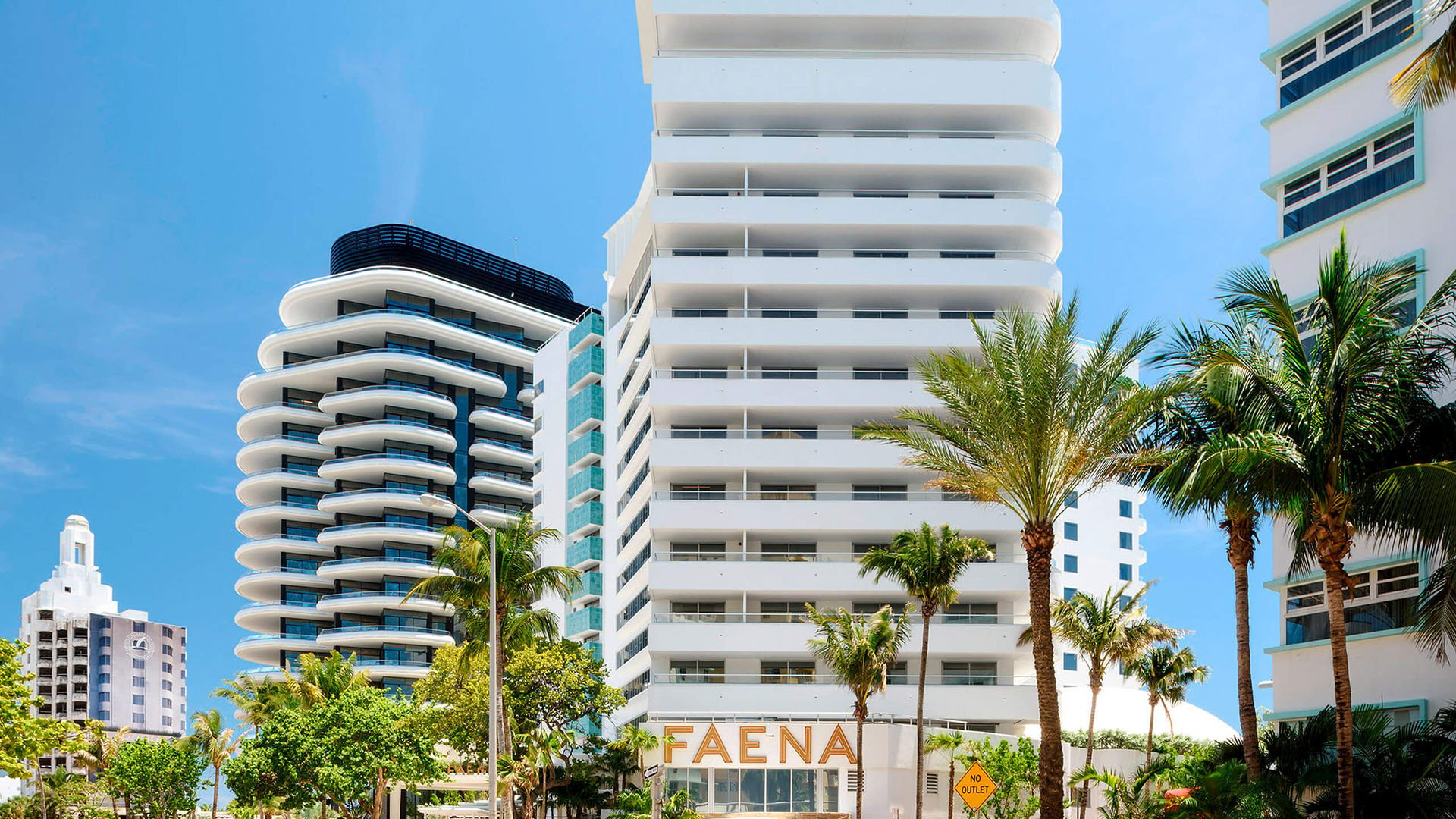
For many New York buyers, the move to Surfside begins with a promise of space: broader water views, softer light, indoor-outdoor living, and a calmer residential rhythm. Yet the strongest purchase is rarely defined by square footage alone. In a coastal market shaped by towers, terraces, and glass, privacy is an architectural question as much as a lifestyle preference.
The instinct is often to ask for the highest floor available. Height can help, but it does not automatically create discretion. A high residence may still face another tower at a similar elevation, while a lower home with a protected angle can feel remarkably private. The sharper question is not simply, “How high is it?” It is, “Who can see into the rooms I actually use, and when?”
That distinction matters in Surfside, where the daily rituals of ownership are highly visible: breakfast on a Terrace, evening light in a primary suite, a quiet swim, or a family dinner with sliding doors open to the air. Privacy is the ability to live those moments naturally, without managing shades like a second occupation.
Before selecting finishes or studying furniture plans, read the neighboring towers as if they are part of the floor plan. Their distance, angle, window placement, balcony orientation, and relative height will shape the experience of the home. A residence can be beautifully composed and still feel compromised if its most intimate rooms face a nearby stack of balconies.
New York buyers are often sophisticated about exposure, but Surfside introduces a different variable: the terrace as a true living room. In Manhattan, a skyline view may be admired from behind glass. In South Florida, exterior space is used, furnished, and occupied for long stretches. That makes lateral sightlines especially important.
When considering Ocean House Surfside, the privacy conversation should extend beyond the interior plan to the way outdoor space, neighboring structures, and daily sun patterns interact. The same principle applies across the market: a beautiful view corridor is only valuable if it supports the way you intend to live.
A disciplined privacy review begins with four questions.
First, what is directly opposite the residence? Look beyond the postcard view. Identify the closest tower face, the most exposed balcony line, and whether neighboring residences have direct or oblique sightlines into bedrooms, baths, kitchens, and entertaining areas.
Second, what is below? Pool decks, amenity terraces, porte cocheres, and service areas can all affect perceived seclusion. A high floor may avoid pedestrian exposure, while a lower floor may gain privacy through setback, landscaping, or a calmer side orientation.
Third, what is above? Privacy is not only about being seen from the side. Overlooking balconies can alter how a terrace feels, especially if the residence is designed for outdoor dining or lounging.
Fourth, how does the home change from day to night? Glass that feels reflective in daylight may become transparent after sunset. If a buyer prefers warm interior lighting and open curtains, the night condition deserves as much attention as the daytime tour.
This is why The Delmore Surfside and other Surfside residences should be evaluated with a privacy brief in hand, not merely a wish list of finishes and views. The right home must perform beautifully at breakfast, sunset, and after the city lights come on.
Privacy is partly physical and partly emotional. A Boutique building can feel more discreet because there are fewer shared thresholds, fewer elevator encounters, and a more residential cadence. Yet scale alone is not a guarantee. A smaller property can still be exposed if its primary rooms face a neighboring tower at close range.
Conversely, a larger building may deliver excellent privacy if its plan, setbacks, glazing, and orientation are favorable. The goal is not to romanticize one building type over another. It is to understand the precise relationship between your residence and everything around it.
Buyers comparing Eighty Seven Park Surfside may be drawn to the idea of a refined coastal lifestyle, but the privacy decision should remain practical: which rooms face open air, which face neighboring mass, and how much of the terrace is genuinely usable without feeling observed?
For households coming from New York, this analysis can be surprisingly personal. In a vertical city, many residents accept visual proximity as part of the bargain. In Surfside, expectations change. The home is often meant to be restorative, resort-like, and family-centered. Privacy is not a luxury add-on. It is part of the value proposition.
An Oceanfront address can deliver powerful emotional appeal, but it should not be confused with complete seclusion. The ocean side may feel open, while side exposures may be more complex. Corner residences, wraparound terraces, and glass-wrapped living rooms can be extraordinary, but they also require a careful reading of angles.
The strongest Oceanfront purchase is one where the best view and the best privacy reinforce each other. If they compete, the buyer must decide which condition will matter more over time. A dramatic panorama may impress on the first tour. A poorly exposed primary suite may irritate every evening.
At Fendi Château Residences Surfside, as with any luxury coastal building, the essential question is not whether the setting is desirable. It is whether a specific residence within that setting offers the degree of discretion the buyer expects.
A privacy-focused showing should be deliberate. Stand in the primary bedroom with lights on. Sit at the dining table. Walk the full depth of the terrace, not just the most photogenic corner. Open the doors, then close them. Ask where window treatments would actually fall, and whether they would interrupt the architecture.
If possible, visit at more than one time of day. Morning glare, afternoon reflection, and evening transparency can produce different answers. Privacy is dynamic. It changes with sun, interior lighting, occupancy in adjacent buildings, and the rhythm of the neighborhood.
Also consider furniture. A terrace that appears private when empty may feel exposed once seating is placed near the rail. A bath with a sculptural tub may be beautiful, but the relevant question is whether the sightline supports real use. A media room, office, or guest suite may need different privacy standards than a formal living room.
Not every neighboring tower is a problem. In some cases, an angled relationship creates enough separation. In others, solid walls, offset windows, landscape buffers, or room placement reduce the sense of exposure. A neighboring building can even frame a view, giving the residence a more composed, urban coastal character.
The issue is fit. Some buyers want cinematic openness and are comfortable with a degree of visibility. Others want a home that feels almost villa-like, with minimal visual contact. Neither preference is wrong. The mistake is discovering the mismatch after closing.
For New York buyers, the most elegant Surfside purchase is the one that translates familiar vertical living into a softer, more private coastal routine. It respects views, but it also respects the unseen hours of ownership: early coffee, family weekends, quiet work calls, and evenings when the home should feel entirely one’s own.
Is a higher floor always more private in Surfside? Not always. A higher floor can still align with another tower, while a lower floor may benefit from better angles, setbacks, or landscaping.
What is the first privacy issue to check during a showing? Identify what faces the primary bedroom, living room, and terrace. These are usually the spaces where visual exposure matters most.
Should New York buyers prioritize ocean views or privacy? The best purchase balances both, but daily comfort should guide the decision. A spectacular view is less valuable if the main rooms feel exposed.
Can window treatments solve tower-to-tower privacy concerns? They can help, but they may also reduce light and views. A strong residence should not depend on closed shades at all hours.
Why does terrace orientation matter so much? In South Florida, the terrace functions as living space. If it feels exposed, a meaningful part of the home may go underused.
Are Boutique buildings automatically more private? No. Boutique scale can support discretion, but the specific sightlines, neighboring massing, and plan geometry still matter.
How should I evaluate privacy at night? View the residence with interior lights on if possible. Glass often reads differently after sunset than it does during the day.
Does an Oceanfront residence guarantee privacy? No. The ocean exposure may feel open, while side elevations or terraces may still face neighboring buildings.
What rooms deserve the closest privacy review? Primary suites, baths, home offices, dining areas, and terraces deserve special attention because they carry the most personal use.
What is the safest way to compare Surfside residences? Compare specific floor plans, exposures, and neighboring buildings rather than relying on general impressions of a project or address.
To compare the best-fit options with clarity, connect with MILLION.
If branded residences are on your mind — as a home or as an allocation — we would be glad to share what we are seeing, privately.
Begin a quiet conversation