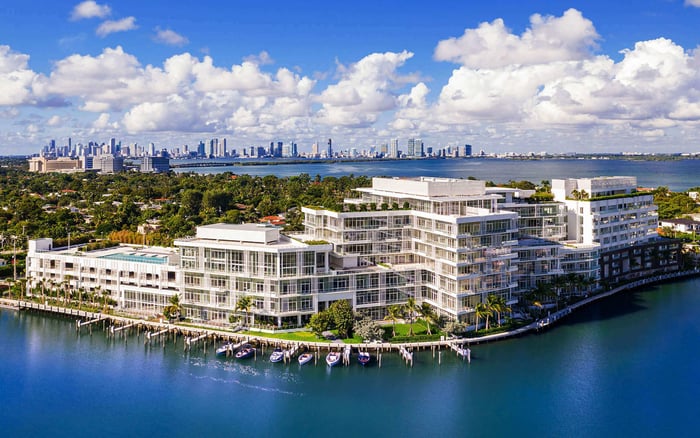
A considered framework for moving several generations from Chicago to Miami Beach, with clear distinctions between estate-planning decisions, Florida homestead benefits, title coverage and the true cost of ownership.

For a multigenerational household moving from Chicago to Miami Beach, the most consequential decisions extend beyond bedroom placement. Who will own the residence, fund the purchase, occupy it permanently and oversee its expenses should be settled before a contract becomes binding.
The objective is more than a successful acquisition. It is a home whose financial arrangements remain workable as family circumstances change. A considered plan separates four matters: purchase liquidity, estate and beneficiary coordination, title coverage, and recurring residence costs.
When evaluating 57 Ocean Miami Beach, for example, pair the residential brief with a family brief. Identify intended occupants, anticipated contributions and the person responsible for coordinating counsel, the closing agent and financial advisers. Treat these as planning questions, not conclusions about anyone’s legal rights.
Begin with a funding schedule that distinguishes deposits, closing funds, moving expenses and reserves for ongoing ownership. For financed purchases, budget beyond the price for lender-related charges, recording and loan taxes, appraisal, survey, inspections and required reserves.
Then ask estate counsel and financial advisers a separate question: what funds would support the residence if a principal contributor died or became unable to manage payments? Do not treat an expected inheritance or anticipated account distribution as confirmed purchase funding without an individualized review.
Identify each proposed funding source, its owner, its intended purpose and the approvals needed to use it. Ask advisers to test the plan against a delayed Chicago sale, an interrupted contribution or a period of overlapping residences. These are scenarios to evaluate, not predictions.
Keep the purchase decision connected to the estate-liquidity decision, but do not assume that satisfying the closing statement resolves the family’s longer-term needs.
Before settling the ownership structure, bring the proposed title arrangement, estate documents and relevant beneficiary designations into a single professional review. Ask counsel whether they reflect the family’s intended occupancy, decision-making and succession arrangements. Resolve questions before signing final ownership documents rather than relying on informal family understandings.
For a household considering Five Park Miami Beach, begin with who will live in the home and who will contribute to it. Then address payment responsibility, future changes in occupancy and how disagreements should be handled. Ask counsel whether and how those expectations should be documented.
Property-tax homestead eligibility must remain distinct from constitutional homestead, creditor-protection and inheritance questions. A property-tax benefit is not a substitute for advice on those separate legal issues. Nor should a family contribution receive a legal or tax characterization without review.
Florida’s homestead exemption requires a qualifying permanent residence occupied by the property owner or the owner’s dependent. Occupancy alone does not establish eligibility. A qualifying exemption also makes the property eligible for the Save Our Homes assessment limitation.
Illinois property-tax exemptions and assessment history cannot be transferred to Florida. A Chicago household should approach its Miami Beach tax position as a new analysis, not a continuation of its Illinois treatment.
The buyer must apply for homestead benefits. The seller’s exemption and Save Our Homes protection do not automatically pass with the purchase. A change in ownership generally removes the seller’s assessment benefit and triggers reassessment.
Do not use the seller’s tax bill as the buyer’s operating-cost forecast. Request a buyer-specific tax estimate and have its assumptions reviewed before incorporating it into the annual budget. Keep prospective benefits separate from confirmed ones.
A household member with a previous Florida homestead may qualify for portability when establishing a new Miami Beach homestead, subject to eligibility requirements. That possibility warrants an individual review, not an assumption that the entire household has a transferable benefit.
Eligible homeowners can transfer up to $500,000 of homestead assessment difference-the difference between assessed and market values. This is not $500,000 in tax savings.
The new homestead generally must be established within three assessment years after abandoning the previous Florida homestead. Homestead and portability applications generally must be filed with the county property appraiser by March 1 for the applicable tax year. Portability requires Form DR-501T with the new homestead application.
Add these dates and documents to the relocation calendar. The question is whether a particular applicant qualifies, not simply whether someone in the family has owned Florida property.
Florida title-insurance premium rates are established under Rule 69O-186.003, Florida Administrative Code. They are not freely negotiated by each title company. Who pays the owner’s premium, however, is negotiable through the purchase contract.
Original owner’s coverage carries a $100 minimum premium, with listed rates of $5.75 per $1,000 for the first $100,000 and $5.00 per $1,000 from $100,000 through $1 million. Qualifying reissue coverage has lower listed rates of $3.30 and $3.00 per $1,000 across those respective tiers. Confirm reissue eligibility with the closing agent.
These tiers are not a complete luxury-property premium schedule. For a purchase at Setai Residences Miami Beach, request an itemized estimate for the actual transaction and coverage amount rather than extending the quoted tiers beyond $1 million.
An owner’s policy and a lender’s policy protect different interests; one does not replace the other. In Miami-Dade resale transactions, the seller customarily pays the deed documentary stamp tax, but confirm the allocation in the contract.
For a residence under consideration at The Perigon Miami Beach, request the applicable cost documents and quotes before deciding what the family can comfortably sustain. Avoid a generic Chicago-to-Miami Beach cost comparison.
Build the worksheet around buyer-specific property taxes, insurance quotes, applicable association charges, utilities, maintenance and any financing payments. Ask which expenses are included in shared charges and which require separate payment. Review applicable assessment notices and reserve information with advisers rather than assigning an unsupported contingency figure.
Finally, propose a household payment protocol: who receives invoices, who approves exceptional spending and how contributions will be revisited. Keep acquisition costs separate from annual expenses, and both separate from estate-liquidity planning. This gives the family a clearer framework for choosing a residence that serves every generation without obscuring the responsibilities behind it.
Explore Miami Beach residences with MILLION as you shape a property search around your household’s priorities.
If branded residences are on your mind — as a home or as an allocation — we would be glad to share what we are seeing, privately.
Begin a quiet conversationNo. Illinois exemptions and assessment history cannot transfer to Florida; Florida portability concerns benefits from a previous Florida homestead.
No. Florida requires a qualifying permanent residence occupied by the owner or the owner’s dependent, and occupancy alone does not establish eligibility.
No. Buyers must apply for their own benefits, and a change in ownership generally removes the seller’s Save Our Homes benefit and triggers reassessment.
It represents up to $500,000 of eligible homestead assessment difference, not tax savings. Eligibility depends on the applicant’s prior Florida homestead and other requirements.
The new homestead generally must be established within three assessment years after abandoning the previous one. Applications generally are due March 1, with Form DR-501T submitted with the new homestead application.
Premium rates are established under Florida’s title-insurance rate rule. The purchase contract can negotiate who pays the owner’s premium.
The stated tiers cover only amounts through $1 million and are not a complete luxury-property premium schedule. Request a transaction-specific estimate and confirmation of any reissue eligibility.
No. Owner’s and lender’s title policies protect different interests, so owner’s coverage does not replace lender’s coverage.
Ask estate counsel and financial advisers to review proposed ownership, estate documents, relevant beneficiary designations and funds intended to support the residence. Keep that review distinct from property-tax homestead eligibility.
Request buyer-specific tax estimates, insurance quotes and applicable association costs, then budget for utilities, maintenance and financing payments where relevant. Do not use the seller’s tax bill as the buyer’s forecast.