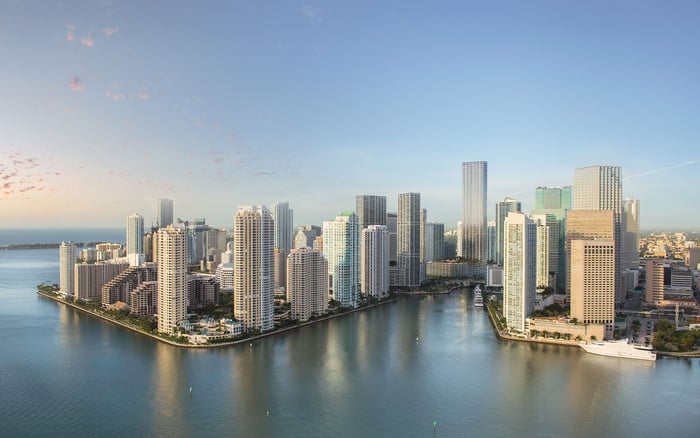
A discreet guide to mortgage interest strategy for international buyers weighing liquidity, currency exposure, underwriting, and premium South Florida residential choices.

At the high end of South Florida real estate, financing is rarely a simple question of need. Many international buyers have the capacity to purchase in cash, yet still consider a mortgage for liquidity, currency management, portfolio flexibility, estate planning, or future optionality. The decision is less about whether debt is available and more about whether debt improves the overall architecture of the acquisition.
That distinction matters. A waterfront condominium, a branded residence, a penthouse, or a private island address may carry a very different ownership profile from a primary home in the buyer’s country of residence. The mortgage should be evaluated alongside the buyer’s holding period, income currency, family use, resale expectations, and tolerance for rate movement.
In practice, sophisticated buyers do not begin with, “What rate can I get?” They begin with, “What structure preserves the most control?” The answer may be a cash purchase, a conservative loan, a variable facility, a fixed-rate product, or a staged approach that changes after closing.
International buyers should expect the lending process to be more document-driven than a domestic purchase. A lender may review identification, global income, assets, liabilities, banking history, entity ownership, and the source of funds. The buyer may also need to coordinate documents across languages, jurisdictions, and time zones.
This is not necessarily difficult, but it rewards preparation. Before pursuing a residence in Brickell, Miami Beach, Sunny Isles Beach, Fisher Island, or Palm Beach, a buyer should know which assets are liquid, which are pledged, which are jointly owned, and which can be verified quickly. A delay in documentation can become a negotiation issue if the seller expects certainty of closing.
For a buyer comparing a financial district lifestyle at St. Regis® Residences Brickell with a more resort-oriented coastal residence, the financing file should be ready before contract terms are sharpened. At the upper tier, speed and credibility often matter as much as price.
Mortgage interest strategy should include the interest rate, but not stop there. Buyers should ask how the rate is set, how long it is fixed, whether it can adjust, what happens if the loan is repaid early, how reserves are calculated, and whether the lender requires a banking relationship. A low headline rate can become less attractive if the structure reduces flexibility.
For some international buyers, a fixed-rate product provides psychological clarity. The payment is easier to model, especially when the property will be used as a second home. For others, a shorter-term or variable approach may feel more efficient if they expect to repay, refinance, sell, or restructure after a liquidity event abroad.
The correct answer depends on the buyer’s broader balance sheet. If the purchase is part of a larger investment plan, the question becomes whether borrowing protects productive capital or merely adds complexity. If the property is primarily for family use, predictability may carry more value than theoretical savings.
Many international buyers earn, invest, or hold wealth outside the United States. A U.S. dollar mortgage introduces a second variable: the relationship between the buyer’s home currency and the dollar. A loan that looks efficient at closing can feel more expensive if the buyer’s funding currency weakens.
This is why currency planning belongs in the same conversation as mortgage interest. Buyers should model payment obligations, reserves, insurance, taxes, association dues, maintenance, and future capital needs in the currency they actually use to fund the property. The goal is not to predict exchange rates. The goal is to avoid being surprised by them.
A buyer considering Miami Beach, for example, may focus on architectural pedigree and beachfront access at The Perigon Miami Beach, but the ownership plan still needs a disciplined currency overlay. Luxury does not eliminate financial friction. It simply raises the cost of ignoring it.
Mortgage strategy should also reflect the type of property being acquired. A move-in ready residence, a pre-construction contract, a boutique building, a branded tower, and an estate property can each create different timing and liquidity considerations. The buyer’s intended use matters as well: seasonal retreat, long-term family base, rental-oriented asset, or eventual relocation.
In Sunny Isles Beach, buyers looking at highly vertical coastal living, including Bentley Residences Sunny Isles, may care about long-term carrying comfort, privacy, and a resilient exit plan. In Fisher Island, where privacy and scarcity are central to the ownership thesis, a buyer evaluating The Residences at Six Fisher Island may prioritize capital preservation and certainty over maximum leverage.
The loan should follow the life of the asset. If the buyer expects to hold for many years, payment stability may matter. If the buyer expects a shorter horizon, prepayment flexibility may matter. If the buyer is coordinating a sale abroad, bridge timing may matter. In each case, interest cost is only one layer.
At the upper end, liquidity itself is a form of luxury. Cash can create negotiation strength, simplify closing, and reduce ongoing obligations. Financing can preserve cash for business, investment, family office priorities, philanthropy, or opportunistic acquisitions. Neither approach is inherently superior.
The danger is choosing a mortgage solely because it is available. A buyer should understand how much liquidity remains after the down payment, closing costs, reserves, furnishing, improvements, and annual carrying expenses. A residence that is comfortable to buy should also be comfortable to own.
This is especially relevant for international clients because the purchase often sits inside a global financial picture. A property in South Florida may be one of several homes, one of several currencies, and one of several jurisdictions. Mortgage interest strategy should support that complexity, not add unnecessary pressure.
Pre-construction purchases can create a different rhythm from resale acquisitions. Instead of funding the full purchase at closing, the buyer may make deposits over time before final financing is arranged. That timeline can be useful, but it should not be mistaken for a financing plan.
Before committing, buyers should understand when financing will be needed, how changes in rates could affect the eventual cost of ownership, and whether they would still complete the purchase if the lending environment changes. A residence such as The Residences at Mandarin Oriental, Miami may appeal to buyers who value brand, service, and long-term presence, but the capital plan should be as carefully considered as the design plan.
A prudent approach is to model more than one scenario: cash close, partial financing, higher interest cost, currency movement, and delayed liquidity from another asset. The exercise is not pessimistic. It is professional.
International buyers should assemble the right advisory circle before they begin making offers. That may include a real estate advisor, private banker, mortgage professional, tax counsel, estate counsel, and, where relevant, a family office representative. Each should understand the buyer’s objectives before the property is selected.
The best mortgage strategy is rarely created in isolation. Entity ownership may affect lending. Estate planning may affect title. Currency planning may affect reserves. Rental intentions may affect the loan discussion. Privacy preferences may affect documentation pathways. When these conversations happen late, the buyer has fewer options.
A well-structured acquisition feels quiet. The financing is aligned, the documentation is organized, the closing path is credible, and the buyer can focus on the quality of the property rather than the mechanics of the transaction.
Should an international buyer finance a South Florida purchase? It depends on liquidity, currency exposure, tax planning, and the buyer’s intended holding period. Financing can be useful, but it should serve a clear purpose.
Is the lowest mortgage rate always the best option? No. Flexibility, prepayment terms, reserve requirements, and rate-adjustment risk can matter as much as the quoted rate.
Should buyers get financing reviewed before making an offer? Yes. A prepared financing file can strengthen credibility and reduce delays during negotiation and closing.
How does currency risk affect mortgage planning? If income or liquid assets are held outside the United States, exchange-rate movement can change the real cost of payments and reserves.
Can a cash buyer still benefit from using a mortgage? Sometimes. Debt may preserve liquidity for other priorities, but the added complexity must be justified.
Are pre-construction purchases different from resale purchases? Yes. Deposits and final closing may occur on different timelines, so buyers should model future financing conditions early.
Should the property type influence the loan structure? Absolutely. A seasonal residence, long-term family base, and investment-oriented property may each call for a different structure.
What should buyers prepare before speaking with a lender? They should organize identity documents, asset verification, income information, liabilities, ownership entities, and source-of-funds support.
Is leverage more common for investment-minded buyers? It can be, but leverage should be measured against risk, liquidity, currency exposure, and the buyer’s broader portfolio.
When should legal and tax advisors be involved? Early. Ownership structure, estate planning, and cross-border considerations can influence both the purchase and the financing.
For a confidential assessment and a building-by-building shortlist, connect with MILLION.
If branded residences are on your mind — as a home or as an allocation — we would be glad to share what we are seeing, privately.
Begin a quiet conversation