For Monaco-based families considering Miami, the smartest purchase is rarely just a beautiful residence. It is a coordinated move that aligns immigration posture, U.S. tax residency, Florida domicile evidence, private-school admissions, and neighborhood logistics before the school year begins.

For families accustomed to Monaco, Miami can feel familiar: coastal living, global capital, marina culture, private aviation access, and a social calendar shaped by international movement. Yet the legal architecture behind the move is fundamentally different. Monaco is commonly used as a low-tax residence base because the Principality does not levy personal income tax on most residents, with notable exceptions such as French nationals. Anyone intending to live there for more than three months must also satisfy residence-card requirements tied to accommodation, financial means, and background checks.
Miami offers a different proposition. Florida does not impose a personal income tax, giving the state a strong comparative advantage within the United States. But Miami is not Monaco in tax terms. U.S. citizens and resident aliens are generally taxed by the United States on worldwide income. Foreign buyers can also become U.S. tax residents through lawful permanent residence or by meeting the substantial-presence test, which generally looks for at least 31 days in the current year and 183 days under a three-year weighted formula.
The result is clear: the school-year move should not be treated as a lifestyle decision first and a tax decision later. Immigration planning, federal tax-residency analysis, and family-office coordination should begin before the purchase contract, lease, or school deposit becomes the anchor event.
Florida domicile is a question of intent supported by conduct. A buyer may record a sworn Declaration of Domicile stating that Florida is the person’s permanent home and principal establishment, but that declaration should match the family’s actual pattern of life. Residence use, personal records, voter and driver documentation where applicable, club and medical relationships, and the timing of the move all help tell the same story.
For luxury homeowners, Miami-Dade homestead planning adds another timing layer. The homestead exemption generally requires the property to be the owner’s permanent residence as of January 1, with a standard filing deadline of March 1. For eligible primary residences, the exemption can reduce taxable value by up to $50,000. Florida’s Save Our Homes assessment limitation can also cap annual increases in assessed value for homesteaded property, making long-term holding strategy more relevant than many international buyers initially expect.
This is where the residence itself becomes evidence, not merely shelter. A family purchasing The Residences at 1428 Brickell, for example, may be choosing an urban base close to financial, legal, and cultural infrastructure. But the more important question is whether the use pattern, records, and calendar support the intended Florida domicile position.
Private-school strategy is not the same as public-school zoning. In Miami’s private-school ecosystem, address can improve daily logistics, but it does not guarantee admission. Schools operate their own admissions processes, calendars, grade-level availability, and program requirements. Families considering Ransom Everglades, Gulliver Prep, Miami Country Day School, Carrollton School of the Sacred Heart, or other independent schools should treat acceptance, housing, and domicile evidence as parallel workstreams.
Private-school timing also intersects with Florida attendance rules. Compulsory school attendance generally applies to children who have attained age 6 by February 1 and continues until age 16. For internationally mobile families, the academic calendar is more than a convenience issue. It affects when the family should be present, when records should shift, and when a primary residence begins to look like a lived-in home.
Curriculum continuity can be equally important. Monaco-based families accustomed to international education may use the International School of Monaco as a reference point because it offers International Baccalaureate programming. In Miami, IB pathways exist within the private-school landscape, including Gulliver Prep’s IB Diploma Programme and programming at Carrollton School of the Sacred Heart. The relevant question is not simply which school is prestigious. It is which curriculum, campus, commute, and admissions timeline best support the child’s transition.
The best neighborhood is often the one that reduces friction. Coconut Grove and Coral Gables remain natural considerations for families looking at established school corridors, residential streets, and a more settled daily rhythm. A buyer drawn to Four Seasons Residences Coconut Grove may be prioritizing a refined bayfront lifestyle while staying near the Grove’s family-oriented fabric. Nearby Coral Gables options such as The Village at Coral Gables can appeal to buyers who want a more residential setting with access to cultural, academic, and dining amenities.
Miami Beach answers a different need. It can suit families who value oceanfront living, privacy, and a resort-caliber daily environment, provided the school commute has been tested at the right time of day. The Ritz-Carlton Residences® Miami Beach frames the conversation in lifestyle terms, but the prudent buyer still measures morning logistics, after-school activities, and how often the residence will be occupied during the year.
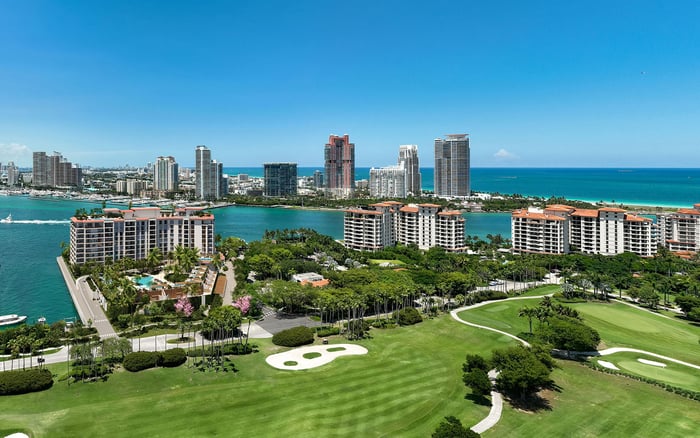
Fisher Island sits in its own category. Privacy, controlled access, and a highly curated residential environment can be compelling for families accustomed to discretion. Still, even at The Residences at Six Fisher Island, private-school admissions and domicile documentation remain independent disciplines. The water crossing may be elegant, but it must fit the school calendar and the family’s administrative plan.
The cleanest Monaco-to-Miami plan usually begins with counsel, not property tours. First, analyze immigration posture and U.S. tax residency. EB-5 may be relevant for some investor families seeking permanent residence, but immigration status should be considered separately from Florida domicile and school enrollment. Second, shortlist schools by curriculum, grade, admissions timeline, and commute. Third, determine whether a purchase, interim lease, or staged arrival best supports the family’s calendar.
Only then should the residence search narrow. The ideal home should support the chosen school path, the family’s presence pattern, and the documentary story of Florida domicile. For some buyers, that may mean Brickell efficiency. For others, it may mean Coconut Grove, Coral Gables, Miami Beach, or Fisher Island. The luxury is not merely the address. It is the absence of conflict between the home, the school, and the family’s long-term legal position.
Is moving from Monaco to Miami tax-equivalent? No. Florida has no personal income tax, but U.S. federal tax residency can create worldwide-income exposure for U.S. citizens and resident aliens.
Can a foreign buyer become a U.S. tax resident without realizing it? Yes. Lawful permanent residence or the substantial-presence test can create U.S. tax residency, so days in the country should be tracked carefully.
Does buying a Miami home automatically establish Florida domicile? No. Domicile depends on intent supported by conduct, records, residence use, and documentation such as a Declaration of Domicile.
Why does January 1 matter for homestead planning? Miami-Dade homestead exemption generally requires the property to be the owner’s permanent residence as of January 1, with a standard March 1 filing deadline.
Can homestead status matter for a luxury property? Yes. The exemption can reduce taxable value by up to $50,000, and Save Our Homes can limit annual assessed-value increases for qualifying homesteaded property.
Does living near a private school guarantee admission? No. Private schools use independent admissions processes, so proximity should be viewed as a logistics benefit, not an admissions right.
Which Miami schools may interest IB-focused families? Families seeking IB continuity may evaluate options such as Gulliver Prep and Carrollton School of the Sacred Heart, among others.
When should school planning begin? It should begin before the residence decision, because application deadlines, campus placement, grade availability, and commute can all shape the purchase strategy.
Is EB-5 the same as Florida domicile? No. EB-5 may be relevant to immigration planning, but domicile, tax residency, and school enrollment are separate issues.
What is the best first step for a Monaco family considering Miami? Coordinate tax, immigration, school, and real-estate advice before selecting a neighborhood or signing a purchase contract.
If you'd like a private walkthrough and a curated shortlist, connect with MILLION.
If branded residences are on your mind — as a home or as an allocation — we would be glad to share what we are seeing, privately.
Begin a quiet conversation