Miami Tropic Residences pairs Jean-Georges-influenced residence kitchens with planned culinary services. For buyers employing a private chef, the real evaluation begins with workflow, equipment, staff access and the terms behind the advertised amenities.
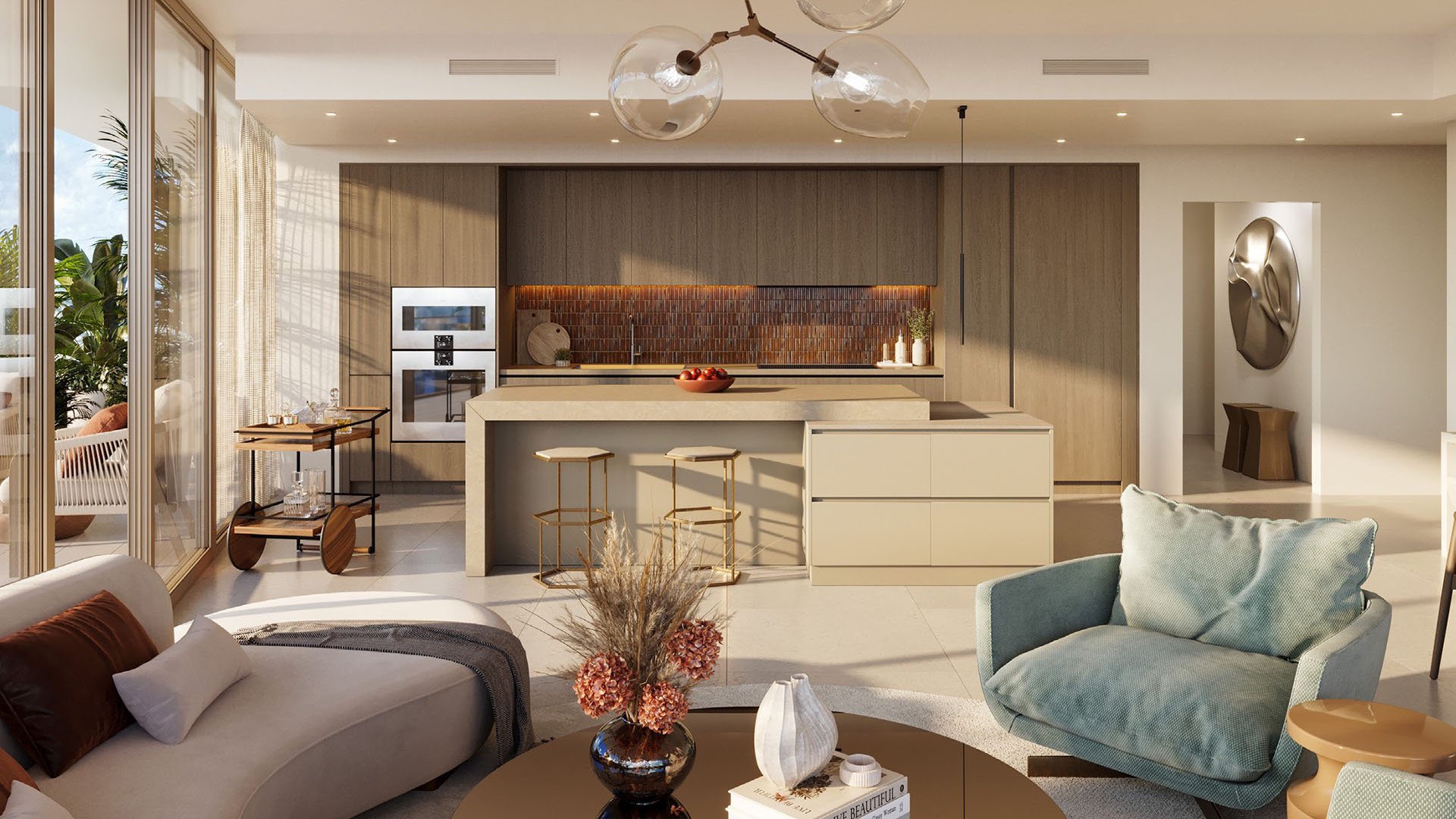
For a household that employs a private chef, the most consequential luxury may be a kitchen that works gracefully while guests are present. At Miami Tropic Residences, Jean-Georges Vongerichten’s involvement is intended to extend beyond a restaurant address to residence-kitchen design and building-wide culinary programming. That distinction warrants a closer look at daily use, not simply brand recognition.
The announced development comprises 48 stories, 320 condominium residences and 27,500 square feet of ground-floor retail. Planned just south of the Design District and near the Shops at Midtown Miami, it brings Terra and Lion Development Group together with the chef. The announced address is 3501 NE First Avenue; buyers should confirm it against current sales documents.
For an owner employing a private chef, the decisive question is narrower: can the selected residence support the way the household eats and entertains? Chef-influenced design is meaningful, but it does not establish commercial-grade capacity or guarantee restaurant-style service.
The advertised collaboration between Jean-Georges and Yabu Pushelberg covers kitchen layouts, appliance and fixture selections, storage solutions and island configurations. Each has practical consequences for a buyer whose kitchen will be used professionally, even in a residential setting.
The islands are described as both preparation and entertaining spaces. That dual role deserves a careful floor-plan review. Ask your chef to trace an ordinary dinner from ingredient storage through washing, preparation, cooking, plating and clearing. Repeat the exercise with guests seated nearby. A visually generous island may still demand compromises when preparation, service and conversation compete for the same surface.
Request dimensions rather than relying on renderings. Assess usable counter space, circulation around open appliance doors, pantry accessibility and the distance between refrigeration and the cooking zone. The relevant measure is not how many people can gather around the kitchen, but whether the chef can work comfortably without disrupting them.
Buyers also considering ORA by Casa Tua Brickell can apply the same discipline: compare the documented kitchen configuration of the residence under consideration rather than assuming that a project’s identity resolves operational questions.
Residence kitchens are advertised with electric induction stovetops, presented as energy-efficient and easier to clean than conventional gas cooking. For a private-chef household, the next step is to establish precisely what will be installed.
Request the appliance schedule, model numbers, dimensions and induction power specifications. Have the chef assess cooking-zone sizes, simultaneous-use requirements and cookware compatibility against the household’s usual menus. The question is whether the specified equipment suits the intended service, not whether induction is categorically preferable to gas.
Ventilation warrants equal attention. Obtain exhaust specifications, electrical capacity and any restrictions on appliance changes. Confirm refrigeration and freezer capacity, pantry storage and waste-handling arrangements. None of these details should be inferred from the chef’s involvement or the kitchen’s appearance. If a preferred appliance substitution is essential, establish whether it is permitted before making it part of the purchase plan.
The advertised culinary services include in-residence dining, pantry stocking, specialty entertaining and catering menus curated by Jean-Georges. These offerings could complement a household’s own chef, particularly when owners want an alternative to cooking at home. They should not be treated as an included private-chef arrangement without explicit confirmation.
Clarify who provides each service, how it is staffed and what fees apply. Ask whether pantry stocking accommodates an owner’s preferred ingredients, whether in-residence dining requires advance reservations and how catering requests are scheduled. Availability and booking rules matter as much as the menu.
The planned culinary amenities include a private restaurant on the pool level, a dedicated chef’s kitchen and a private dining room. Jean-Georges’ abc kitchens concept is also planned for the ground-floor retail space. These are distinct settings, not interchangeable extensions of the residence. Establish which spaces your own chef may use and whether outside staff, equipment or ingredients are permitted.
Evaluate all of these facilities and services as planned or advertised offerings; do not assume they are operational.
A beautiful kitchen is only one part of private-chef service. Groceries, staff, equipment and cleared dishes must move through the building under rules that suit the household’s schedule.
The project advertises a second-level drive-up porte-cochère, dedicated valet service, valet parking and a 24-hour concierge. These features address arrival and assistance, but they do not establish arrangements for private staff. Confirm loading access, service-elevator availability, delivery hours, chef parking, staff permissions and after-hours entry separately.
Walk through two scenarios with the sales team: a routine weekday meal and a larger dinner. Where does the chef arrive? How are groceries received? What happens when service ends late? Request the applicable written policies rather than assuming that concierge or valet services cover every operational need.
Indoor/outdoor dining, an outdoor kitchen, lounges, gardens and a pool deck form part of the advertised entertaining program. These spaces may offer alternatives to hosting entirely within the residence, but their usefulness depends on reservation terms, staffing requirements and access rules.
Ask whether the private dining room and dedicated chef’s kitchen can be reserved together, whether outside chefs are allowed and how cleanup is handled. Establish any event charges or minimum spending requirements before building a hosting routine around these amenities.
For a buyer also evaluating Cipriani Residences Brickell, the comparison should rest on documentation: separate what belongs to the residence from what requires a booking, a service charge or building approval. A compelling culinary identity is not a substitute for clear operating terms.
Before committing, assemble a review package with the selected floor plan, appliance schedule, kitchen dimensions, ventilation details and available service policies. Let the chef test it against the household’s menus, storage needs and entertaining habits.
Miami Tropic’s proposition connects chef-influenced domestic design with a broader planned culinary program. Its value to a particular buyer depends on how well those elements support everyday life. The right residence should make the chef’s work more fluid while allowing the owner to remain the host, rather than the coordinator of unresolved logistics.
For a discreet assessment of residences through the lens of your household’s culinary needs, connect with MILLION.
If branded residences are on your mind — as a home or as an allocation — we would be glad to share what we are seeing, privately.
Begin a quiet conversationHis advertised involvement includes residence-kitchen design and culinary programming, rather than only a restaurant within the building.
Jean-Georges worked with Yabu Pushelberg on layouts, appliance and fixture selections, storage solutions and island configurations.
Chef involvement does not establish commercial-grade capacity. Buyers should review the actual equipment, ventilation and layout with their private chef.
The residence kitchens are advertised with electric induction stovetops. Buyers should confirm model numbers, power specifications and compatibility with their chef’s cookware.
The advertised offerings do not establish an included private-chef arrangement. In-residence dining, pantry stocking and catering require confirmation of providers, fees and availability.
The planned program includes a pool-level private restaurant, a dedicated chef’s kitchen and a private dining room. The abc kitchens concept is also planned for the ground-floor retail space.
Private-chef access is not established by the advertised amenity description. Buyers should confirm outside-staff permissions, reservation rules and charges.
Confirm loading access, service elevators, delivery hours, chef parking and after-hours entry. Advertised valet and concierge services do not establish these arrangements.
The announced location is 3501 NE First Avenue, just south of the Miami Design District and near the Shops at Midtown Miami. Buyers should confirm the address against current sales documents.
They should be treated as planned or advertised offerings. Buyers should verify current delivery status and service availability before relying on them.