A practical luxury buyer’s guide to evaluating Miami residences through the lens of family routines, school commutes, building services, privacy, pets, and neighborhood rhythm.

For families buying in Miami, the strongest residence is rarely defined by size alone. Square footage matters, but the real test is rhythm: the school morning, the sports pickup, the weekend birthday party, the visiting grandparents, the pet walk before dinner, and the ability to move through it all with calm.
Luxury buyers often begin with skyline, water, and architecture. Families quickly add a second framework. How many transitions does each weekday require? Can a caregiver, driver, or parent manage the route without constant friction? Does the building support real life, or simply photograph well? The right Miami residence should reduce complexity while preserving the pleasures that drew the household to South Florida in the first place.
This is where neighborhood fit becomes as important as interior finish. Brickell, Coconut Grove, Coral Gables, Bay Harbor Islands, Miami Beach, Sunny Isles, and Fort Lauderdale can all support family life, but they do so in different ways. A family choosing between an urban tower, a boutique bayfront building, and a village-scaled address is really choosing the operating system for daily living.
School commute planning is not just about distance. It is about predictability, route options, drop-off patterns, afternoon obligations, and how much stress a household is willing to absorb. A residence that looks ideal on a quiet Sunday may perform very differently on a weekday morning.
Families considering Brickell may be drawn to the convenience of an urban center, with proximity to dining, offices, and cultural life. A residence such as 2200 Brickell can be part of that conversation when buyers want to evaluate a central address against school routes, after-school activities, and household staffing patterns. The question is not whether Brickell is elegant. It is whether its pace supports the children’s week.
Private-school decisions add another layer. Private-school commutes can cross neighborhood lines, and the most sensible home base may be the one that gives a family multiple workable routes rather than a single ideal route. Families should test the commute at the times they will actually use it, including early drop-off, late pickup, and rainy afternoons.
In family real estate, service is not a decorative amenity. It is infrastructure. Valet, reception, package handling, secure arrival, bicycle storage, pet accommodations, and dependable maintenance can change how a household feels on a Tuesday morning.
For parents who travel, service also becomes a form of continuity. A well-managed building can simplify arrivals, guests, household deliveries, and coordination with caregivers. Families with older children may prioritize secure independence, allowing teens to meet friends, receive food deliveries, or return from activities with an added layer of oversight.
Storage deserves particular attention. Children accumulate equipment, instruments, sports gear, beach items, school projects, seasonal clothing, and luggage. A beautiful residence without adequate storage can become visually compromised very quickly. Buyers should ask how the building handles bikes, strollers, scooters, paddleboards, golf gear, and off-season items before being seduced by the view.
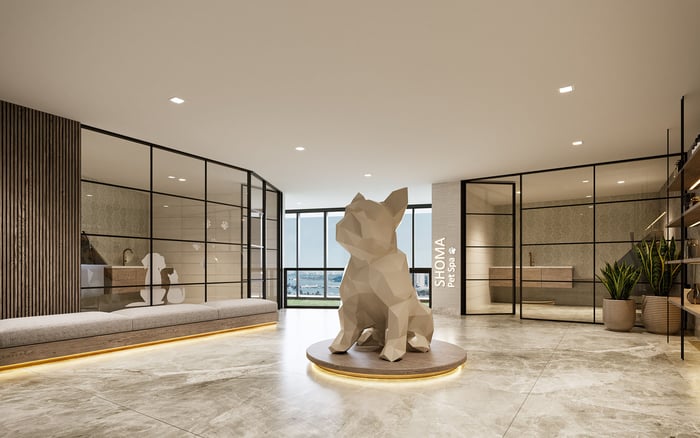
Pets also belong in the family calculus. Pets influence elevator routines, outdoor access, flooring choices, and the value of nearby green space. A pet-friendly residence is not simply one that permits animals. It is one that allows daily life with animals to remain graceful.
Coconut Grove and Coral Gables remain natural considerations for families that want a softer residential cadence without leaving the center of Miami’s cultural and dining life. The appeal is less about spectacle and more about proportion: shade, neighborhood identity, familiar routes, and a sense of daily continuity.
In Coconut Grove, buyers may compare condominium living with townhouse or single-family alternatives, especially when they want privacy without the maintenance burden of a traditional estate. The Well Coconut Grove is the kind of project families may place into a broader conversation about wellness, services, and Grove lifestyle, while Arbor Coconut Grove may appeal to buyers studying a more neighborhood-oriented residential setting.
Coral Gables often enters the discussion when families want a composed environment with a strong sense of place. Coral Gables buyers tend to focus on daily movement: school runs, dining, errands, clubs, grandparents, and weekend routines. The Village at Coral Gables can be evaluated through that lens, particularly for families that want residential character and access to an established neighborhood fabric.
Waterfront living can be extraordinary for families, but it requires careful lifestyle matching. Some households want sunrise walks, beach access, and resort energy. Others prefer a quieter island scale with easier routines and less performance. The distinction matters.
Bay Harbor locations can be attractive to buyers who want a more residential atmosphere while remaining connected to the beach, shopping, dining, and schools across the broader northern Miami corridor. A project such as Bay Harbor Towers can be considered by families evaluating boutique-scale living, water proximity, and a calmer neighborhood rhythm.
Beach addresses may offer a more sensory lifestyle: sand, ocean air, resort services, and the pleasure of hosting. Yet families should study elevator volume, guest policies, parking flow, beach equipment storage, and how children will move safely between residence, pool, beach, and street. The glamorous choice should still function on a school night.
A family residence must age well with its occupants. Young children may need bedrooms close to the primary suite. Teenagers may need separation, study areas, and privacy. Visiting relatives may require a guest suite that feels independent. A floor plan that is perfect today should not feel obsolete in three years.
Look closely at bedroom placement, acoustic separation, kitchen functionality, laundry capacity, service entries, and the relationship between indoor and outdoor space. Terraces can be valuable, but only if they are usable for the family’s actual habits. A shallow terrace may be lovely for a photograph, while a deeper outdoor space may support breakfast, reading, or supervised play.
Privacy is also a form of luxury. Families should study sightlines from neighboring towers, elevator access, corridor design, and the way guests move through the building. In ultra-premium Miami residences, discretion is often as valuable as drama.
The best family purchase begins with honest self-knowledge. A family that thrives on restaurants, offices, and walkable urban energy may feel constrained in a quieter enclave. A household that values calm, shade, and routine may find a high-gloss district overstimulating. Neither choice is superior. The right choice is the one that protects the family’s time.
Buyers should map a normal week before committing. Include school, sports, tutoring, medical appointments, airport runs, dining, groceries, clubs, beach time, and visits from friends. Then compare each neighborhood against that map. A residence that saves fifteen minutes twice a day can feel more luxurious than a larger home in the wrong location.
For South Florida families, the ultimate luxury is not merely access. It is ease. The right address makes the calendar lighter, the home calmer, and the weekend feel closer.
What should families evaluate first when choosing a Miami residence? Begin with the school commute and weekly routine. The right address should reduce daily friction, not add to it.
Is Brickell practical for families? Brickell can work well for families that value urban convenience and centrality. The key is testing school and activity routes during real commute windows.
Why do families often consider Coconut Grove? Coconut Grove offers a village rhythm that can suit households seeking neighborhood character, greenery, and a softer daily pace.
How does Coral Gables fit into a family search? Coral Gables can appeal to buyers who want established residential character and a composed setting for school, errands, and dining.
Are waterfront residences suitable for children? They can be, provided the building’s access, storage, security, and outdoor areas support the family’s everyday habits.
How important are building services for parents? Services can be highly important because they simplify deliveries, arrivals, guest coordination, maintenance, and travel days.
Should families prioritize square footage or layout? Layout is often more important than raw size. Bedroom placement, storage, privacy, and flexible rooms shape daily comfort.
What should pet owners ask before buying? Pet owners should review building rules, elevator routines, outdoor access, flooring, and nearby walking options.
How can families compare different Miami neighborhoods? Map a full week of school, activities, work, errands, and leisure. Then evaluate which address makes that week feel easiest.
What defines true family luxury in Miami? True family luxury is a residence that protects time, privacy, comfort, and calm while supporting the household’s long-term rhythm.
When you're ready to tour or underwrite the options, connect with MILLION.
If branded residences are on your mind — as a home or as an allocation — we would be glad to share what we are seeing, privately.
Begin a quiet conversation