A discreet buyer’s guide to choosing between Miami and Palm Beach when privacy, family rhythm, staff circulation, and guest separation define the residence.

For high-net-worth buyers, the choice between Miami and Palm Beach is rarely just about view, address, or architectural taste. It is about choreography. Where does family life unfold when guests are in residence? Can adult children visit without disrupting the primary suite? Can grandparents stay for a season and still feel independent? Can staff, deliveries, friends, and extended family move through the home without turning every moment into one shared public zone?
Separate guest and family zones are not a decorative preference. They are a measure of whether a residence can absorb real life gracefully. In South Florida, that test plays out differently in Miami and Palm Beach. Miami often rewards flexibility, vertical living, and social adjacency. Palm Beach often rewards calm sequence, longer stays, and a more residential sense of retreat. Neither is better. The right answer depends on how your household actually lives.
Miami suits buyers who expect a residence to perform in multiple modes. One week, the home may be a private family base. The next, it may host friends for a long weekend, business guests before dinner, or adult children arriving with partners. In this setting, the strongest floor plans allow the guest experience to feel natural without giving guests command of the family core.
In condominium residences, the issue is usually solved through plan discipline. Look for bedrooms that do not all open directly into the same family corridor, powder rooms placed near entertaining areas, and secondary suites that can be reached without passing the primary suite. A buyer comparing Brickell residences, for example, may study St. Regis® Residences Brickell not only for its urban setting, but for how a vertical home can separate hosting, sleeping, and everyday routines.
Miami also works for families who want proximity to restaurants, marinas, culture, and school or office routines, while still requiring a residence that can go quiet. The key is not simply the number of bedrooms. It is whether the plan gives each bedroom a clear purpose. A guest suite beside the living room may be convenient for a short visit, but less successful for a month-long stay. A secondary suite with a buffer, its own bath, and a sense of remove can make hospitality feel polished rather than improvised.
Palm Beach appeals when guest stays are longer, family routines are more protected, and the residence is expected to feel settled rather than constantly adaptive. The ideal plan often creates a clear hierarchy: primary quarters, family bedrooms, guest rooms, service areas, and formal entertaining spaces, each with its own rhythm.
For buyers considering the Palm Beach side of the decision, the question becomes one of duration. If guests come for holidays, school breaks, charity weekends, or the season, they need more than a beautiful room. They need independence without isolation. That may mean a guest wing, a suite with outdoor access, or a plan where early risers and late diners do not disturb the household’s center of gravity.
Palm Beach Gardens can also enter the conversation for buyers seeking a more relaxed residential pattern with a luxury-service lens. A residence such as The Ritz-Carlton Residences® Palm Beach Gardens may appeal to those weighing a quieter North County lifestyle against Miami’s sharper tempo. The principle is the same: do not buy only for the guest room. Buy for the path to it, the privacy around it, and the way it behaves when the home is full.
The most successful separated-zone residences share a few quiet traits. First, they avoid forcing guests through family-only spaces. Second, they protect the primary suite from noise and visual exposure. Third, they give secondary bedrooms enough autonomy to support different generations under one roof.
Circulation is the most overlooked luxury. A beautiful foyer that immediately exposes the family room may not work for a household with frequent guests. A long gallery, a private elevator landing, or a subtle turn in the plan can create psychological distance. In Miami Beach, where entertaining and privacy often coexist, buyers may consider The Perigon Miami Beach through this lens: how does arrival unfold, and how quickly does the home reveal its private life?
Bathroom placement is equally important. Guests should not rely on a bath that belongs emotionally to the family zone. Storage matters too, especially for repeat visitors. A suite that can hold luggage, beachwear, and personal items without spilling into the corridor will feel more like an invitation and less like a temporary arrangement.
In a single-family estate, separation may come through wings, courtyards, guest houses, cabanas, or secondary entrances. In a condominium, it comes through vertical planning, elevator arrival, bedroom placement, and the relationship between public and private rooms. Both can work beautifully, but they solve privacy in different languages.
Miami’s condominium market can be particularly compelling for buyers who want a lock-and-leave residence with sophisticated hosting capacity. The strongest plans create a sequence from arrival to view to entertaining, while keeping sleeping quarters discreet. For an internationally mobile household, this can be more practical than maintaining a larger estate with more operational complexity.
Palm Beach and its neighboring residential markets may be preferable when the household wants a more grounded daily pattern. Children, visiting relatives, wellness routines, pets, and staff can be accommodated with less dependence on elevators and shared building choreography. Yet a larger footprint is not automatically better. A sprawling home with poor adjacency can feel less private than a smaller plan designed with discipline.
Some buyers are not purely Miami or Palm Beach in temperament. They want water, privacy, and family ease without choosing the most extroverted or most traditional version of either market. In those cases, transitional locations deserve attention.
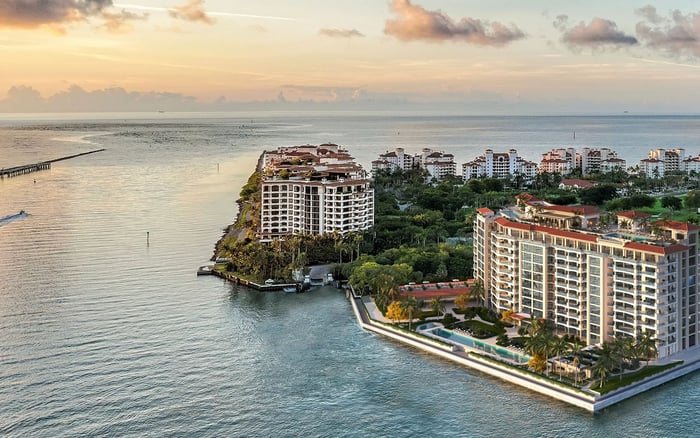
Bay Harbor Islands, Surfside, Coconut Grove, Fisher Island, and Boca Raton can each offer a different balance of discretion and access. A buyer considering Bay Harbor Towers may be thinking less about spectacle and more about calm proximity. A family studying The Residences at Six Fisher Island may be prioritizing privacy, arrival control, and a residence that feels removed while still connected to Miami.
The in-between decision is especially relevant for multigenerational buyers. If parents, children, and guests use the home differently, the winning address is the one that reduces friction. Privacy should not require explanation. It should be embedded in the plan.
Choose Miami if your home must pivot quickly between family life, social life, and business entertaining. Prioritize residences where guests can arrive, sleep, and depart without crossing the family’s most intimate spaces. Look for flexible secondary suites, strong acoustic separation, and a public zone that can host elegantly even when the family bedrooms are occupied.
Choose Palm Beach if your household values duration, quiet, and a more legible domestic order. Prioritize guest quarters that can support longer stays, family zones that remain protected during entertaining, and outdoor areas that allow people to gather or withdraw without competing for the same room.
Above all, do not let a spectacular view distract from a compromised plan. In the ultra-premium market, beauty is expected. Livability is what sustains value for the owner. The best residence is the one where hospitality feels effortless, family life remains private, and no one has to negotiate the house to feel at ease.
Should I choose Miami or Palm Beach for frequent guests? Choose Miami if visits are shorter and more social. Choose Palm Beach if guests tend to stay longer and need a quieter sense of independence.
What is the most important feature in a guest zone? The most important feature is separated circulation. Guests should not need to pass through private family areas to reach their room.
Are more bedrooms always better for family zoning? No. A smaller residence with intelligent separation can live better than a larger one where every bedroom opens into the same shared corridor.
Can a condominium provide true guest and family separation? Yes, if the plan uses bedroom placement, elevator arrival, and public-private transitions well. The quality of circulation matters more than the building type.
Is Palm Beach better for multigenerational living? It can be, especially for buyers who value longer stays and a calmer household rhythm. The deciding factor is the specific plan, not only the location.
Is Brickell practical for families who host often? Brickell can work well for households that want urban access and flexible entertaining. Buyers should focus on acoustic privacy and suite placement.
How should I evaluate a guest suite during a showing? Walk the exact path a guest would use from arrival to bedroom to bath. If that route exposes too much family life, the plan may not be ideal.
Do outdoor areas help with separation? Yes. Terraces, gardens, and pool areas can give guests and family members different places to gather without crowding one interior room.
What should families with adult children prioritize? Prioritize secondary suites with privacy, storage, and bathrooms that feel complete. Adult children need autonomy more than simply a spare bedroom.
Can one residence serve both formal entertaining and private family life? Yes, but only when the floor plan gives each function its own territory. The best homes make transitions feel natural rather than negotiated.
If you'd like a private walkthrough and a curated shortlist, connect with MILLION.
If branded residences are on your mind — as a home or as an allocation — we would be glad to share what we are seeing, privately.
Begin a quiet conversation