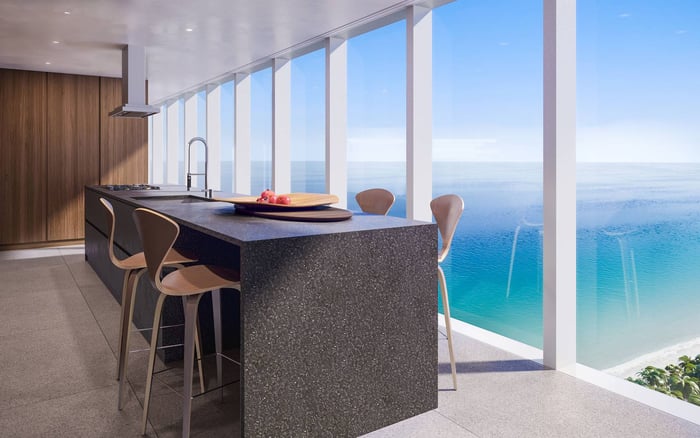
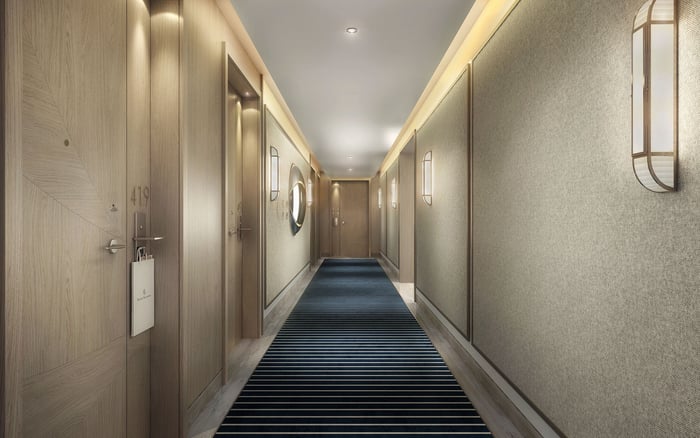
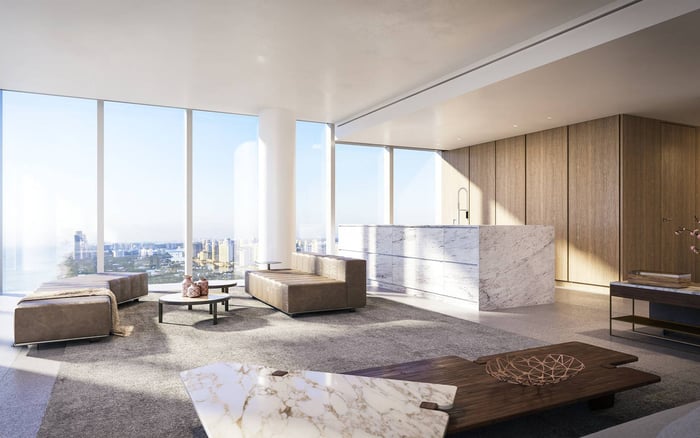
Hallandale Beach offers meaningful choice across new and established luxury towers. Buyers should test a residence against building-level resale depth, duplicate lines, view durability, and regional alternatives before accepting a premium.
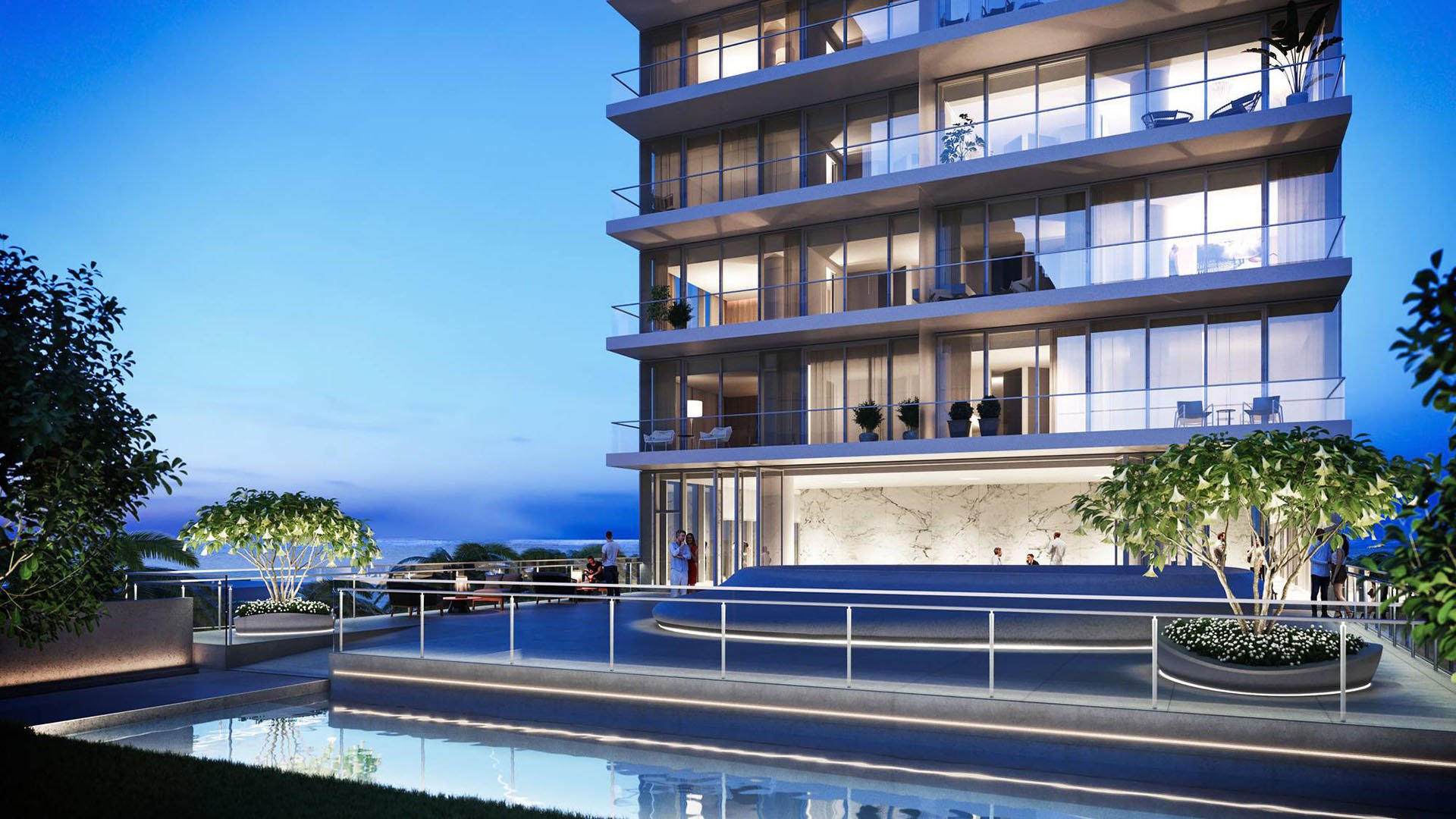
A polished sales gallery can make a new residence feel singular. In Hallandale Beach, however, the more consequential question is how singular that home will remain once it enters the resale market. Buyers of vertical luxury should examine the depth of competing inventory, the number of comparable stacks, and the durability of the view before assigning substantial value to newness, elevation, or finish.
This is particularly relevant in a Broward market where beachfront, Intracoastal, and inland-facing residences occupy a compact geography yet offer distinctly different ownership propositions. The right review begins at the building and line level, not with a citywide price alone.
In April 2024, luxury condo resale supply in the Hollywood and Hallandale area stood at approximately 18 months. By February 2025, it was nearly 19 months. In January 2026, Hallandale Beach had 487 active condo listings against 112 pending sales.
These figures do not predict the outcome for an individual residence, but they establish a buyer-favorable context with meaningful choice. Hallandale Beach homes also averaged 117 days on market, with sales averaging 5.15% below asking. Because those measures covered Hallandale Beach homes generally, they provide context rather than a substitute for tower-specific analysis.
For a luxury buyer, depth creates time to compare. It also makes premiums easier to test against recent closings, current listings, withdrawn offerings, and the number of credible substitutes within the same building.
The contrast between 2000 Ocean Hallandale Beach and larger local towers illustrates why building scale matters. The oceanfront 2000 Ocean contains 64 residences across 38 floors, while Beach Club II contains 483 units across 52 floors. Available inventory began at $2.782 million at the former and $598,000 at the latter.
Price alone does not make one opportunity superior. The key issue is duplication. In a large tower, multiple versions of a similar floor plan, exposure, or floor band may compete simultaneously. A smaller building may offer fewer direct substitutes, although buyers must still examine nearby towers and future supply.
Ask how many residences share the same bedroom count, orientation, terrace position, and approximate elevation. Then review how often those alternatives have appeared for sale. When line-by-line absorption data are unavailable, that exercise offers a practical proxy for resale depth.
Waterfront inventory in Hallandale spans direct oceanfront and Intracoastal settings. A generic water label can therefore conceal meaningful distinctions among direct ocean, angled ocean, Intracoastal, skyline, and potentially obstructed exposures.
View scarcity should be tested physically and comparatively. Buyers should consider what occupies the foreground, whether adjacent construction could alter the corridor, and how many other stacks reproduce substantially the same outlook. Elevation can improve reach, but a high floor is not automatically scarce when many residences above and below share an equivalent perspective.
The strongest premium case combines a difficult-to-replicate exposure with a layout that directs the principal rooms toward it. That is more defensible than paying for a view description that applies to numerous competing homes.
New construction should be evaluated alongside move-in-ready inventory, not in isolation. In January 2026, luxury-tower condo pricing ranged from $675,000 to $4.4 million, with entry-level luxury beginning around $400,000. At that moment, 176 condos across 10 properties averaged $1.73 million and $1,172 per square foot.
At the upper end, future ultra-luxury project Shell Bay by Auberge Hallandale had pricing from $5.746 million. Its presence is a reminder that a buyer's eventual resale competition may include projects not yet delivered.
The comparison set can also extend beyond city limits when lifestyle and pricing overlap. A buyer considering Hallandale's northern oceanfront edge may reasonably review Regalia Sunny Isles Beach as part of a wider coastal search. The purpose is not to force equivalence, but to understand what another scarce line, view, or ownership experience may offer at a similar budget.
A disciplined review follows a simple sequence: define the exact line, map its duplicates, identify active and recent resale competition, compare nearby substitutes, and then isolate the premium assigned to view, floor, and newness.
That sequence helps prevent finishes from overshadowing fundamentals. In a market with substantial resale choice, the most compelling residence is often the one whose essential attributes remain difficult to replace after the initial presentation has faded.
What does resale depth mean in a condo tower? It is the volume of comparable current and potential listings that could compete with a residence when it returns to market.
Why should line selection come before finish selection? Finishes can often be changed, while orientation, floor-plan geometry, and the principal view corridor generally cannot.
Is a high floor always more valuable? No. Elevation matters most when it creates a materially better or scarcer exposure than nearby floors and competing towers.
How can a buyer assess a line without line-specific absorption data? Review duplicate floor plans, active listings, recent closings, days on market, and the frequency with which comparable stacks appear.
Does oceanfront automatically mean an unobstructed ocean view? No. The angle, foreground, neighboring structures, and position within the tower can materially shape the outlook.
Why does the total number of units matter? A larger residence count can create more competing lines and listings, although the exact floor-plan mix remains important.
Should citywide inventory determine an offer? It provides negotiating context, but building-level and line-level competition are more relevant to a specific residence.
How should new construction be compared with resale? Compare total pricing, layout scarcity, exposure, delivery timing, and the quality and availability of move-in-ready substitutes.
Can future projects affect today's purchase decision? Yes. Future luxury supply may become direct competition by the time an owner chooses to sell.
What makes a view premium more defensible? A premium is stronger when the exposure is protected, visually distinctive, and unavailable across many comparable residences.
To compare the best-fit options with clarity, connect with MILLION.
If branded residences are on your mind — as a home or as an allocation — we would be glad to share what we are seeing, privately.
Begin a quiet conversation