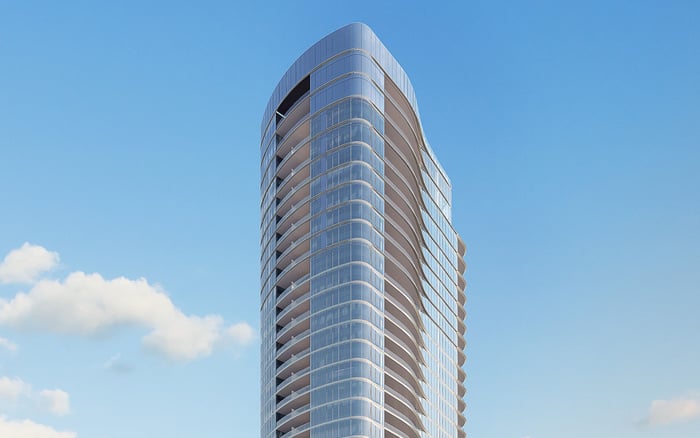
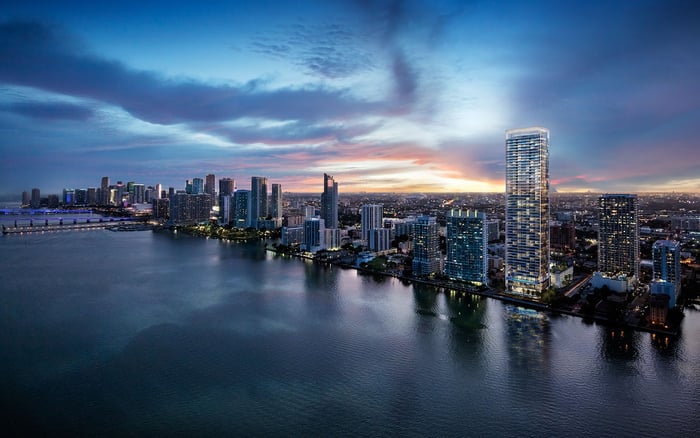
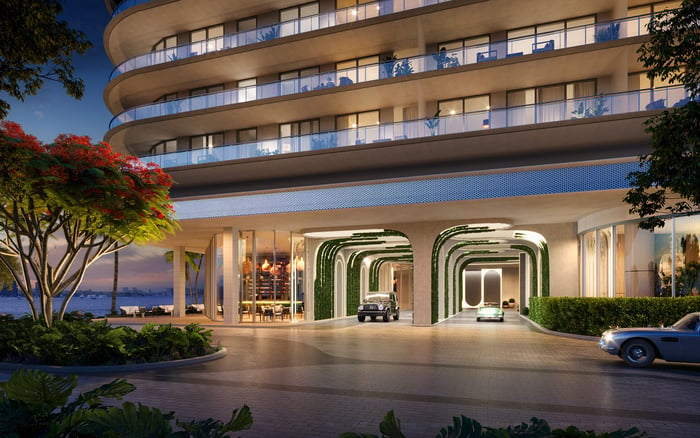
A buyer-focused framework for evaluating Miami Design Residences Midtown Miami through causeway access, privacy, building service logistics, and long-term resale positioning.

The most elegant residence is still lived through the rituals around it: the arrival, the valet handoff, the school run, the dinner departure, the vendor appointment, the airport transfer, and the late return after a night across the bay. For buyers considering Miami Design Residences Midtown Miami, the question is not simply whether the address feels central. It is whether its access profile supports the discretion, service, and future liquidity expected from a serious luxury purchase.
Causeway bottlenecks are often framed as a traffic inconvenience. In upper-tier real estate, they are more consequential. They can shape who reaches a building easily, how staff and vendors operate, how spontaneous a beach or island evening feels, and how a future buyer compares one residence with another. A Midtown Miami buyer should therefore read the causeway network as part of the property itself, not as a separate civic condition.
This does not mean avoiding locations that touch major routes. In many cases, access friction creates a desirable filter. The right building can feel connected without becoming porous. The discipline is to distinguish between friction that protects privacy and friction that erodes daily ease.
Privacy in Miami is not only about elevator cores, setbacks, or the number of residences per floor. It is also about approach. A residence in a highly visible, high-movement district can still feel private if the sequence from street to lobby is calm, legible, and well managed. Conversely, an address with postcard water views can feel exposed if every arrival is entangled with congestion, ride-share overflow, or event-driven traffic.
For a boutique buyer, the test is direct: can the building absorb daily movement without making residents feel on display? Study how cars queue, where guests are received, how valets separate resident vehicles from service vehicles, and whether the curb experience remains composed during peak dinner hours. A privacy-forward building does not rely on a quiet day to perform well. It performs when the district is active.
Causeways add another layer. They concentrate movement between mainland neighborhoods and barrier-island destinations. That concentration can make a mainland location appealing to buyers who want access to Miami Beach without living inside its visitor patterns. For some, Midtown offers a more measured base, one that can reach cultural, dining, and waterfront zones while preserving a sense of residential remove.
In luxury real estate, service is not a soft concept. It is operational. Housekeeping, private chefs, dog walkers, florists, art handlers, personal assistants, drivers, and maintenance teams all rely on predictable entry, loading, parking, and scheduling. If causeway congestion affects timing, the building’s service infrastructure must compensate.
A buyer should ask practical questions before falling in love with finishes. How are deliveries staged? Can vendors enter without disturbing the resident arrival sequence? Are service elevators adequately separated from social spaces? Is there a clear system for recurring household staff? Does the building team understand high-frequency residences, where owners may travel often and require precise coordination in their absence?
The stronger the service platform, the less daily life depends on perfect traffic. This is especially relevant for buyers comparing Midtown with waterfront alternatives in Edgewater, where projects such as EDITION Edgewater place a different emphasis on bay proximity and vertical residential living. Edgewater may offer a compelling waterview experience, while Midtown may appeal to buyers prioritizing Design District adjacency and mainland flexibility. The right answer depends on how the household lives.
Resale value is shaped by how future buyers interpret convenience. A route that feels manageable to one owner may become a negotiation point for another. The most resilient residences have a clear access story: close enough to what matters, insulated enough to feel private, and operationally strong enough to reduce friction.
For investment-minded buyers, the issue is not whether traffic exists. It is whether the residence has a defensible lifestyle thesis despite it. A Midtown property should be evaluated against likely buyer groups: full-time Miami residents, seasonal owners, design and art patrons, downsizers seeking urban energy, and international buyers who value service reliability over pure frontage. Each group will price access differently.
A future resale conversation should be easy to articulate. If the pitch requires too much explanation, the asset may be more vulnerable. If the pitch is intuitive, such as central mainland access, measured privacy, strong building operations, and selective proximity to beach and business districts, then causeway bottlenecks become part of the broader calculus rather than a fatal flaw.
A refined buyer should not study Midtown in isolation. Brickell, Miami Beach, Edgewater, Coconut Grove, Bay Harbor Islands, and Downtown all offer different balances of arrival, privacy, and mobility. The best comparison is not price per square foot alone. It is the lived experience of moving through the city.
Brickell, for example, often appeals to buyers who want proximity to finance, dining, and a highly vertical urban rhythm. A project such as Baccarat Residences Brickell belongs in that comparison when the buyer wants polished city energy and a more formal downtown-adjacent lifestyle. The tradeoff is that Brickell’s density creates its own access questions, especially during peak business and dining periods.
Miami Beach introduces another equation. Residences such as The Ritz-Carlton Residences® Miami Beach may appeal to buyers who want the island lifestyle first, with mainland access as the secondary question. In that case, causeways are not a small detail. They become the bridge between daily beauty and mainland commitments.
Midtown sits between these instincts. It can serve buyers who want cultural adjacency, mainland practicality, and a softer alternative to business-core intensity. That positioning can be powerful when matched with the right building operations and the right expectation of movement.
Begin with your actual week, not an imagined vacation week. Where are dinners? Where is school? Where are medical appointments, private aviation, office meetings, fitness routines, boats, beaches, and family obligations? Then map the residence around those patterns. Luxury is not theoretical when a driver is late, a guest cannot find the entry, or a delivery disrupts the lobby.
Visit at several times if possible: weekday morning, weekday evening, weekend afternoon, and a major-event window. Notice whether access feels merely busy or structurally constrained. Busy can be manageable. Constrained is different. It means limited alternatives, unpredictable delays, and a higher burden on building staff.
Next, evaluate redundancy. Are there multiple ways to approach the building? Can a driver choose a calmer route? Is the valet positioned to handle surges? Does the lobby feel residential rather than transactional? A strong access plan reduces the emotional cost of urban living.
Finally, look at the resale language. If you can describe the residence as private yet connected, central yet composed, and serviceable even when Miami is active, the asset has a cleaner story. If the description depends solely on future optimism, be cautious.
For Miami Design Residences Midtown Miami, the central question is balance. The address should be viewed through three lenses: how it protects the resident, how it supports the household, and how it will read to the next buyer. Privacy, service, and resale are not separate categories. They reinforce one another when the property is well chosen.
A buyer who values immediate beach frontage may reach a different conclusion than one who values mainland fluidity. A buyer who hosts frequently may care more about guest arrival. A seasonal owner may prioritize staff coordination and secure absence management. A collector may think about art movement, climate-controlled logistics, and discreet deliveries. None of these concerns are secondary. They are the architecture of daily ownership.
The best purchase decision is therefore not the one that avoids all bottlenecks. In Miami, that is unrealistic. The best decision identifies which bottlenecks are tolerable, which are strategic, and which would become a recurring compromise. In the most sophisticated transactions, access is not an afterthought. It is underwriting.
Why do causeway bottlenecks matter for Midtown Miami buyers? They influence daily timing, guest arrivals, service access, and how future buyers judge convenience.
Can traffic friction ever improve privacy? Yes. Some friction can filter casual movement, but only if the building arrival and service systems remain composed.
What should I test before purchasing? Test weekday and weekend approaches, valet flow, delivery protocols, guest arrival, and alternate routes.
Is Midtown Miami a beach alternative? It can be for buyers who want mainland flexibility while retaining access to Miami Beach and nearby cultural districts.
How does service access affect luxury living? Reliable service access supports staff, vendors, deliveries, and owner absences without disrupting resident privacy.
Should I compare Midtown with Brickell? Yes. Brickell offers a different urban rhythm, so the comparison clarifies whether you prefer business-core energy or Midtown balance.
Should I compare Midtown with Miami Beach? Yes. Miami Beach may prioritize island lifestyle, while Midtown may offer a more mainland-oriented ownership pattern.
What is the key resale question? Ask whether a future buyer can quickly understand the residence’s access, privacy, and service advantages.
Are waterview residences always better for resale? Not always. Views matter, but operational ease, privacy, and location logic can be equally important at the luxury level.
Is this mainly an investment concern or a lifestyle concern? It is both. The same access conditions that shape daily enjoyment can also shape future resale confidence.
When you're ready to tour or underwrite the options, connect with MILLION.
If branded residences are on your mind — as a home or as an allocation — we would be glad to share what we are seeing, privately.
Begin a quiet conversation