A practical comparison of Miami Beach and Surfside for primary-residence buyers, weighing privacy, school geography, daily service, zoning, and condominium context.

For a primary-residence buyer, the choice between Miami Beach and Surfside is less about prestige than operating rhythm. Both offer Atlantic access, luxury housing, and established residential addresses, yet they organize daily life differently. Surfside is compact and primarily residential; Miami Beach encompasses a broader range of neighborhoods, school locations, commercial corridors, and activity patterns.
The framework begins with three questions. How much visual and acoustic separation does the household require? Which school route must work on an ordinary weekday? Which services need to be accessible without turning every errand into a drive? These practical tests are more revealing than any municipality-wide reputation.
Surfside holds a structural advantage for buyers drawn to lower-scale surroundings. Its interior is predominantly single-family and low-rise, and its low-density residential category permits up to eight dwelling units per acre with a maximum height of 30 feet. A moderate-low-density category permits up to 17 units per acre, also with a 30-foot maximum. These controls can create a calmer residential scale, but they do not make every address equally private.
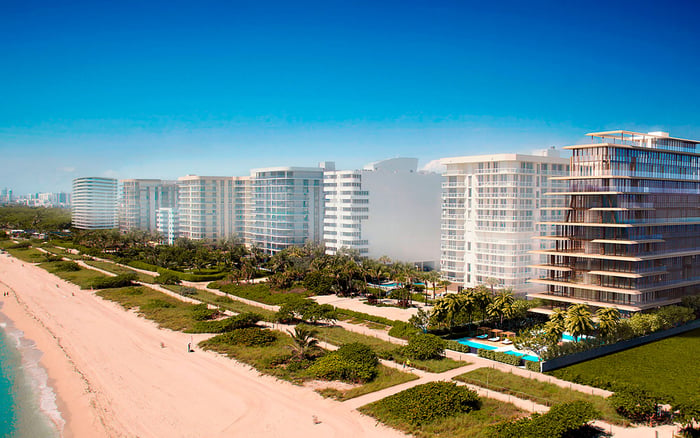
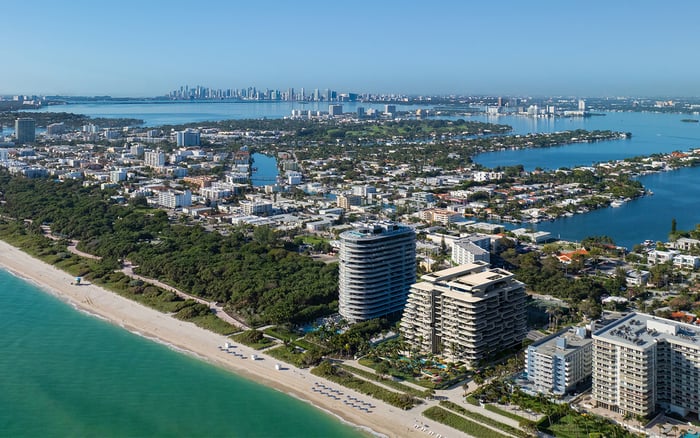
The town changes materially east of Collins Avenue, where oceanfront land can accommodate buildings up to 120 feet. The result is two distinct experiences: the lower-rise interior and the condominium corridor. A buyer touring The Surf Club Four Seasons Surfside or Arte Surfside should assess privacy through the arrival sequence, elevator use, staffing, exposure from neighboring buildings, and amenity placement-not simply through the Surfside name.
Miami Beach demands even closer attention to micro-location. Privacy can vary with distance from commercial streets, building security, waterfront orientation, and the particular enclave. The city offers more residential formats and greater neighborhood complexity, so a highly private home may sit relatively close to substantial visitor or service activity. The decisive unit of analysis is the property itself.
Surfside is identified with Ruth K. Broad Bay Harbor K-8 Center for public-school zoning, making the school question relatively focused at the initial comparison stage. Even so, buyers should confirm address-specific assignments directly with Miami-Dade County Public Schools before making a purchase decision.
Miami Beach has a broader public-school network, including Miami Beach Senior High School, Nautilus Middle School, Fienberg Fisher K-8, Biscayne Beach Elementary, North Beach Elementary, and South Pointe Elementary. Their distribution makes school access a geographic issue within the city. Miami Beach Senior High is at 2231 Prairie Avenue, Nautilus Middle at 4301 North Michigan Avenue, and Fienberg Fisher K-8 at 1420 Washington Avenue. Biscayne Beach Elementary, at 800 77th Street, gives northern Miami Beach its own distinct school-access logic.
Do not reduce the analysis to mileage. Test the route at the required weekday hour, accounting for drop-off, pickup, after-school obligations, and the household's return journey. A theoretically central residence may be less convenient than one aligned with the family's actual routine.
Surfside's business district is concentrated around 94th through 96th Streets along Collins and Harding avenues, with buildings generally capped near 40 feet. This compact pattern can support an efficient daily lifestyle for households that value walkability and a less nightlife-driven beachfront setting. Bal Harbour Shops is about a 10-minute walk from Surfside, extending nearby luxury retail and dining beyond the town's small commercial center.
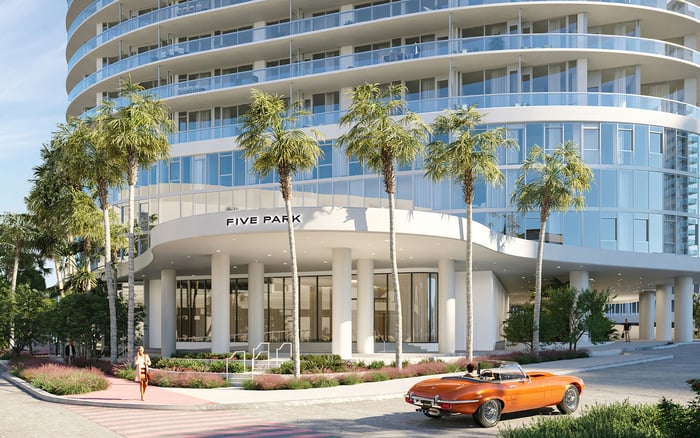
Miami Beach offers a wider service landscape, but convenience depends on where the residence sits within the city. A buyer considering The Ritz-Carlton Residences® Miami Beach should map regular needs from that precise location rather than rely on assumptions drawn from South Beach, Mid-Beach, or North Beach. Grocery runs, household staffing, medical appointments, dining, and school travel should be modeled as a weekly schedule.
Once the preferred geography is clear, compare the residential operations themselves. For a condominium, seek clarity on access control, guest arrival, deliveries, service elevators, parking circulation, staffing, amenity traffic, and planned work. At The Perigon Miami Beach, as with any project under consideration, the buyer's task is to determine whether the residence and its operating model meet the household's privacy threshold and service expectations.
In Surfside, parcel-level zoning matters. The town map includes H30C, H40, H120, and the special SD-B40 district, while setback rules vary by district. Nearby development also warrants scrutiny. A 2022 approval at 8809 Harding Avenue, known as 8800 Collins Avenue, authorized eight residences and 18 parking spaces-an illustration of why buyers should review current applications and approvals around a target property.
The final decision is not simply Surfside versus Miami Beach. It is one block, one building, and one routine measured against another. Buyers should examine zoning, setbacks, nearby construction, flood exposure, school assignment, traffic patterns, and the residence's physical relationship to adjoining properties. That discipline turns an appealing address into a durable primary home.
Which location generally offers a lower-scale residential setting? Surfside's interior is predominantly single-family and low-rise, with relevant residential categories capped at 30 feet.
Is all of Surfside low-rise? No. Land east of Collins Avenue can permit buildings up to 120 feet, creating a distinct oceanfront tower corridor.
Does Miami Beach have more public-school options? Miami Beach has a broader public-school network distributed across several parts of the city.
Is a school associated with a municipality guaranteed for every address? No. Confirm current attendance boundaries and address-specific assignments directly with Miami-Dade County Public Schools.
Where is Surfside's main business district? It is concentrated around 94th through 96th Streets along Collins and Harding avenues.
Is Surfside more private than Miami Beach? Surfside's lower-scale interior can offer a structural advantage, but actual privacy depends on the specific street, parcel, unit, and building operations.
What should condominium buyers inspect for privacy? Review access control, arrival sequence, elevator use, neighboring exposure, amenity placement, deliveries, and service circulation.
Why does zoning matter before purchase in Surfside? Height and setback rules vary among districts, so the exact parcel and nearby development context can materially affect the residence.
How should buyers assess daily service? Map recurring school, grocery, medical, dining, staffing, and household-service trips at the times they will actually occur.
What is the best final comparison test? Compare two specific residences through a full weekday routine rather than rely on broad impressions of either municipality.
For a tailored shortlist and next-step guidance, connect with MILLION.
If branded residences are on your mind — as a home or as an allocation — we would be glad to share what we are seeing, privately.
Begin a quiet conversation