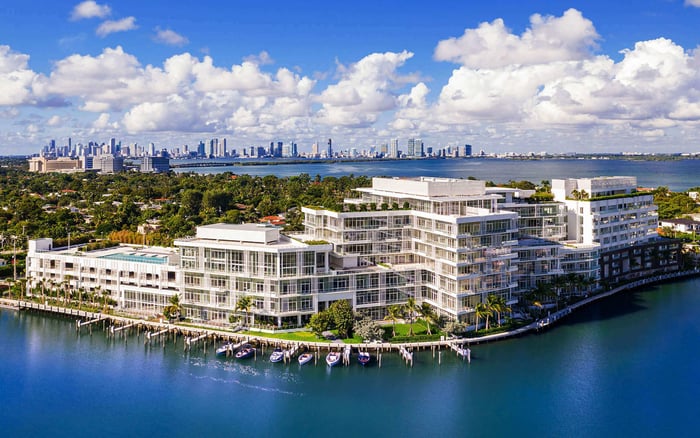
A disciplined framework for reviewing ownership authority, condominium records, freight access, structural loading, art installation, permits, and climate control before a Miami Beach purchase closes.

For a Miami Beach buyer purchasing through a trust or entity, the legal and physical reviews should advance in tandem. The ownership structure determines who may sign, receive association approval, hold title, and authorize future work. The building review establishes whether the residence can support the buyer’s intended collection, furnishings, climate requirements, and delivery schedule.
In a typical Florida trust, the trustee holds legal title while the beneficiaries retain the beneficial interest. A land-trust arrangement may give the trustee both legal and equitable title, together with specified powers. Before contract execution, counsel should compare the purchaser name and signatory block with the trust instrument or entity documents. The current recorded deed remains the primary ownership record and should not be considered private simply because a trust or entity is involved.
This is particularly relevant to investment and second-home acquisitions, where signers, beneficial users, and property managers may be different people. The contract, title commitment, association application, financing documents, and closing instruments should identify the purchasing party consistently.
Florida condominium associations maintain official records that can clarify both legal restrictions and future costs. The review should encompass the declaration, bylaws, rules, financial materials, insurance records, applicable structural documents, and association estoppel. Buyers should identify purchaser-approval procedures, transfer requirements, occupancy restrictions, renovation limitations, and any provisions affecting trust or entity ownership.
The estoppel merits a separate review for regular assessments, special assessments, outstanding balances, and other charges attached to the unit. Where applicable, milestone-inspection and structural-integrity reserve materials should be considered alongside budgets, insurance, and pending assessments. This broader record set is essential for waterfront ownership, where a visually exceptional residence still depends on the building’s operational and financial discipline.
For readers approaching Miami Beach through buyer’s guides or design and architecture coverage, projects such as The Perigon Miami Beach and Shore Club Private Collections Miami Beach may help frame a search, but every acquisition requires a property-specific document review. Marketing context cannot substitute for governing documents, written management responses, or professional inspections.
A freight elevator should be assessed as one segment of a continuous route. Before the contractual diligence period ends, request its rated capacity, interior car dimensions, clear door opening, operating status, and reservation protocol. Then measure or verify the loading dock, service corridors, turns, thresholds, ceiling clearances, and unit entry.
Obtain the move-in and contractor packets in writing. These may address delivery hours, advance reservations, protective coverings, certificates of insurance, indemnities, contractor access, staffing, deposits, and oversized-art handling. A successful installation also depends on whether management permits temporary staging and how long the freight car may be reserved.
The same questions apply when evaluating established residences such as The Ritz-Carlton Residences® Miami Beach or Setai Residences Miami Beach. Never assume building-specific dimensions, capacities, or delivery privileges. Request current written information directly from management and confirm critical measurements onsite.
An elevator’s ability to transport an object does not establish that the unit slab can support it. Heavy sculpture, stone, safes, aquariums, and built-ins raise distinct questions about total weight, concentrated loads, footprint, placement, and the route through the residence.
Request available structural plans and engage a qualified structural engineer to review the proposed installation. The engineer should evaluate the exact object and intended location rather than rely on a generalized building description. If anchoring, blocking, penetrations, or structural alterations are contemplated, determine the association and municipal approval path before committing to either the piece or the residence.
Miami Beach enforces the Florida Building Code and city ordinances. Association consent does not replace code compliance or permit review. Likewise, the installation, alteration, or relocation of a conveyance requires a city permit and work by an appropriately licensed elevator company.
For collectors, art diligence extends beyond whether a canvas fits through a door. Written rules should address installers, riggers, wall penetrations, common-area protection, elevator scheduling, insurance, indemnification, and restoration obligations. Clarify whether exterior lifting, façade access, or temporary door removal would be considered, without assuming that any technique will be approved.
Art Basel season may heighten attention around acquisition and installation, but a prudent buyer completes this review before closing. A proposed display wall can affect electrical planning, lighting, blocking, security, and climate strategy. Each element may carry a separate approval or permit requirement.
Permit compliance alone does not establish that a residence will maintain stable temperature and humidity for art or wine. Request available HVAC service records and commission an operational assessment tailored to the buyer’s intended use. The review should consider equipment condition, controls, distribution, equipment location, and the practical implications of any proposed mechanical work.
HVAC replacement or modification should be evaluated through the city’s building-permit process, together with the required condominium approval. Align the mechanical scope with association rules before ordering equipment or finalizing custom interiors.
A disciplined diligence plan assigns ownership review to counsel, title review to the title team, association analysis to counsel and advisers, structural questions to an engineer, and climate performance to a qualified mechanical professional. Management should confirm operational rules in writing.
Resolve these workstreams before the contractual diligence period expires. A buyer should emerge with confirmed signing authority, a coherent title path, reviewed association obligations, measured delivery access, an engineering opinion where needed, and a realistic plan for permits and climate control.
Who usually holds title when a Florida trust buys a condominium? The trustee generally holds legal title, while the beneficiaries hold the beneficial interest.
What should be checked before the purchase contract is signed? Compare the purchaser and signer names with the trust instrument or entity documents, and confirm signing authority.
Does trust ownership make the condominium purchase private? Not fully. The recorded deed remains an official ownership record.
Which association documents matter most? Review the declaration, bylaws, rules, financial and insurance materials, structural records, and estoppel.
What freight-elevator information should a collector request? Request rated capacity, car and door dimensions, operating status, delivery hours, and reservation procedures.
Is elevator capacity proof that a sculpture is safe in the unit? No. Transport capacity and structural floor loading are separate engineering questions.
Who should evaluate a heavy sculpture or safe? A qualified structural engineer should assess its weight, footprint, location, and supporting structure.
Does association approval replace a Miami Beach permit? No. Association consent and municipal code and permit compliance are distinct requirements.
What should art-installation rules address? They should cover freight access, insurance, indemnities, protection, installers, scheduling, and oversized handling.
How should climate control be reviewed for art or wine? Examine service records and commission an operational HVAC assessment tailored to the intended collection.
For a confidential assessment and a building-by-building shortlist, connect with MILLION.
If branded residences are on your mind — as a home or as an allocation — we would be glad to share what we are seeing, privately.
Begin a quiet conversation