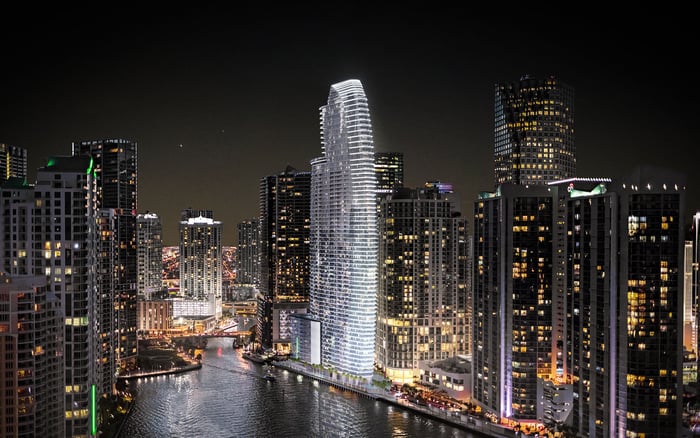
A buyer-focused comparison of two of Miami’s most distinct branded towers, examining how mobility-led design in Brickell differs from hotel-rooted service in Downtown and what that means for luxury purchasing decisions.

In Miami’s upper-tier new-development market, branding alone is no longer enough. The more relevant question is what, exactly, a brand builds into daily life. That is where Mercedes-Benz Places Miami and Waldorf Astoria Residences Downtown Miami begin to diverge.
Both projects sit at the premium end of the market. Both use globally recognized names to sharpen identity and command attention. Yet their amenity ecosystems are fundamentally different. Mercedes-Benz Places Miami is organized around design language, mobility, technology, and an urban lifestyle tied to Brickell. Waldorf Astoria Residences Downtown Miami is organized around hospitality, staffed service, wellness, and a globally legible hotel experience in Downtown.
For the buyer, this is less a contest of prestige than a question of operating model. One offers a luxury residence shaped by branded physical experiences. The other offers a private home embedded in a hotel-minded service environment.
Mercedes-Benz Places Miami is planned in Southside Park, within Brickell, as a mixed-use development with residences, office space, health and fitness components, and a hotel element. Its significance is not simply the automotive name. It is that the brand’s identity appears intended to shape the mechanics of everyday living.
The project’s amenity story is mobility-first. Publicly disclosed features include a house car program, charging solutions, bicycles and scooters, along with other mobility-focused elements that connect directly to the Mercedes-Benz identity. This creates a form of branded luxury that feels less ceremonial and more integrated into the rhythms of the city.
That matters in Brickell, where time efficiency and urban access often carry as much value as spectacle. A buyer comparing this project with The Residences at 1428 Brickell or 888 Brickell by Dolce & Gabbana is not just comparing architecture or finish levels. The comparison is also between philosophies of branded living. Mercedes-Benz Places Miami leans toward an executive, design-conscious resident who wants the home to feel contemporary, connected, and less dependent on a hotel-service stack.
The broader amenity package supports that reading. Pools, fitness, coworking areas, park space, padel and basketball courts, and dining all point to a community-oriented environment. In other words, Brickell is not just the backdrop. It is part of the product logic.
Waldorf Astoria Residences Downtown Miami approaches luxury from the opposite direction. Instead of translating a product brand into residential life, it extends a hospitality brand into private ownership. The result is an amenity ecosystem centered on service delivery.
The tower pairs private residences with a Waldorf Astoria hotel under Hilton’s luxury platform, giving the residential proposition a distinctly international frame. Buyers who already understand the value of a recognized hotel flag do not need to be persuaded of the appeal of concierge-style living, hospitality programming, or operational consistency. Here, those service layers are not ancillary. They are central.
A 30,000-square-foot spa stands out as a defining wellness anchor, while food-and-beverage offerings including Peacock Alley reinforce the project’s hotel DNA. The implication is clear: residents are buying not only a home in Downtown, but a managed atmosphere of convenience, care, and ritual.
That sets Waldorf Astoria apart from peers like Aston Martin Residences Downtown Miami and Faena Residences Miami Downtown Miami, where branding may be powerful but the lived proposition does not necessarily rest on the same hotel-rooted service matrix. In Downtown, prestige often has a public dimension. Waldorf Astoria sharpens that dimension through hospitality heritage.
The difference between Brickell and Downtown is not cosmetic. It can reshape the entire value equation.
Brickell tends to attract buyers who want immediate access to Miami’s financial core, a walkable urban routine, and a polished yet fast-paced residential environment. For them, Mercedes-Benz Places Miami aligns naturally with a life organized around meetings, movement, and design-led efficiency. The neighborhood supports a luxury model in which the residence complements an active schedule rather than buffering it with layers of hotel service.
Downtown, by contrast, carries a broader sense of arrival. The address reads as metropolitan, visible, and closely tied to Miami’s cultural and bayfront identity. Waldorf Astoria Residences Downtown Miami benefits from that positioning because its hospitality-forward concept feels legible to international buyers, part-time residents, and frequent travelers who prioritize turnkey ease over self-directed urban choreography.
This is why a buyer may be choosing not simply between two towers, but between two modes of ownership. Brickell suggests participation in the city’s daily engine. Downtown suggests residence in a more ceremonious urban setting.
At the highest end of the market, amenities are less about quantity than the type of dependence they create.
Mercedes-Benz Places Miami appears designed for owners who enjoy branded identity but do not necessarily want their daily lives mediated by a hotel. Its ecosystem is tactile and physical: transportation solutions, active recreation, coworking, fitness, and open space. The reward is autonomy with polish.
Waldorf Astoria Residences Downtown Miami appeals to a different instinct. It offers reassurance through service. Spa, dining, hospitality management, and concierge-style living create an environment in which the owner can delegate more of the practical and atmospheric work of luxury. The reward is convenience with ceremony.
Neither model is inherently superior. The sharper question is which feels more natural after the novelty fades. Buyers who value discretion often discover that the best amenities are the ones that disappear into habit. For one owner, that may mean seamless mobility in Brickell. For another, it may mean arriving in Downtown and knowing service is already in motion.
Mercedes-Benz Places Miami is likely the stronger fit for buyers drawn to design, technology, and mobility as status markers in their own right. It suits the purchaser who sees the home as an extension of contemporary urban identity and values a branded environment that feels active rather than ceremonially serviced.
Waldorf Astoria Residences Downtown Miami is likely better aligned with buyers who travel often, maintain multiple residences, or simply prefer a home that behaves more like a world-class hotel when needed. For this buyer, consistency, staffing, wellness, and dining are not extras. They are part of the reason to buy.
There is also a subtle distinction in how each project may age in the owner’s imagination. Mercedes-Benz Places Miami offers a concept tied to lifestyle integration and contemporary brand expression. Waldorf Astoria offers the continuity of hospitality tradition. One feels directional and modernist. The other feels enduring and service-rich.
For South Florida’s ultra-premium buyer, the most important distinction is not whether a residence is branded. It is whether the brand meaningfully changes the lived experience.
Mercedes-Benz Places Miami uses Brickell, design, and mobility to create a less hotel-dependent form of luxury. Waldorf Astoria Residences Downtown Miami uses service, wellness, and hospitality infrastructure to create a more managed one. Both are coherent. Both are compelling. But they answer different desires.
The buyer who wants independence, design fluency, and a branded urban ecosystem will likely gravitate to Mercedes-Benz Places Miami. The buyer who wants global familiarity, turnkey comfort, and hotel-style service will likely prefer Waldorf Astoria Residences Downtown Miami. In a market where branding can sometimes feel superficial, that is a meaningful divide.
What is the main difference between Mercedes-Benz Places Miami and Waldorf Astoria Residences Downtown Miami? Mercedes-Benz Places Miami emphasizes design, mobility, and technology, while Waldorf Astoria Residences Downtown Miami emphasizes hospitality, wellness, and service.
Which project is in Brickell? Mercedes-Benz Places Miami is in Brickell, placing it closer to Miami’s financial district and an executive-oriented urban lifestyle.
Which project is in Downtown? Waldorf Astoria Residences Downtown Miami is in Downtown, where its hotel-led identity aligns with a more globally recognizable luxury address.
Does Mercedes-Benz Places Miami have hotel-style amenities? It includes a hotel component and broad lifestyle amenities, but its branding is more centered on mobility and design than on a traditional hotel-service framework.
What are signature amenities at Mercedes-Benz Places Miami? Publicly disclosed highlights include a house car program, charging solutions, bicycles and scooters, plus fitness, pools, coworking, park space, and sports courts.
What are signature amenities at Waldorf Astoria Residences Downtown Miami? Key highlights include concierge-style living, hospitality programming, a 30,000-square-foot spa, and food-and-beverage offerings including Peacock Alley.
Which project may suit frequent travelers better? Waldorf Astoria Residences Downtown Miami may appeal more to frequent travelers because its proposition is rooted in service, convenience, and hotel-style operations.
Which project may suit design-focused buyers better? Mercedes-Benz Places Miami may be more attractive to buyers who value branded design language, mobility perks, and a less hotel-dependent luxury experience.
Are both projects considered branded residences? Yes. Each uses a major global brand, but one derives its identity from automotive lifestyle and the other from hospitality heritage.
How should buyers decide between the two? The best approach is to decide whether daily luxury should feel more independent and mobility-led or more serviced and hotel-like.
When you're ready to tour or underwrite the options, connect with MILLION Luxury.
If branded residences are on your mind — as a home or as an allocation — we would be glad to share what we are seeing, privately.
Begin a quiet conversation