For families weighing Key Biscayne against Fisher Island, the stronger choice depends less on prestige than on the daily choreography of school access, privacy, household staff, activities, and the tolerance for friction between home and routine.
For South Florida’s ultra-premium family buyer, the Key Biscayne versus Fisher Island decision is rarely resolved by architecture alone. It is resolved by rhythm. The residence must support school mornings, after-school activities, visiting tutors, household staff, security preferences, weekend recovery, and the social life of children and parents alike.
Both names carry immediate emotional weight in a Miami search. Yet when school access and seclusion both matter, the stronger choice is the one that makes a demanding private life feel calm on an ordinary Tuesday. The waterfront view may seduce, but the car line, appointment cadence, and guest protocol will reveal whether the property truly fits.
A practical search brief might include Key-biscayne, Fisher-island, Private-school, Gated-community, Exclusive-area, and Second-home as shorthand priorities. The sharper exercise is to translate those labels into daily tolerances: how much transition is acceptable, how often children need independent mobility, and how much separation the household wants from the broader city.
Key Biscayne can be the more intuitive answer when school logistics sit at the center of the family calendar. That does not mean a buyer should assume convenience. It means the family should test the actual morning and afternoon routes that matter, at the exact times they will use them, before allowing a view, floor plan, or club amenity to dominate the decision.
For buyers considering a condominium lifestyle on the island, Oceana Key Biscayne often frames the appeal of a polished residential setting without drifting away from the practical questions. How do children leave in the morning? Where does staff arrive? How do grandparents visit? Where does the family decompress after school?
The Key Biscayne advantage, for the right buyer, is psychological as much as geographic. It can feel residential without asking the family to make seclusion the organizing principle of every day. That matters for households with multiple children in different grades, frequent appointments, and parents whose work or philanthropy requires regular movement across Miami.
The tradeoff is that a setting with easier daily movement may feel less removed. Buyers who prize deep separation should ask whether the home will still feel sufficiently private during peak season, weekends, and social periods. Privacy is not only a gate or a lobby. It is the degree to which the family can live without unwanted exposure.
Fisher Island becomes more compelling when seclusion is the primary luxury and the family is willing to design its schedule around that preference. The buyer who chooses it well is not pretending daily transitions do not matter. Rather, the household has decided that privacy, controlled arrival, and distance from ordinary city texture are worth more than the fastest possible school routine.
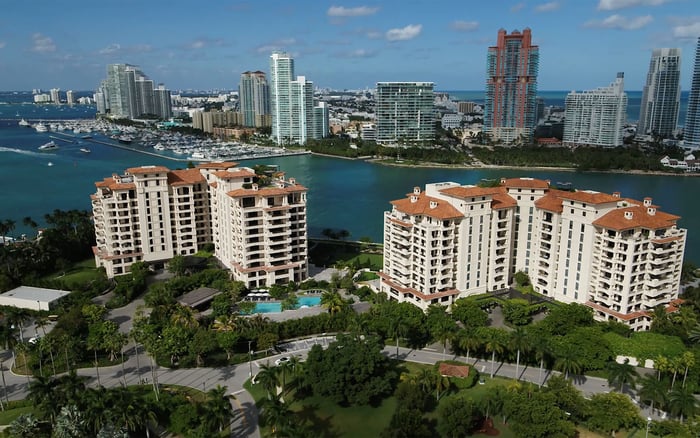
In this context, the residence becomes part of a larger privacy system. A family comparing Palazzo del Sol with Palazzo della Luna is not only comparing finishes or views. It is comparing how each home supports arrival, retreat, entertaining, service, and the quiet separation many Fisher Island buyers are seeking.
For some families, that seclusion is the entire point. The children may have a highly structured routine, parents may travel frequently, and the home may function as a protected base rather than a constantly porous social address. In that scenario, the additional planning required around school and activities may feel like an acceptable cost of preserving the family’s private sphere.
The caution is simple: seclusion should be chosen deliberately, not romantically. A buyer should walk through ordinary scenarios before committing. What happens when one child forgets a school item? How does a last-minute tutor visit work? How does the household handle simultaneous departures? If the answers feel elegant rather than burdensome, Fisher Island may be the more coherent fit.
Before choosing either address, families should build a mock week. Include two school mornings, two afternoon returns, one evening event, one sports practice, one medical appointment, one visiting relative, and one staff transition. Then ask whether the home makes those moments feel composed.
This is especially important for Private-school families because access is not merely distance. It is timing, predictability, the number of moving parts, and the parent’s emotional tolerance for friction. A five-minute theoretical advantage can disappear if the route is unreliable for the family’s actual routine, while a longer route may be acceptable if it is consistent and well managed.
Families should also resist buying only for the current school year. Children change campuses, activities intensify, friendships shift, and parents’ work patterns evolve. The right residence should have enough flexibility to remain graceful as the family moves through stages.
Seclusion has a powerful pull in South Florida because it promises silence, control, and status without announcement. But it must be weighed against the household’s real appetite for movement. An Exclusive-area can be magnificent and still wrong if the family wants constant spontaneity. A Gated-community can feel secure and still feel restrictive if children are entering a more independent stage.
For a buyer who wants Fisher Island’s privacy while evaluating the newest residential language on the island, The Residences at Six Fisher Island can serve as a useful reference point in the search conversation. The question is not simply whether the property is beautiful. The question is whether beauty and privacy are organized around the family’s actual life.
Second-home buyers should be even more precise. A seasonal residence can tolerate different tradeoffs than a primary family base. If the home is used for holidays and school breaks, seclusion may dominate. If it is used during active school weeks, convenience becomes much harder to compromise.
Choose Key Biscayne when the school calendar is the spine of the household and the family wants a residential island atmosphere without making maximum separation the defining constraint. It is often the more practical emotional choice for families that need daily flexibility and frequent movement.
Choose Fisher Island when the household values privacy so highly that logistics can be choreographed around it. It is often the more compelling choice for buyers who want the home to feel like a private enclave first and a commuting base second.
The most disciplined buyers will not decide after a single weekend showing. They will test weekdays, speak with the people who run the household, and compare properties through the lens of repeatable calm. In this tier of the market, the winning address is not the one that photographs best. It is the one that keeps the family’s life beautifully ordered.
Is Key Biscayne better than Fisher Island for school access? It may be better for families that prioritize daily school movement, but the correct answer depends on the family’s exact school locations and schedule.
Is Fisher Island better for privacy? It may suit buyers who place seclusion first, provided the household is comfortable planning daily routines around that preference.
Should families choose based on commute time alone? No. Predictability, transitions, staff movement, activities, and after-school obligations can matter as much as raw travel time.
How should a buyer test the decision? Run a mock school week from each property, including mornings, afternoon returns, activities, appointments, and guest arrivals.
Does a waterfront condominium simplify the choice? Not by itself. A beautiful residence still has to support school routines, service access, privacy expectations, and family flexibility.
Is Fisher Island best for a Second-home? It can be compelling for seasonal use when seclusion matters more than active school-week logistics.
Can Key Biscayne still feel private? It can, depending on the residence and household expectations, but buyers should evaluate privacy during real peak-use periods.
What should Private-school families ask first? Ask how each school day will actually work, including departure timing, backup plans, activities, and parent availability.
Should buyers compare new projects and resale options together? Yes. Lifestyle fit, building operations, service patterns, and privacy can matter more than whether the residence is new or resale.
What is the simplest rule of thumb? Let school rhythm lead if the family needs flexibility, and let seclusion lead if privacy is the non-negotiable luxury.
For a confidential assessment and a building-by-building shortlist, connect with MILLION.
If branded residences are on your mind — as a home or as an allocation — we would be glad to share what we are seeing, privately.
Begin a quiet conversation