At The Estates at Acqualina, association dues establish only the first layer of ownership cost. A disciplined annual budget should also recognize voluntary staff gratuities, taxes, unit insurance, assessments and optional services.

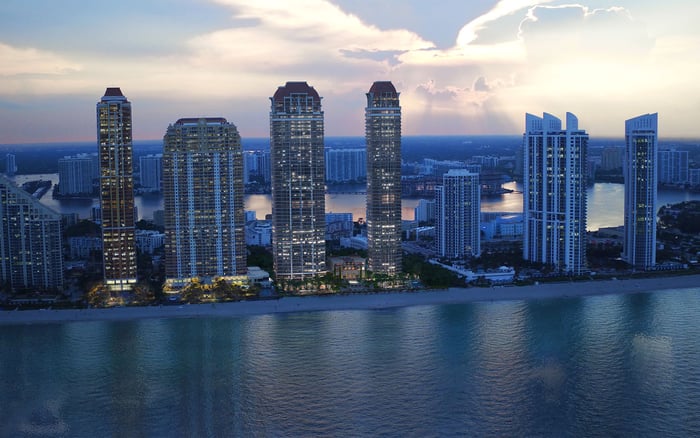
The Estates at Acqualina Sunny Isles comprises two 50-story oceanfront condominium towers at 17901 Collins Avenue in Sunny Isles Beach. Each residence is individually owned, while building-level management supports the common property, amenities and shared services. That familiar condominium structure is straightforward. Its true cost, however, demands more nuance than multiplying a single monthly line item by 12.
The development’s residence count appears as either 205 or 245. That discrepancy underscores why buyers should rely on current association and legal documents for the controlling unit count. The same discipline applies to fees: figures vary substantially among residences, and a building-wide average cannot replace the current statement for the home under consideration.
At a highly serviced condominium, association dues establish the baseline, while personal use patterns shape the lived cost.
For buyers accustomed to evaluating the service propositions at Armani Casa Sunny Isles Beach, The Ritz-Carlton Residences® Sunny Isles or Turnberry Ocean Club Sunny Isles, the essential question is not simply whether service exists. It is how fixed association expenses and discretionary service habits combine into a realistic household budget.
Maintenance for an Estates residence has included common areas, the building exterior, common-element insurance, pool service, trash removal, amenities, elevators, hot water, management, parking, sewer, water and internet or Wi-Fi. Identified amenities also include heated pools, a sauna, spa or hot tub, exercise facilities, children’s areas, business facilities and ocean access.
Those inclusions help explain the scale of the fee, but they do not make it an all-inclusive ownership figure. Common-element insurance is not necessarily a substitute for the owner’s unit policy. Nor should a buyer assume that property taxes, special assessments, optional services or every in-residence request fall within regular maintenance.
This distinction is especially important in an oceanfront lifestyle purchase, where daily convenience can render separate expenses nearly invisible. A valet interaction, a special concierge request and in-residence service may occur within the same polished ecosystem, yet they need not share the same method of payment.
A building average of approximately $2.24 per square foot per month provides an initial planning tool. At that rate:
A 3,000-square-foot residence would imply about $6,720 monthly, or $80,640 annually.
A 4,000-square-foot residence would imply about $8,960 monthly, or $107,520 annually.
A 5,000-square-foot residence would imply about $11,200 monthly, or $134,400 annually.
The range among individual residences is equally instructive. Unit 1104 has carried a $4,653 monthly fee, equal to $55,836 annually. Unit 2303 has carried a $5,195 monthly fee, or $62,340 annually. Unit 3003 has carried a $7,338 monthly fee, or $88,056 annually, while Unit 3004 has carried a $9,248 monthly fee, or $110,976 annually.
At the higher end of these examples, Unit 4005 has carried a $9,743 monthly association fee, equivalent to $116,916 annually. Penthouse 4705 has carried an $11,949 monthly fee, or $143,388 annually. An approximate monthly average of $9,430 and a broad building-wide range of $350 to $18,342 further illustrate the variation.
These figures are snapshots, not quotations for a new purchase. They demonstrate why square footage, unit allocation and the latest association records matter. Because the charges are payable monthly, they also represent a substantial recurring liquidity requirement rather than a single year-end expense.
No mandatory gratuity schedule is established in the property information. Tipping should therefore be treated as an owner-specific lifestyle assumption, not folded into HOA dues or characterized as an association obligation. Before setting a budget, an owner should ask management whether the property has guidance on gratuities, staff gifts, pooled programs or holiday practices.
Valet use is the clearest recurring service interaction because garage and valet parking are identified for Estates residences. Yet frequency differs dramatically. An owner who retrieves several vehicles throughout the day may incur a different discretionary outlay from a seasonal resident who rarely drives. Concierge assistance, pool or beach help, holiday acknowledgments and in-residence services can create additional occasions for gratuities.
A defensible model begins with behavior rather than a generic percentage. Track anticipated valet interactions each week, the number of months the residence will be occupied, likely concierge requests, pool or beach assistance, holiday giving and separately arranged services. Apply the owner’s preferred gratuity assumptions only after confirming building policy. The result is a personal estimate that does not imply tips are fixed, compulsory or uniform among households.
The cleanest calculation separates expenses into three layers. First, annualize the residence’s current monthly association charge. Second, add verified property taxes, unit insurance, known assessments and other required owner expenses. Third, create a discretionary service reserve based on actual occupancy and habits.
For a second-home buyer, occupancy is a critical variable. The service reserve might be seasonal, while association dues continue monthly. For an investment review, the analysis should still begin with the owner’s obligations rather than assuming a future occupancy pattern will offset them. Neither use case changes the need to examine the association’s current budget and assessment notices.
This layered approach also prevents double counting. If parking, water or internet is confirmed within maintenance, it should not appear again as a separate recurring estimate. Conversely, common-element insurance should not be interpreted as complete personal coverage without reviewing the unit-policy requirements.
For a resale acquisition, request the latest association budget, the unit’s current statement or estoppel, recent assessment notices and the applicable insurance information. Confirm precisely what the quoted maintenance includes, when payments are due and whether any optional services are billed separately. Ask whether the amount presented for the residence remains current.
The owner should also test the annual plan against a 12-month cash calendar. This exercise reveals the difference between a manageable annual total and a recurring monthly obligation that competes with taxes, insurance premiums, household staffing and residence-specific upkeep. The buyer’s-guide principle is simple: precision at acquisition protects the ease that full-service living is meant to provide.
The Estates offers a service-rich ownership proposition, but the prudent buyer distinguishes contractual charges from customary personal generosity. HOA dues fund the shared platform. Gratuities reflect how an individual household uses that platform. The real annual carry is the sum of verified obligations and consciously chosen lifestyle expenses, not a single advertised fee.
For confidential guidance on evaluating South Florida’s most distinguished residences, connect with MILLION.
If branded residences are on your mind — as a home or as an allocation — we would be glad to share what we are seeing, privately.
Begin a quiet conversationIt is a condominium structure with individually owned residences supported by building-level management, common property and shared services.
The property consists of two 50-story oceanfront condominium towers at 17901 Collins Avenue in Sunny Isles Beach.
Published profiles differ, citing either 205 or 245 residences. Buyers should verify the controlling legal unit count in current association documents.
A publicly disclosed average is approximately $2.24 per square foot per month, but it is only a planning reference.
At $2.24 per square foot monthly, the illustration is about $8,960 per month or $107,520 per year.
No mandatory gratuity schedule is established by the supplied property information. Tips should be modeled as a personal lifestyle expense rather than an HOA obligation.
Owners may consider valet frequency, concierge requests, pool or beach assistance, holiday acknowledgments and any in-residence services.
A disclosed example includes common areas, exterior upkeep, common-element insurance, pool service, trash, amenities, elevators, hot water, management, parking, sewer, water and internet or Wi-Fi.
No. Buyers should separately verify property taxes, unit insurance, assessments, optional services and their own gratuity assumptions.
Review the latest association budget, current unit statement or estoppel, assessment notices, insurance information and written details of included or optional services.