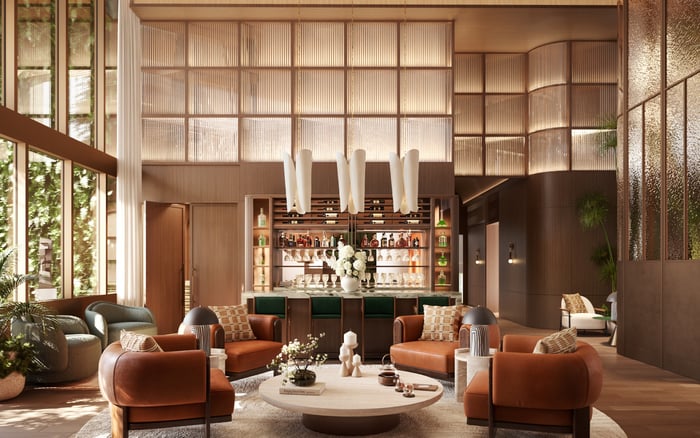
Private entertaining is part of the appeal of Coconut Grove’s branded residences, but amenity access and event charges require separate scrutiny. A buyer-focused look at THE WELL’s advertised dining space, the Mr. C hotel’s dated catering terms, and the residential agreements that determine an owner’s actual rights.

For a Coconut Grove buyer who enjoys entertaining, a private dining room promises something more personal than another amenity: the possibility of hosting beautifully without turning home into an event venue. Yet its value to an owner rests as much on reservation rights, staffing arrangements and billing rules as on the room itself.
At Mr. C Tigertail Coconut Grove, the essential distinction is between the residences and the Mr. C Miami Coconut Grove hotel at 2988 McFarlane Road. The detailed private-dining terms discussed here apply to that hotel. They do not establish Tigertail owners’ dining privileges, residential event charges or access to hotel facilities.
At The Well Coconut Grove, a private dining room with a catering kitchen and bar is a marketed residential amenity. That identifies an entertaining space, not a complete operating agreement. Neither residential project’s legal ownership structure, association governance, operator contracts or allocation of event revenue is established by the disclosures discussed here.
The useful comparison, then, is between what is disclosed and what a buyer should secure in writing-not a verdict that one residence is less expensive or more transparent.
The hotel’s private-dining terms dated February 24, 2025, illustrate how catered hospitality is structured. These prices and conditions require reconfirmation and should never be treated as a residential tariff.
Menu selections are required 30 days before an event; the final guaranteed guest count is due 14 days before. Once submitted, that guarantee cannot be reduced under the dated terms. For hosts whose invitations depend on changing travel plans, the commitment matters: a smaller gathering does not reduce the guaranteed count.
Increasing the guaranteed minimum by more than 5% within 72 hours triggers a 25% per-person surcharge on food-and-beverage pricing under those terms. Same-day meals are unavailable for newly added guests. Before signing, clarify exactly which guests and charges a late-change surcharge would cover.
Scale also matters. Events with fewer than 20 guests carry an additional $20 per person. At least one plated-dining format has a 60-guest maximum, but that is not the hotel’s overall event capacity. Confirm the intended format, room and attendance together rather than treating one menu limit as a venue-wide rule.
The hotel’s dated terms include a taxable 25% administrative fee, a 9% food tax and a 7% sales tax. These figures should not simply be added together as a universal surcharge. An itemized estimate is needed to establish which tax applies to each charge and how the administrative fee is taxed.
Equally important, the administrative fee is not identified as a gratuity, and its distribution to staff is not established. Ask whether gratuity is included elsewhere, expected separately or discretionary, and obtain a clear explanation before approving the event.
Additional services include bartenders, chef attendants and uniformed station attendants, with listed charges generally ranging from $175 to $220. There is also an $8-per-person cake-cutting fee, with applicable taxes added to fees. These details make the menu price alone an inadequate budget.
Request a proposal that separates food, beverages, administration, staffing, cake service, applicable taxes and any gratuity. The hotel event inquiry contact is [email protected] or 305-800-6672; this contact should not be treated as confirmation of Tigertail residential arrangements.
THE WELL Coconut Grove is a branded residential project at 2835 Tigertail Avenue, Miami, FL 33133. Its marketed private dining room, catering kitchen and event bar sit within a broader collection of shared spaces, including a tea garden, lobby library, children’s room and conservatory with coworking and gathering areas.
The dining room is presented as a resident amenity. Independent booking access for outside parties is not established. For an owner, that distinction calls for specific questions about hosting nonresident guests, resident presence during an event and responsibility for guest conduct.
An event fee schedule covering administrative fees, gratuities, minimum spending, guest-count deadlines and staffing surcharges is not disclosed. Nor is it established whether private-event catering is managed by the condominium association, an affiliated operator or outside vendors. The absence of a published schedule does not mean events are fee-free.
Before assigning financial value to the amenity, request the applicable house rules, reservation policy, catering agreement and fee schedule. Those documents should explain not only whether a dinner can be held, but who has authority to approve it and what the host must purchase.
For either residential purchase, distinguish ownership of the space from control of its services. Ask whether the room is a common element, who administers bookings and what agreement governs any hospitality operator. A brand name does not answer those questions.
The same discipline is useful when considering Four Seasons Residences Coconut Grove: compare documented rights and obligations rather than assuming comparable service arrangements across branded addresses.
A focused document review should address:
Booking control: advance reservation windows, competing requests, cancellation terms and restrictions on exclusive use.
Catering access: required providers, outside-caterer approval, kitchen access and insurance obligations.
Guest management: attendance limits, access procedures, resident presence and responsibility for damage.
Event costs: deposits, minimum spending, staffing, cleanup, administrative charges, taxes and gratuities.
Ongoing obligations: which costs are included in assessments, which are billed to the host and who receives event revenue.
These are questions to resolve, not established terms at either project. Ask counsel to reconcile the answers with the governing documents and applicable service agreements, especially where marketing language suggests convenience without defining its cost.
A practical comparison begins with the same proposed gathering at each residence: identical attendance, menu expectations, service duration and staffing needs. Request written confirmation of availability rules alongside a fully itemized estimate. Separate recurring ownership expenses from charges triggered by an individual event.
For Tigertail, obtain residential documentation rather than importing hotel policies. For THE WELL, obtain operating terms rather than interpreting an amenity description as an inclusive service package. This preserves the distinction between an attractive space and an enforceable right to use it on acceptable terms.
Service-charge transparency has a straightforward test: the owner understands who controls the experience, what each charge purchases and which obligations survive a change of plans. That clarity allows private entertaining to feel effortless without leaving its economics undefined.
For a discreet conversation about evaluating Coconut Grove residences, connect with MILLION.
If branded residences are on your mind — as a home or as an allocation — we would be glad to share what we are seeing, privately.
Begin a quiet conversationThe hotel terms do not establish Tigertail residents’ dining rights or event charges. Separate residential documentation is needed.
Mr. C Miami Coconut Grove is at 2988 McFarlane Road. It is distinct from the Tigertail residences discussed in this article.
THE WELL markets a resident private dining room with a catering kitchen and bar for events. Independent booking access for outside parties is not established.
The dated menu does not identify the administrative fee as a gratuity or establish that it is distributed to staff. Hosts should request a written explanation of any separate gratuity.
The February 24, 2025 menu requires selections 30 days before the event and a final guaranteed guest count 14 days before. The submitted guarantee cannot be reduced under those terms.
Increasing the guaranteed minimum by more than 5% within 72 hours triggers a 25% per-person food-and-beverage surcharge under the dated terms. Same-day meals are unavailable for newly added guests.
The dated hotel menu lists an additional $20 per person for private events with fewer than 20 guests. Current pricing should be reconfirmed.
No universal combined rate can be inferred from the listed 9% food tax and 7% sales tax. An itemized quote should explain their application and the taxation of the administrative fee.
Its reviewed residential fact sheet does not disclose a complete event fee schedule or identify who manages private-event catering. This does not mean events are free.
Request governing documents, house rules, reservation policies, applicable catering agreements and fee schedules. Confirm booking control, guest access, insurance, staffing, cleanup, gratuities and costs included in assessments.