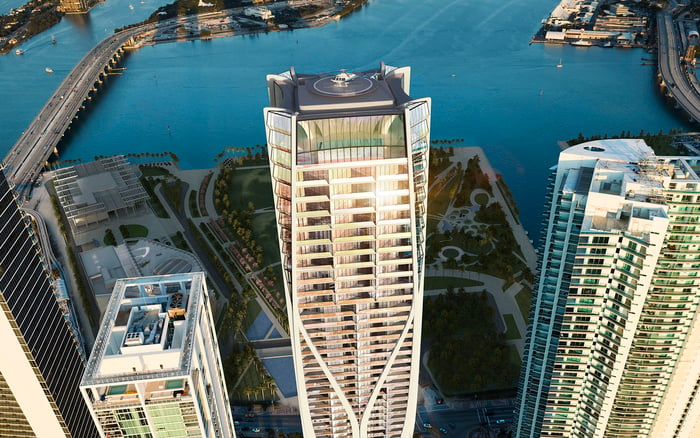
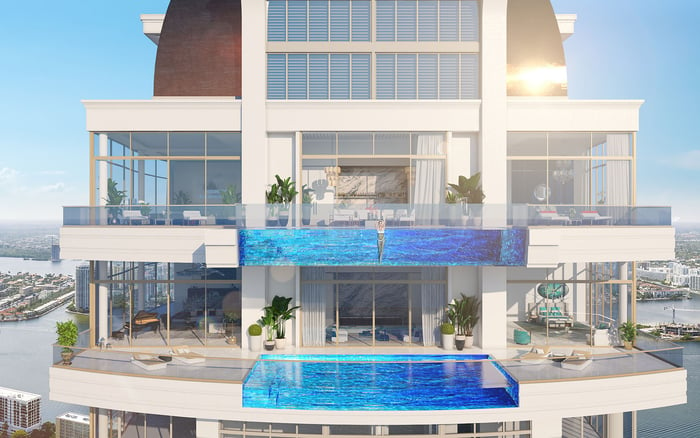
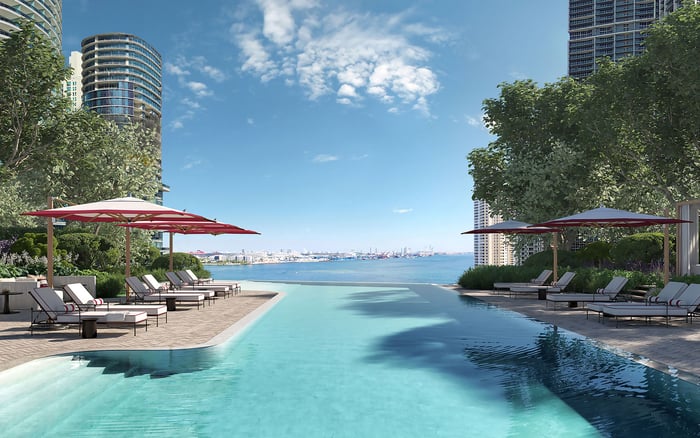
A buyer-focused look at how The Estates at Acqualina translates private-estate living into a serviced Sunny Isles Beach residential tower for owners seeking scale without household friction.
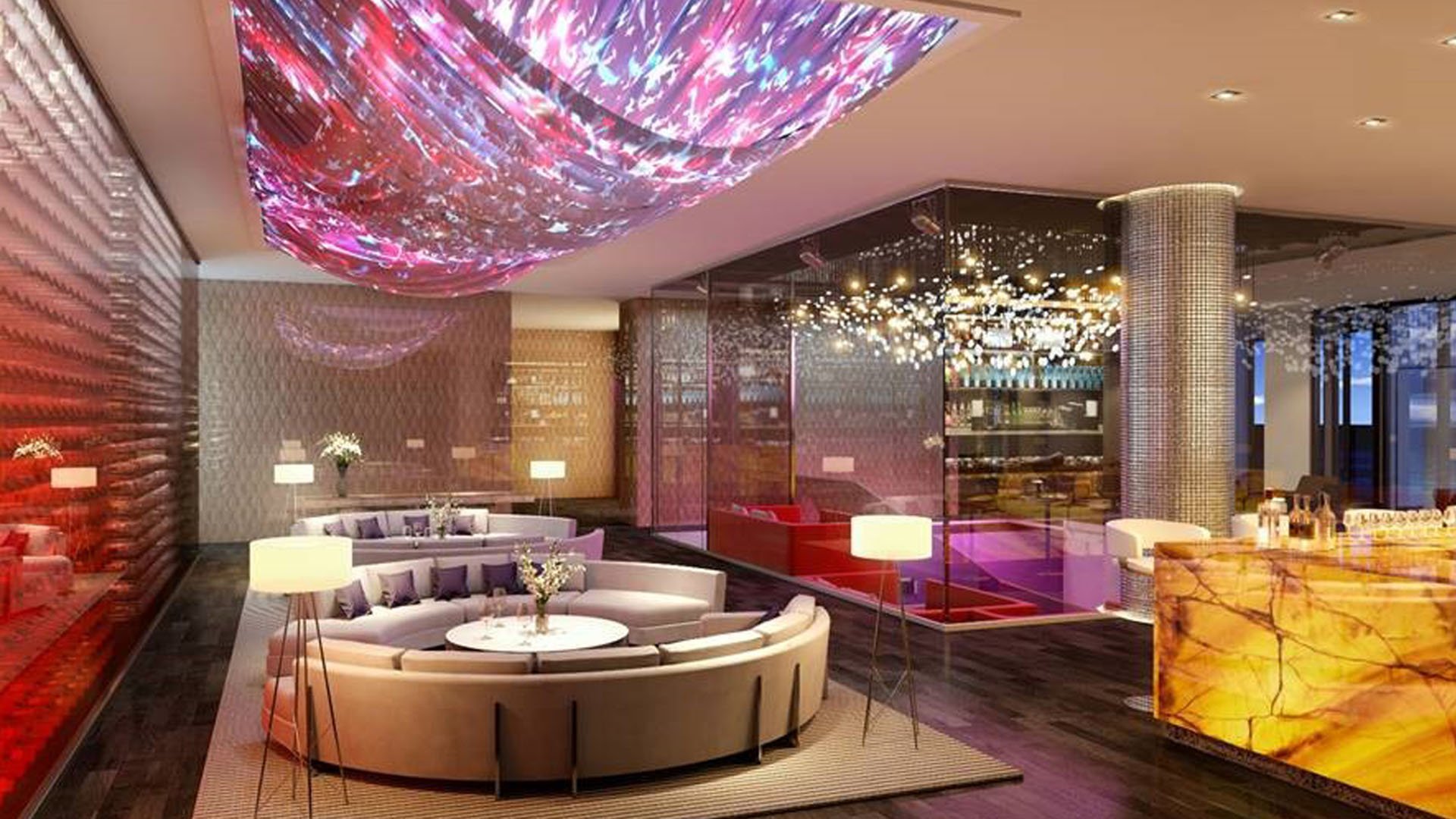
For owners leaving a large oceanfront, Intracoastal, or gated estate-style home, the question is rarely whether they can live beautifully in a condominium. The sharper question is whether a building can carry the emotional and practical weight of a private compound. The Estates at Acqualina Sunny Isles is positioned around that tension: the desire to preserve estate-like space, privacy, prestige, and autonomy while removing much of the daily operational burden that comes with a major standalone property.
That makes the project less about traditional downsizing and more about translation. The residence is not meant to feel like a retreat from the scale of private-home living. It is meant to retain enough of that scale to make the move psychologically credible for buyers accustomed to large rooms, family circulation, staff coordination, and a high degree of discretion.
In this sense, the phrase vertical estate is not decorative. It describes the project’s central promise: a managed, service-rich residential environment that can approximate the support structure of a private compound without requiring the owner to manage the compound itself.
The natural buyer for this kind of residence is often not rejecting estate living. They may love the privacy, hierarchy, and sense of arrival that a large home provides. What changes is their tolerance for friction. Seasonal preparation, vendor coordination, security oversight, pool and landscape maintenance, storm readiness, staffing, and year-round household attention can become less appealing when owners travel frequently or maintain residences in multiple cities.
A lock-and-leave residence answers that fatigue. The building absorbs much of the operational complexity, allowing the owner to arrive, live, entertain, and depart with fewer moving parts. For globally mobile families, that convenience is not a secondary amenity. It is the reason the model works.
The tradeoff is real. A standalone estate offers more absolute control over grounds, architecture, access, and household rhythm. A vertical estate offers a more managed version of that autonomy, supported by building operations, layered staffing, amenities, and programming. The correct buyer is not necessarily seeking less luxury. They are seeking less management.
For this transition to succeed, the residence must avoid any feeling of compression. Estate owners are sensitive to proportion. They notice entry sequences, service access, entertaining flow, guest separation, outdoor living, acoustic privacy, and the ability for multiple generations to occupy a home without crowding one another.
The Estates at Acqualina is framed around oversized residences and a scale of living that goes beyond a typical apartment lifestyle. That is critical for buyers who are not moving from a smaller urban pied-à-terre, but from a full private-home environment. Multigenerational use also matters. Grandparents, adult children, younger children, visiting friends, and household support all create demands that a conventional condominium may not handle gracefully.
In Sunny Isles Beach, this places the project within a highly specific luxury conversation. Nearby branded and design-led towers such as Bentley Residences Sunny Isles and St. Regis® Residences Sunny Isles speak to a market where buyers often expect more than views and finishes. They expect identity, service, privacy, and a residential experience that can withstand global comparison.
The most meaningful amenity for an estate owner may not be a glamorous room. It may be the disappearance of chores. In a large home, luxury is often maintained through invisible labor. In a vertical estate, that burden shifts toward the building. The daily experience depends on whether the service culture feels anticipatory, discreet, and capable of supporting real family life rather than merely presenting a hotel-like gloss.
The broader Acqualina Resort & Residences brand is central to this positioning. The project’s lifestyle model leans into resort-level amenities and services, but the more important issue is how those elements behave in a residential setting. Estate owners do not simply want access to amenities. They want confidence that the building can handle the intensity of their use.
That includes entertaining. A buyer leaving a substantial home may be accustomed to hosting dinners, family celebrations, holiday gatherings, philanthropic moments, or private social weekends. A standard condominium can feel strained by that rhythm. The Estates at Acqualina is framed as a building intended to support high-intensity social use more like an estate than a conventional condo.
For owners coming from gated or highly controlled environments, privacy is not a feature. It is a baseline expectation. The building must provide layers of separation: from public to resident, from guest to owner, from amenity to private residence, and from social life to retreat. Without those layers, the move from a private estate can feel like a loss of status and comfort.
Security matters in the same way. The appeal is not only physical protection, but peace of mind. Owners who move frequently between homes want to know that their South Florida base remains cared for and controlled while they are away. This is where the managed nature of the building becomes central to the value proposition.
Oceanfront living intensifies the appeal because it combines view, arrival, and scarcity with a lower-maintenance ownership model. In the wider coastal landscape, projects such as Turnberry Ocean Club Sunny Isles illustrate how Sunny Isles has become a serious address for buyers who want height, water, services, and an alternative to the obligations of a single-family estate.
For many buyers, The Estates at Acqualina is best understood through the Second-home lens. It is a residence that can function as a primary South Florida base, but its logic is especially clear for owners who divide time among several homes. The less frequently a family occupies a large estate, the harder it becomes to justify the friction of maintaining it at full readiness.
A service-heavy tower reduces that mismatch. The home can be dormant without feeling neglected, active without requiring a full private-property mobilization, and social without asking the owner to rebuild an estate operation from scratch every season.
This is also why Aventura proximity and broader north Miami-Dade connectivity matter for some buyers. The residence is not isolated in the manner of a private island estate, yet it still preserves a resort-like beachfront posture. That combination suits families who want access, services, and a controlled residential environment without retreating entirely from urban convenience.
In the ultra-luxury market, the word Penthouse often dominates the imagination. But the more nuanced issue here is not only altitude. It is whether the day-to-day living experience carries enough private-estate logic: generous residence scale, family flexibility, entertaining capacity, privacy, security, and service.
That is why New-construction buyers in this category should evaluate the building as an operating environment, not just a floor plan. The question is not simply what the residence looks like on a quiet afternoon. It is how the building performs during peak season, with guests arriving, family overlapping, travel schedules shifting, and expectations remaining high.
This is where Sunny Isles differentiates itself from more urban markets. A buyer comparing The Ritz-Carlton Residences® Sunny Isles with The Estates at Acqualina may be studying not only architecture or brand, but also the style of residential life each address makes possible. For former estate owners, the deciding factor is often experiential: does the home feel like a substitute for estate living, or merely an elegant compromise?
The strongest fit is a buyer who wants the privileges of a major South Florida residence without the full-time responsibility of a major South Florida property. That buyer may still value privacy intensely. They may still entertain seriously. They may still need space for children, grandchildren, guests, and staff coordination. They simply prefer those needs to be supported by a professional building ecosystem.
The Estates at Acqualina Sunny Isles is therefore not a rejection of estate living. It is a reorganization of it. Land is exchanged for height. Groundskeeping is exchanged for service. A private compound is exchanged for a managed residential world. The status remains, but the maintenance burden changes hands.
For the right owner, that is not downsizing. It is liberation from the operational weight of a larger estate while preserving the rituals that made estate living desirable in the first place.
Is The Estates at Acqualina Sunny Isles designed for buyers downsizing from large homes? It is better understood as a vertical estate concept for buyers leaving large homes who still want scale, privacy, service, and prestige.
What makes it different from a conventional luxury condominium? The positioning centers on oversized residences, resort-level amenities, layered service, privacy, and an experience closer to estate living than standard condo life.
Why would an estate owner prefer this model? The main appeal is reduced operational burden, especially for owners who travel often or maintain multiple residences.
Does the lifestyle work for multigenerational families? Yes, the project is positioned to support family use beyond a typical apartment lifestyle, with enough scale and programming for broader household needs.
Is privacy a major part of the appeal? Yes, privacy and security are central for buyers moving from gated or highly controlled estate environments.
Is this mainly for seasonal owners? It can work as a primary residence, but the lock-and-leave model is especially relevant for seasonal and globally mobile owners.
What is the key lifestyle tradeoff? Owners give up some standalone-estate control in exchange for a managed, service-heavy environment with fewer daily maintenance demands.
How important is entertaining to the concept? Entertaining is a major part of the fit, since the building is framed to support more intensive social use than a standard condominium.
Why is Sunny Isles Beach relevant for this buyer? Sunny Isles offers an oceanfront tower lifestyle with luxury services, water views, and proximity to broader north Miami-Dade destinations.
Who is the best-fit buyer for this residence? The best fit is an owner who wants estate-level living without the year-round friction of managing a large private property.
To compare the best-fit options with clarity, connect with MILLION.
If branded residences are on your mind — as a home or as an allocation — we would be glad to share what we are seeing, privately.
Begin a quiet conversation