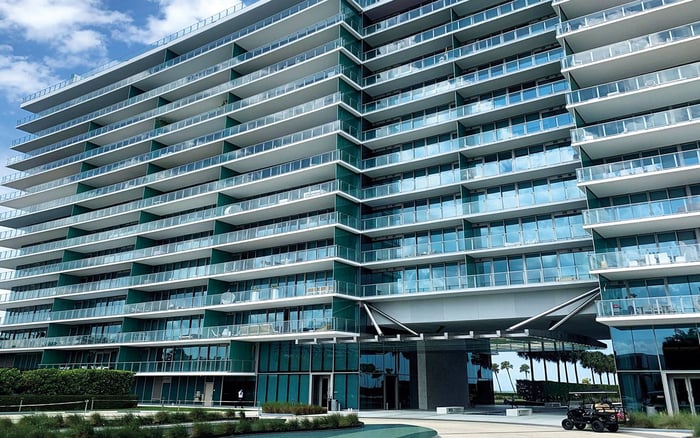
An oceanfront purchase deserves more than a view-led decision. For Key Biscayne buyers, a disciplined file connects seller tax status, closing costs, title review, association finances, insurance exposure, and the eventual resale.

The appeal of an oceanfront condo in Key Biscayne is immediate. Confidence in owning it should come from something less visible: a due-diligence file that explains the transaction, the building’s obligations, and the questions a future purchaser may ask.
For a buyer considering Oceana Key Biscayne, the discipline is the same as for any significant condominium acquisition. Separate the residence’s appeal from the evidence supporting the purchase. Seller tax status, transfer taxes, title documentation, association finances, and insurance belong in one coordinated review-not in disconnected exchanges during the final days before closing.
The objective is not to eliminate every uncertainty. It is to distinguish fixed transaction costs from contingent exposure, identify unresolved questions, and determine which answers are essential before committing capital.
FIRPTA generally requires the buyer to withhold when acquiring U.S. real property from a foreign seller. The default rate is 15% of the amount realized, not 15% of the seller’s gain. Nor is withholding the seller’s final capital-gains tax rate. Reporting and remittance generally use Forms 8288 and 8288-A.
For a Key Biscayne condo above $1 million, a foreign seller generally triggers that 15% withholding unless another exception or an IRS withholding certificate applies. Personal use alone does not bring an above-$1-million purchase within the reduced residential withholding thresholds.
Those thresholds still deserve a place in the file. A qualifying residence purchase with an amount realized of $300,000 or less can be exempt from withholding. Above $300,000 and up to $1 million, qualifying residence purchases receive a reduced 10% rate. The residence-use test requires intended buyer or family use for at least 50% of the days anyone uses the property during each of the first two 12-month periods after transfer.
Ask the closing and tax advisers to establish seller tax status, the applicable withholding treatment, and responsibility for the paperwork early. A withholding assumption should never remain an unresolved line in a closing estimate.
Key Biscayne buyers should budget under Miami-Dade rules, rather than simply applying Florida’s general deed rate. The statewide documentary stamp rate is generally $0.70 per $100, or fraction thereof, of consideration. Miami-Dade’s base rate is $0.60 per $100, or fraction thereof.
Miami-Dade also imposes a $0.45-per-$100 surtax on transfers outside its single-family-dwelling exception. Have the closing professional confirm the particular condo transfer’s treatment before adding the surtax. A blanket combined rate is no substitute for a property-specific determination.
Financing requires separate calculations. Mortgage documentary stamp tax is generally $0.35 per $100, or fraction thereof, of secured indebtedness. The $2,450 documentary stamp cap applies to notes and other written obligations to pay money; it is not a general ceiling on tax for recorded mortgages. Deeds are taxable whether recorded or not, while mortgages and other real-property liens are taxable when recorded.
Request an itemized budget covering applicable deed stamps, mortgage stamps, nonrecurring intangible tax, title premiums, and recording fees. Ask which amounts are estimates and how the contract allocates them between the parties. This helps distinguish the cash required to close from the total transaction cost.
Treat title insurance as a document review, not merely a premium on the settlement statement. Request the proposed title commitment and policy materials. Then ask counsel and the title professional to explain the proposed coverage, exceptions, requirements, and any endorsements under consideration. Keep their explanations alongside the documents they address.
Do not assume that paying a premium establishes a particular scope of protection. Ask explicitly what coverage is proposed for the owner and, if financing is involved, for the lender. Conclusions about coverage should follow the actual documents, not a general description of title insurance.
If the search also includes 57 Ocean Miami Beach, use the same review checklist for both candidate residences. A consistent approach helps the buyer compare unresolved transaction questions without treating different buildings or title files as interchangeable.
The association file should include the unit estoppel or account statement, governing documents, budget, reserve study, financial statements, board minutes, assessment notices, engineering reports, capital-project contracts, and insurance details.
Read these materials together. Ask whether the budget and reserves address the work described in the engineering documents, whether contracts clarify project scope and cost, and whether assessment notices explain the unit’s obligations. Review board minutes for questions that may not yet be reflected in a single closing figure.
Organize the findings into three categories: amounts already identified, proposed or developing obligations, and questions awaiting clarification. This is a practical decision framework, not a prediction of future assessments. Before closing, ask counsel to reconcile the unit account with the contract’s treatment of assessments and any unresolved payment obligations.
The insurance review should include the association’s master-policy declarations, replacement-cost appraisal, covered perils, and hurricane deductible. Condominium association property insurance is based on replacement cost rather than market value. A residence’s purchase price is therefore not the measure of building coverage adequacy.
Verify flood coverage separately. Do not assume wind or hazard coverage includes flood losses. Hurricane deductibles, losses above policy limits, and excluded damage can create funding shortfalls that lead to special assessments. Under applicable statutory conditions, condominium boards’ emergency powers can permit assessments without an owner vote.
Review the proposed unit-owner policy with the same care. Florida residential condominium unit-owner policies must include at least $2,000 in property loss-assessment coverage, but the actual limits and terms matter. Such coverage responds to qualifying covered losses-not ordinary maintenance, reserve funding, or routine repair assessments.
Ask the insurance adviser to distinguish insured events from expenses the owner may need to fund directly. That distinction is more useful than treating loss-assessment coverage as a general safeguard against association bills.
Preserve the closing file and update it with assessment notices, financial information, insurance details, and capital-project documentation throughout ownership. Reserve weakness and substantial assessments are potential resale and closing risks, but neither establishes a specific future price discount.
For buyers also weighing Oceana Bal Harbour, apply the same exit-focused discipline to each property rather than assuming comparable obligations from a similar coastal setting. Before a future sale, revisit seller tax status and work with qualified advisers to model applicable withholding separately from final tax liability.
A well-organized file cannot guarantee an effortless exit. It can make today’s decision more deliberate and tomorrow’s questions easier to address.
For a discreet conversation about your next South Florida residence, connect with MILLION.
If branded residences are on your mind — as a home or as an allocation — we would be glad to share what we are seeing, privately.
Begin a quiet conversationThe buyer generally must withhold when purchasing U.S. real property from a foreign seller. Reporting and remittance generally use Forms 8288 and 8288-A.
No. The default withholding rate is 15% of the amount realized, not the seller’s gain, and it is not the seller’s final capital-gains tax rate.
Personal use alone does not qualify an above-$1-million purchase for the reduced residential thresholds. A foreign seller generally triggers 15% withholding unless another exception or an IRS withholding certificate applies.
Qualifying residence purchases can receive no withholding at $300,000 or less and 10% withholding above $300,000 through $1 million. Intended buyer or family use must meet the 50% test during each of the first two 12-month periods.
The base rate is $0.60 per $100, or fraction thereof, of consideration. Confirm whether the additional $0.45-per-$100 surtax applies to the particular condo transfer.
It is not a general cap on tax for recorded mortgages. Mortgage documentary stamp tax is generally $0.35 per $100, or fraction thereof, of secured indebtedness.
Request the proposed title commitment and policy materials, and have counsel explain coverage, exceptions, requirements, and proposed endorsements. Clarify what is being proposed for the owner and any lender.
Include the unit estoppel or account statement, governing documents, budget, reserve study, financial statements, board minutes, assessment notices, engineering reports, capital-project contracts, and insurance details.
No. It responds to qualifying covered losses, not ordinary maintenance, reserve funding, or routine repair assessments; review the actual policy limits and terms.
No specific discount follows from reserve weakness or substantial assessments alone. Both are potential resale and closing risks to evaluate through the property’s documents.