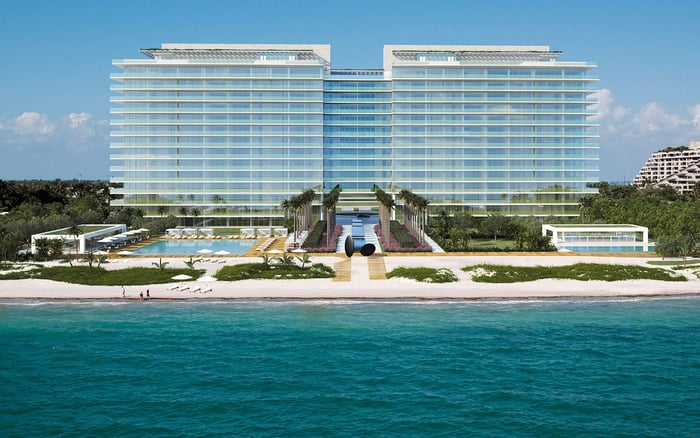
An oceanfront address does not, by itself, define a purchaser’s beach, cabana, or guest rights. The decisive evidence lies in the recorded instruments, governing documents, allocation schedules, rules, title exceptions, site plans, and current operating records that translate an amenity description into an enforceable bundle of rights and restrictions.

For an oceanfront condominium in Key Biscayne, the most valuable amenity may also be the easiest to describe imprecisely. Phrases such as private beach, direct access, exclusive access, and deeded beach access can evoke the same effortless morning: an elevator ride, a landscaped path, and the Atlantic. Legally, however, they may describe very different arrangements.
A purchaser should begin with the declaration, amendments, plat, survey, title commitment, recorded easements, site plan, and applicable rules. Together, these materials can establish whether access is a unit-specific right, a common-element privilege, a limited common-element interest, or a route dependent on another parcel. They can also reveal title exceptions and crossing rights that a polished amenity description leaves unexplained.
At Oceana Key Biscayne, the lifestyle offering includes a gated setting, private beach area, oceanfront pool, spa, gym, beachfront dining room, tennis courts, landscaped routes to the beach, and cabanas. The diligence question is not whether these features are promoted, but which documents control their boundaries, use, allocation, and continuity.
At the water’s edge, the governing instrument matters more than the adjective.
The review should produce a practical map tracing the route from the residence to the beach. Mark building exits, security posts, gates, paths, dune crossings, cabanas, private amenity zones, and adjacent public corridors. Then reconcile that map with the recorded survey and easement drawings.
This exercise is especially important at Oceana Key Biscayne. Public Access #2, Oceana North, and Public Access #3, Oceana South, reach the beach beside the development. They are two of five established public beach-access points addressed in the municipal discussion. Their presence does not define the limits of the condominium’s private areas, but it makes the precise location of each corridor material to privacy, circulation, security, and guest management.
A separate public-access agreement for 199 Ocean Lane Drive illustrates why recorded language must be read parcel by parcel. Buyers should not assume that one access agreement describes another property. Counsel and a survey professional can match the correct instrument to the correct land and identify where public passage begins and ends.
A cabana can be a deeded interest, a limited common element, an association assignment, a license, or a reservable amenity. Each structure carries different consequences for exclusivity, transfer, fees, insurance, maintenance, and guest use. Marketing photographs and a unit listing cannot settle the allocation.
Request the declaration provisions, cabana schedule, any separate deed or license, assignment records, amendments, reservation procedures, fee schedules, waiting lists, and current rules. Confirm whether the right follows the unit at closing, requires association approval, can be transferred separately, or expires under stated conditions. The file should also establish who pays for utilities, repairs, furnishings, storm preparation, and damage.
The distinction applies across the island. The Ocean Club includes approximately 1,000 feet of private beach and cabana facilities, while Key Colony includes private beach access and cabanas within a broader amenity program. Lake Villa features beach and pool cabanas equipped with utilities. In every case, the governing documents must establish who may use or transfer a cabana. Buyers comparing island ownership with Oceana Bal Harbour should apply the same document-first standard rather than infer equivalent rights from a similar name or coastal setting.
Ownership access and guest amenity use are not necessarily identical. Review guest-registration requirements, beach and pool pass systems, daily or seasonal limits, occupancy restrictions, family privileges, tenant rules, short-term rental provisions, and procedures for contractors or household staff. Ask whether the owner must accompany guests and whether cabana reservations can be made in a guest’s name.
Enforcement provisions deserve equal attention. Members and guests must follow the governing documents, and associations may respond to guest violations. Access to a residence is also distinct from use of common amenities, which may be suspended in some circumstances. Because a condominium’s declaration and Florida condominium law may apply differently, condominium counsel should confirm the operative authority and procedures for the property under review.
Recent board minutes can reveal how written rules function in practice. Look for discussions involving passes, crowding, unauthorized entry, cabana disputes, disciplinary hearings, tenant access, and security staffing. A rulebook defines formal authority; minutes and notices can show its current administration.
An easement is not merely a title-page exception. Its width, location, permitted users, maintenance obligations, hours, signage, landscaping, lighting, and enforcement provisions can shape daily experience. The recorded instrument and drawing should be reviewed together, then reconciled with current site conditions.
Beach renourishment introduces a separate operational issue. During construction, the public access paths on both the north and south sides of Oceana will close. A purchaser should obtain current schedules, construction notices, staging plans, and relevant agreements to understand the temporary effects on resident and guest circulation. The review should also determine whether the work affects cabanas, dune crossings, views, noise, security deployment, or beach service-without presuming impacts the documents do not specify.
For broader waterfront comparisons, projects such as 57 Ocean Miami Beach and The Perigon Miami Beach can be evaluated through the same disciplined lens: identify the legal source of access, map every crossing, and separate ownership rights from services or privileges.
Physical access has a financial dimension. Request budgets, reserve schedules, insurance information, contracts, and recent notices addressing the beach, dunes, cabanas, security, pool deck, and related operations. Determine who maintains each area and whether an easement agreement reallocates costs or duties. For a resale acquisition, pending changes may matter as much as the current rule.
The Towers of Key Biscayne demonstrates the vocabulary issue. Its descriptions use both exclusive private beach access and deeded beach access, alongside waterfront and ocean terminology. A buyer should compare those terms with the declaration, survey, easement drawings, and title exceptions. Commodore Club and Mar Azul also include direct beach access, but their security and amenity descriptions cannot replace property-specific instruments.
The final file should contain clean, legible copies of the controlling declaration and amendments, plat, current survey, title commitment and exceptions, recorded easements, cabana instruments and schedules, rules, guest policies, budgets, reserves, insurance materials, board minutes, renourishment notices, and construction communications. Any inconsistency should be resolved in writing before the diligence period expires.
The goal is not to diminish the romance of Key Biscayne. It is to preserve it by understanding exactly how a residence connects to the beach, which cabana privilege transfers, how guests are admitted, where the public may pass, and what temporary work can alter the route. For discreet guidance on evaluating South Florida’s finest coastal residences, connect with MILLION.
If branded residences are on your mind — as a home or as an allocation — we would be glad to share what we are seeing, privately.
Begin a quiet conversationNo. The declaration, plat, survey, title exceptions, and recorded easements should establish the legal scope and route of access.
Review the declaration and amendments, plat, current survey, title commitment, site plan, easement instruments, and easement drawings.
Village records identify Public Access 2 as Oceana North and Public Access 3 as Oceana South.
Not necessarily. The recorded easements and site plan must be mapped against entrances, cabanas, security posts, and private amenity zones.
A cabana may be deeded, licensed, assigned, designated as a limited common element, or offered through reservations. The controlling documents determine its status.
Request allocation schedules, separate deeds or licenses, transfer restrictions, fees, reservation procedures, assignment records, and maintenance obligations.
Not always. Guest registration, passes, occupancy limits, accompaniment rules, tenant provisions, and disciplinary policies may restrict amenity use.
Governing documents may permit action involving common-area privileges after violations. Condominium counsel should confirm the applicable declaration and Florida condominium law.
Construction can temporarily alter access routes. Municipal information states that public paths on both sides of Oceana will close during construction.
Resolve inconsistencies involving access boundaries, cabana transfer, guest rules, public corridors, operating costs, and construction impacts in writing.