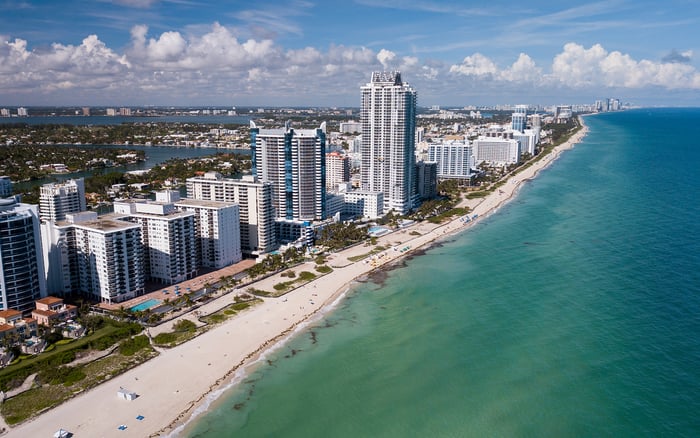
A buyer-oriented guide to organizing the legal and financial file behind a boutique North Bay Village condominium, from seller-status documentation and deed taxes to title premiums and future resale liquidity.

Lifestyle may draw a buyer to a boutique condominium in North Bay Village, but the acquisition deserves an equally considered legal and financial review. Waterfront appeal belongs alongside a clear understanding of seller status, transfer taxes, title coverage and the mechanics of eventual resale. The objective is not simply to reach closing, but to know what each payment represents, who bears responsibility and which assumptions need confirmation.
Tula Residences North Bay Village offers a local example of a project marketed around boutique luxury living. That positioning provides context, not evidence of any particular association’s financial condition or governance. Buyers should evaluate the transaction and condominium documents rather than let the boutique label stand in for diligence.
A useful file separates four questions: the seller’s tax status, the deed’s tax treatment, the scope and cost of title coverage, and the owner’s future exit obligations.
FIRPTA generally requires withholding of 15% of the gross sales price when a foreign person sells U.S. real property, unless an exemption or reduced-withholding certificate applies. This is withholding, not the seller’s final tax rate. Its effect on cash at closing can therefore differ materially from the seller’s ultimate tax liability.
The buyer is the statutory withholding agent and can face liability for missed withholding even when a closing agent handles the transaction. Delegating closing logistics does not remove that responsibility. Ask counsel to identify the applicable treatment early and document its basis.
When the transaction relies on the seller’s non-foreign status, retain a compliant signed certification containing the required identifying and taxpayer information. An overseas mailing address, an assumption about citizenship or an informal assurance is no substitute for a proper determination. Living abroad is not synonymous with being a foreign person under U.S. tax law.
Buyer-residence exceptions can reduce or eliminate withholding, but eligibility depends on price and intended residential use. Foreign sellers may also apply for a reduced-withholding certificate based on projected U.S. tax liability. Treat that application as a pre-closing planning matter, not an assumed last-minute adjustment.
Florida documentary stamp tax applies to documents transferring real-property interests and is calculated on consideration. Miami-Dade’s base deed-tax rate is $0.60 for each $100 of consideration or fraction thereof. An additional $0.45 surtax applies to transfers other than qualifying single-family residences.
That distinction requires transaction-specific confirmation. Do not assume every Miami-Dade condominium automatically incurs a combined 1.05% charge. Have the closing professional confirm the property’s treatment and present the calculation separately from the contractual allocation.
At $1 million of taxable consideration, the base deed tax is $6,000. If the surtax applies, the total becomes $10,500. These figures represent alternative treatments, not interchangeable estimates.
Miami-Dade resale custom generally assigns deed documentary stamps to the seller, but the purchase contract can allocate the cost differently. All parties to the document remain liable for documentary stamp tax regardless of their payment agreement. A negotiated seller-paid provision should not be mistaken for an elimination of statutory exposure.
Financed acquisitions also involve separate mortgage-related documentary stamp and intangible taxes, customarily paid by the buyer. Keep those charges distinct from deed tax so the closing estimate remains clear.
Florida uses a statewide promulgated title-insurance premium schedule for standard coverage. For original owner’s coverage, the schedule charges $5.75 for each $1,000 of the first $100,000, then $5.00 for each $1,000 of the next $900,000. Above $1 million through $5 million, the rate is $2.50 for each $1,000.
The resulting base original-policy premiums are:
$1 Million of coverage: $5,075.
$3 Million of coverage: $10,075.
$5 Million of coverage: $15,075.
These are not all-in closing quotes. Request separate figures for endorsements and other title or closing charges. Above $5 million through $10 million, the scheduled rate is $2.25 for each $1,000; above $10 million, it is $2.00.
In Miami-Dade, the buyer customarily pays for the owner’s policy and selects the title or closing company, subject to negotiation. Review the contract rather than treating that custom as mandatory.
For a buyer also considering 57 Ocean Miami Beach, the same statewide premium framework provides a consistent starting point. It does not make title exceptions or closing charges identical. Keep the commitment, its exceptions and payoff documentation together for counsel’s review.
The association file belongs beside, not apart from, the transaction file. Collect the association estoppel, condominium documents, budgets, reserves and litigation disclosures with the title materials and seller-status certification. Ask advisers to identify unresolved questions before attention turns to the closing statement.
If Continuum Club & Residences North Bay Village is also on the shortlist, use the same document categories to organize the comparison. A consistent review is useful; assuming different projects share financial conditions, governance or contractual terms is not.
A practical summary sheet should distinguish confirmed amounts, contractual allocations and open questions. This helps the buyer assess whether an attractive headline price is being weighed against a fully understood transaction.
The acquisition file should also contain a preliminary exit model. Separate projected sale price from deed tax, commissions, applicable association charges, legal and closing costs, and any FIRPTA withholding. Do not equate withholding with a final tax expense or treat gross sale price as available cash.
At a hypothetical $2 million future resale, the stated Miami-Dade rate structure yields $12,000 in base deed tax, or $21,000 if the surtax applies. These figures illustrate the stated rates; they do not predict future law or the unit’s classification.
Revisit the owner’s foreign-person status under U.S. tax law at resale. FIRPTA treatment at the original purchase does not settle the owner’s position as a future seller. Where withholding may apply, discuss possible certificate planning before the resale closing calendar is fixed.
Retain the closing documents and update the ownership file as circumstances change. The benefit is a clearer starting point for advisers, not a promised increase in resale pricing. Keep tax classification, contractual payment obligations and actual cash movements distinct throughout ownership.
A carefully assembled file allows the residence to be assessed on both its lifestyle merits and its transaction terms, without confusing one for the other.
For a considered approach to South Florida condominium ownership, explore MILLION.
If branded residences are on your mind — as a home or as an allocation — we would be glad to share what we are seeing, privately.
Begin a quiet conversationFIRPTA generally requires withholding of 15% of the gross sales price when a foreign person sells U.S. real property, unless an exemption or reduced-withholding certificate applies. It is not the seller’s final tax rate.
The buyer is the statutory withholding agent and can face liability for missed withholding even when a closing agent handles the transaction.
Retain a compliant signed certification containing the seller’s required identifying and taxpayer information. Living abroad alone does not establish foreign-person status under U.S. tax law.
Buyer-residence exceptions may apply depending on price and intended residential use. Foreign sellers may also apply for a reduced-withholding certificate based on projected U.S. tax liability.
Do not assume that treatment. Miami-Dade charges a base $0.60 for each $100 of consideration or fraction thereof, with an additional $0.45 surtax on transfers other than qualifying single-family residences; the subject property’s treatment needs confirmation.
Resale custom generally assigns the charge to the seller, but the contract may allocate it differently. All parties to the document remain liable regardless of that agreement.
No. Financed purchases have separate mortgage-related documentary stamp and intangible taxes, customarily paid by the buyer.
The stated Florida schedule produces a base original-policy premium of $10,075. Endorsements and other title or closing charges should be quoted separately.
Keep the association estoppel, condominium documents, budgets, reserves and litigation disclosures alongside the title commitment, exceptions, payoff documentation and seller-status certification.
Separate projected sale price from deed tax, commissions, applicable association charges, legal and closing costs, and any FIRPTA withholding. Reassess the owner’s foreign-person status and applicable tax rules when planning the sale.