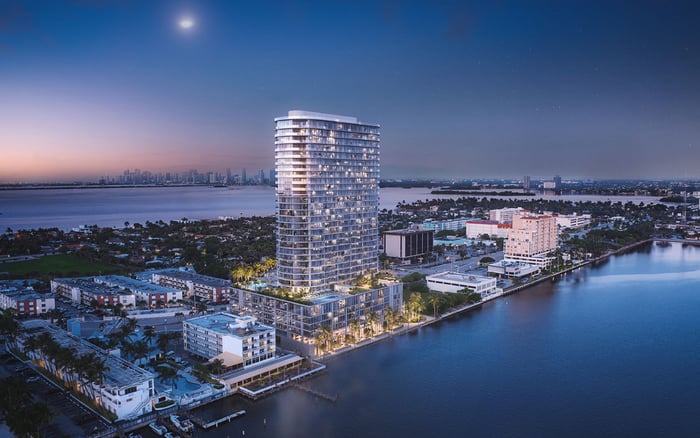
A discreet buyer’s framework for evaluating guest access, arrival protocols, parking, amenity privileges, overnight stays, and leasing rules at three North Bay Village residences.

In a refined condominium, hospitality is measured not only by finishes and amenities, but by what happens when a friend, relative, household employee, or service professional arrives. The best experience feels gracious to the visitor, effortless for the resident, and appropriately controlled by management.
That balance deserves close attention in 2026. Buyers evaluating North Bay Village should look beyond broad promises of security or concierge service to examine the complete operating sequence: authorization, identity verification, entry, parking, elevator access, resident notification, amenity privileges, and departure. For a second-home owner, these procedures can shape every stay. For an investment-minded purchaser, they may also intersect with leasing and occupancy restrictions.
This edition of MILLION's Buyer's Guides considers Continuum Club & Residences North Bay Village, Shoma Bay North Bay Village, and Tula Residences North Bay Village through that practical lens. Buyers also considering a waterfront residence in Miami Beach should apply the same scrutiny rather than assume neighboring luxury markets follow equivalent protocols.
At Continuum, due diligence should begin with access procedures for friends, family, household staff, and other visitors. Request a demonstration of the arrival journey from every relevant entry point. Buyers should understand how the front desk receives an expected guest, verifies identity, notifies the resident, and proceeds if the resident cannot respond immediately.
Continuum purchasers should also verify pool and amenity rules in the governing documents. Key questions include guest limits, registration requirements, resident-accompaniment rules, and any facility-specific restrictions. Buyers expecting frequent overnight company should determine whether reservable guest suites exist or whether all accommodations must be within the residence.
At Shoma Bay, establish precisely how residents authorize visitors and how identities are confirmed upon arrival. Buyers should ask whether the operating model relies on an app, digital credentials, an intercom, physical passes, concierge personnel, or a combination of systems. The relevant issue is not novelty, but reliability and ease of use for residents and guests alike.
Parking warrants its own review at Shoma Bay. Confirm whether visitor spaces are available, then examine validation, capacity, time limits, fees, and overflow procedures. Amenity access also requires written clarification, particularly whether visitors may enter shared spaces independently or must remain with a resident.
At Tula, avoid drawing conclusions from positioning alone. Request the complete guest policy, parking plan, leasing addendum, and current rules before comparing the residence with the other properties. A polished presentation cannot substitute for binding documents or an association-approved operating policy.
The word “guest” can obscure several distinct categories. A dinner visitor, an overnight relative, a recurring personal assistant, a live-in caregiver, and a tenant may each receive different treatment. Before signing, ask management or counsel to define every category and explain the applicable registration, access, duration, and supervision rules.
This distinction is especially important when short-term rentals or frequent occupancy are contemplated. Continuum buyers should confirm whether short-term leasing is prohibited and whether longer guest stays trigger registration or occupancy restrictions. At Shoma Bay, purchasers should review minimum lease terms, approval procedures, application fees, and any annual limit on the number of permitted leases.
Household staff warrant separate attention. Determine whether recurring personnel may receive standing credentials, whether their access is limited by time or entrance, and how credentials are revoked. These details influence privacy and convenience long after closing.
A buyer should walk the property as a guest would. Begin at the vehicle entrance, identify the first point of contact, and follow the route through reception to the elevators. Ask what happens when a visitor arrives early, uses a rideshare, carries luggage, or has not been preregistered. The answers reveal whether the system is genuinely intuitive or merely presented that way.
Test resident notification as well. Confirm whether alerts arrive by telephone, intercom, text, app, or another channel, and whether owners can authorize visitors remotely. Buyers who travel frequently should ask how the building manages approvals across time zones and what contingency applies during a technology or connectivity interruption.
Privacy matters as much as speed. Ask what visitor information is collected, who can view it, how long it is retained, and how access permissions are cancelled. Reconcile every verbal explanation with the current written policy.
Request the condominium declaration, rules and regulations, current budget, parking plan, leasing addendum, and association-approved guest policies. Review them with qualified counsel, focusing on provisions governing access, common-area use, overnight occupancy, rentals, staff, deliveries, and enforcement.
Then compare those documents with the sales presentation and on-site explanation. If procedures differ, request clarification in writing. Because association rules may change, buyers should also identify who has authority to revise guest limits, parking charges, amenity access, and registration requirements. The objective is not unrestricted access, but a guest-management system whose security, discretion, and service standards suit the owner’s actual lifestyle.
What is the first guest-access question a buyer should ask? Ask how a resident authorizes a visitor and how the visitor’s identity is verified upon arrival.
Should verbal concierge explanations be relied upon? No. Compare every operating explanation with the declaration, rules, and current association-approved policies.
Why does visitor parking require separate diligence? Availability alone is insufficient; capacity, validation, time limits, fees, and overflow procedures may affect usability.
Can guests use condominium amenities without the owner? That depends on the governing rules. Confirm accompaniment, registration, numerical limits, and facility-specific restrictions.
How should buyers evaluate guest-access technology? Identify the tools in use, test remote authorization, and confirm the backup procedure during an outage.
Are overnight guests treated like tenants? Not necessarily, but extended or recurring stays may trigger occupancy, registration, or leasing provisions.
What should owners ask about household staff? Confirm credentialing, approved entrances, access hours, supervision requirements, and revocation procedures.
Do the three projects necessarily follow similar rules? No. Each residence should be evaluated through its own binding documents and current operating policies.
Why review rental restrictions in a guest-management inquiry? Leasing terms help distinguish permitted personal hospitality from occupancy that may be classified as a tenancy.
Can guest policies change after a purchase? They may change if the governing documents grant amendment authority, making current rules and approval procedures essential.
To compare the best-fit options with clarity, connect with MILLION.
If branded residences are on your mind — as a home or as an allocation — we would be glad to share what we are seeing, privately.
Begin a quiet conversation