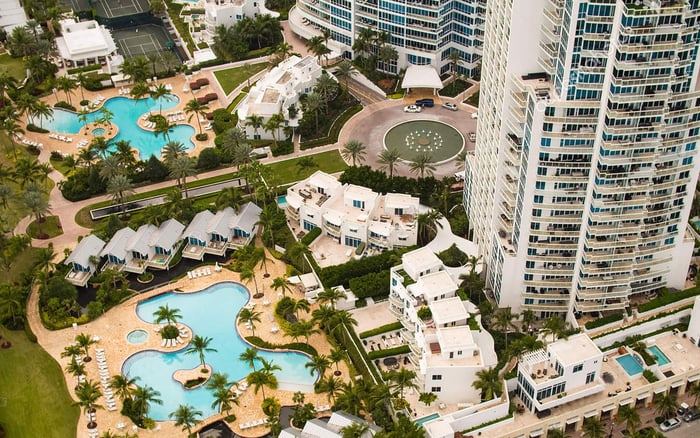
A practical, buyer-oriented framework for evaluating resort-level service in South Florida luxury residences while weighing insurance, HOA fees, reserves, staffing, and real daily use.

In South Florida’s upper tier, the most persuasive residences rarely sell square footage alone. They sell relief: a staffed arrival, a polished lobby, a pool deck that feels composed at 10 a.m. and after sunset, private wellness spaces, food-and-beverage convenience, precise valet service, and the quiet sense that ownership has been professionally choreographed.
That is the promise of resort-level service. The underwriting challenge is that every graceful touch carries an operating cost. Insurance, HOA fees, reserves, payroll, maintenance contracts, security, utilities, and usage patterns all sit beneath the lifestyle narrative. A buyer who studies only the amenity brochure may understand the fantasy. A buyer who studies the operating model understands the asset.
A serious purchaser should evaluate service the way one evaluates mechanical systems or building-envelope quality. The question is not simply whether the building has amenities. The question is whether the service platform is financially coherent, repeatable, and aligned with the number of owners who will actually use it.
In Brickell, where buyers often balance primary residences, pieds-à-terre, and corporate proximity, the most valuable services tend to reduce friction: reliable valet, efficient receiving, security, fitness access, guest management, and well-run common areas. In Aventura or Hallandale, where waterfront, marina, and seasonal-use patterns may play a larger role, owners should pay close attention to how amenity staffing flexes during peak months. In Palm Beach County, where privacy and calm are central to the luxury proposition, service quality may be judged less by spectacle than by consistency.
The underwriting lens should separate visible amenities from operational obligations. A spa treatment room is not the same as a staffed wellness program. A dining space is not the same as a food-and-beverage operation. A concierge desk is not the same as a trained team with coverage standards, vendor relationships, and escalation protocols.
HOA fees are often viewed as a monthly line item. In a service-rich building, they are better understood as the subscription cost of a private operating environment. The budget should show whether the building is paying for labor, insurance, utilities, cleaning, landscaping, management, security, technology, and preventive maintenance in a way that matches the promises made to residents.
A low fee can be attractive, but it may also signal that future increases are likely if the service level is underfunded. A high fee is not automatically negative if it supports durable staffing, strong reserves, careful maintenance, and a predictable owner experience. The buyer’s task is to identify whether the fee is buying genuine convenience or merely subsidizing amenities that look elegant but remain lightly used.
Investment discipline requires practical questions. Which services are included, and which are à la carte? Are valet, beach service, package handling, guest access, private event support, or wellness programming part of the base budget? How much of the budget is fixed, and how much can be adjusted if usage changes? Does the association have a history of planning ahead, or is it reacting to each cost increase after the fact?
In coastal South Florida, insurance cannot be treated as a back-office detail. It influences the economics of ownership, the resilience of the association, and sometimes the appetite of future buyers. A residence may feel like a resort, but the building still exists within a risk environment that must be priced, renewed, and absorbed.
Luxury buyers should understand what is covered by the association, what remains the owner’s responsibility, and how deductibles could affect cash needs after a claim. They should also distinguish between premiums rising because of broad market conditions and premiums elevated by building-specific issues. The practical question is not whether insurance is expensive. The practical question is whether the building has incorporated insurance reality into its long-term financial structure.
For an oceanfront buyer, this is especially important. The view, access, and lifestyle premium can be significant, but so can exposure to wind, water, façade, mechanical, and maintenance considerations. Insurance discipline does not diminish the romance of coastal ownership. It protects it.
The most elegant mistake in luxury real estate is paying for amenities one admires but rarely uses. A buyer may be drawn to a cinema, wine room, spa suite, cold plunge, cigar lounge, golf simulator, coworking salon, private restaurant, or children’s room. Each can be valuable. None should be valued equally by every owner.
Daily-use underwriting begins with a candid calendar. How often will you be in residence? Will the property be a primary home, seasonal retreat, or second home? Do you entertain frequently? Do guests visit without you present? Do you use private training, wellness, boating, beach service, business lounges, pet amenities, or children’s programming? Will you value staff recognition and security more than architectural drama?
A building that feels ideal for a young family may not be optimal for an owner seeking quiet seasonal privacy. A tower designed around social energy may not suit someone who wants minimal interaction. A boutique building may offer calm but less staffing redundancy. A larger building may support more services, but also more shared demand.
The best underwriting assigns value to the amenities that will actually change your week. Everything else should be treated as atmosphere.
Resort-level service is strongest when it can survive real life: staff turnover, insurance resets, maintenance cycles, seasonal crowding, inflation, repairs, and evolving owner expectations. Buyers should favor buildings where governance, management, and reserves appear designed for continuity rather than improvisation.
Key indicators include transparent budgets, professional management, realistic staffing assumptions, disciplined reserve planning, clear rules for private events and guests, and a service culture that does not depend on one charismatic employee. A beautiful lobby matters, but a clear operating protocol matters more when a storm approaches, an elevator needs attention, or dozens of packages arrive before a holiday weekend.
There is also a resale dimension. Future buyers will not only ask what amenities exist. They will ask what they cost, how well they perform, and whether the association has protected the building’s standard. In that sense, service is both lifestyle and investment thesis.
Before making an offer, review the monthly fees, recent budgets, reserve posture, insurance obligations, rules and regulations, staffing model, amenity access policies, and any planned capital projects. Ask how frequently fees have changed and whether any special assessments are contemplated. Confirm the owner’s personal insurance obligations and understand deductibles.
Then walk the property at the times you would actually use it. Visit the arrival sequence during busy hours. Observe the pool deck, fitness areas, elevators, valet flow, package room, and front desk. Ask yourself whether the service feels effortless because it is well designed, or merely because you saw it during a quiet tour.
For South Florida’s luxury buyer, the goal is not to avoid cost. It is to pay for value with clear eyes. The finest residences make daily life easier, more beautiful, and more secure. The smartest owners know precisely what that ease costs.
What is resort-level service in a condominium? It is a coordinated service environment that may include concierge, valet, wellness, security, hospitality, maintenance, and amenity programming.
Are higher HOA fees always a warning sign? Not always. Higher fees can be reasonable when they support staffing, insurance, reserves, and amenities that owners genuinely use.
Why does insurance matter so much in South Florida? Insurance affects association budgets, owner carrying costs, resilience planning, and future resale confidence.
Should I prioritize amenities or reserves? Both matter, but reserves and financial planning help preserve the amenities and building standard over time.
How should seasonal owners evaluate service? They should focus on arrival, security, maintenance oversight, guest management, and peak-season amenity capacity.
Can a boutique building offer resort-level service? Yes, but buyers should confirm whether the staffing model can deliver consistent coverage without overburdening fees.
What documents should I review before buying? Review budgets, rules, insurance responsibilities, reserve information, fee history, and any planned capital projects.
How do I know if amenities are worth paying for? Compare each amenity with your real calendar, habits, guests, wellness routine, and entertainment style.
Do service levels affect resale value? They can. Future buyers often value buildings where service quality is consistent and operating costs are understandable.
What is the simplest underwriting rule? Pay for services that improve your actual life, and scrutinize every cost that merely supports a brochure image.
For a discreet conversation and a curated building-by-building shortlist, connect with MILLION.
If branded residences are on your mind — as a home or as an allocation — we would be glad to share what we are seeing, privately.
Begin a quiet conversation